CoreIPC Industrial Computing Solutions

Vehicle Mounted Industrial Computer
Executive Summary
Modern transportation, logistics, public safety, mining, construction, railway, and fleet management operations increasingly depend on real-time data collection, communication, navigation, and intelligent decision-making. Vehicles are no longer standalone transportation assets; they have become mobile data centers that continuously generate, process, and exchange information with centralized management platforms.
A Vehicle Mounted Industrial Computer serves as the intelligent computing platform installed inside commercial vehicles, emergency response vehicles, public transportation systems, mining trucks, construction machinery, railway vehicles, and specialized mobile equipment. These rugged computing systems enable real-time vehicle monitoring, fleet management, GPS tracking, video surveillance, AI-powered analytics, telematics, predictive maintenance, and edge computing applications.
Unlike conventional commercial computers, vehicle mounted industrial computers are specifically engineered to withstand harsh operating conditions including vibration, shock, dust, temperature fluctuations, unstable power environments, and continuous operation requirements. Their rugged design, industrial-grade components, wide-input power support, and extensive communication capabilities make them ideal for mission-critical mobile deployments.
As intelligent transportation systems, autonomous vehicle technologies, fleet digitization initiatives, and industrial automation continue to evolve, vehicle mounted industrial computers are becoming essential technologies that enable safer, more efficient, and more connected mobile operations across a wide range of industries.
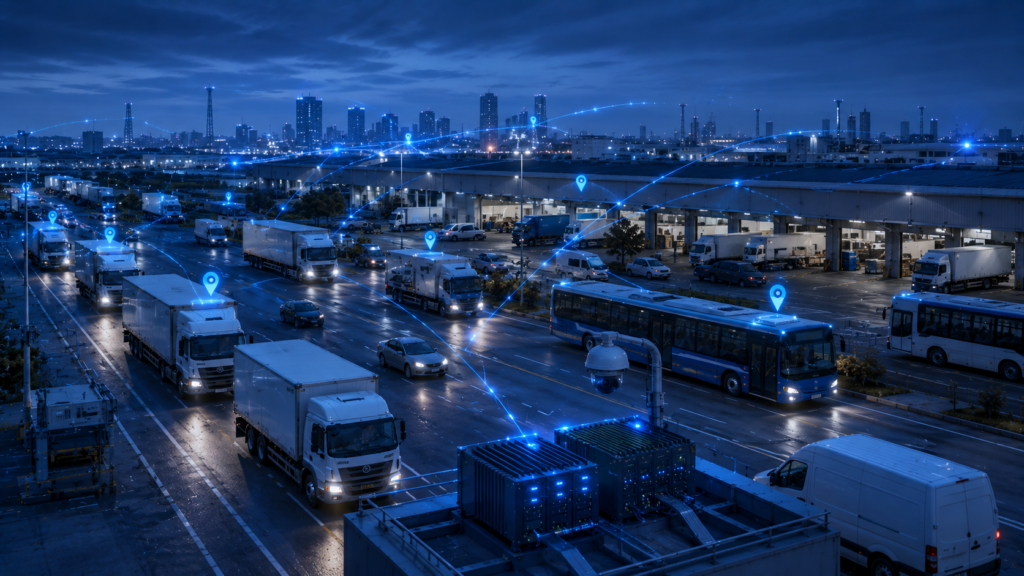
Rugged vehicle-mounted computers enable real-time fleet monitoring, GPS tracking, and intelligent mobile operations.
Industry Overview
The rapid growth of connected vehicles, telematics systems, intelligent transportation infrastructure, and mobile automation technologies has transformed how organizations manage vehicle operations.
Today’s vehicles are expected to support:
- Real-time communications
- GPS positioning
- Fleet monitoring
- Driver behavior analysis
- Video surveillance
- Cargo tracking
- Route optimization
- Vehicle diagnostics
- AI-powered analytics
- Edge computing workloads
Organizations across multiple industries rely on vehicle computing platforms to improve operational visibility and decision-making.
Common deployment sectors include:
- Public transportation
- Logistics and transportation
- Emergency response services
- Mining operations
- Construction equipment
- Railway systems
- Utility vehicles
- Agricultural machinery
- Port operations
- Autonomous mobile systems
Modern vehicle environments generate large amounts of operational data from:
- GPS receivers
- Cameras
- Sensors
- CAN Bus networks
- Vehicle control systems
- Telematics devices
- Driver assistance systems
Processing this information solely in centralized cloud environments can create latency, bandwidth, and connectivity challenges.
Vehicle mounted industrial computers address these challenges by enabling local processing and intelligent decision-making directly within the vehicle.
As fleet digitalization initiatives continue to expand globally, demand for rugged mobile computing platforms continues to increase.

Vehicle mounted industrial computers are designed to withstand vibration, shock, dust, moisture, and extreme operating conditions.
Key Challenges
Harsh Mobile Operating Conditions
Vehicle environments expose computing systems to:
- Constant vibration
- Mechanical shock
- Dust
- Moisture
- Temperature fluctuations
- Road impacts
Commercial computing platforms often struggle in these conditions.
Vehicle mounted industrial computers must maintain reliable operation despite continuous exposure to harsh environments.
Unstable Power Conditions
Vehicles experience frequent power fluctuations caused by:
- Engine startup
- Battery switching
- Voltage spikes
- Voltage drops
- Electrical noise
Computing systems must support wide-range power input and power protection features.
Continuous Connectivity Requirements
Modern fleet operations depend on continuous communications.
Vehicles often require simultaneous connectivity through:
- Cellular networks
- Wi-Fi
- GPS
- Bluetooth
- Vehicle communication networks
Managing multiple communication channels requires a robust computing platform.
Real-Time Data Processing
Mobile operations generate significant volumes of data.
Examples include:
- Video streams
- GPS data
- Vehicle diagnostics
- Sensor information
- Driver monitoring systems
Processing this information in real time is essential for operational effectiveness.
Cybersecurity Concerns
Connected vehicles increasingly interact with enterprise systems and public networks.
Organizations must protect:
- Vehicle data
- Operational information
- Communication systems
- Fleet management platforms
Cybersecurity has become a critical requirement for vehicle computing systems.
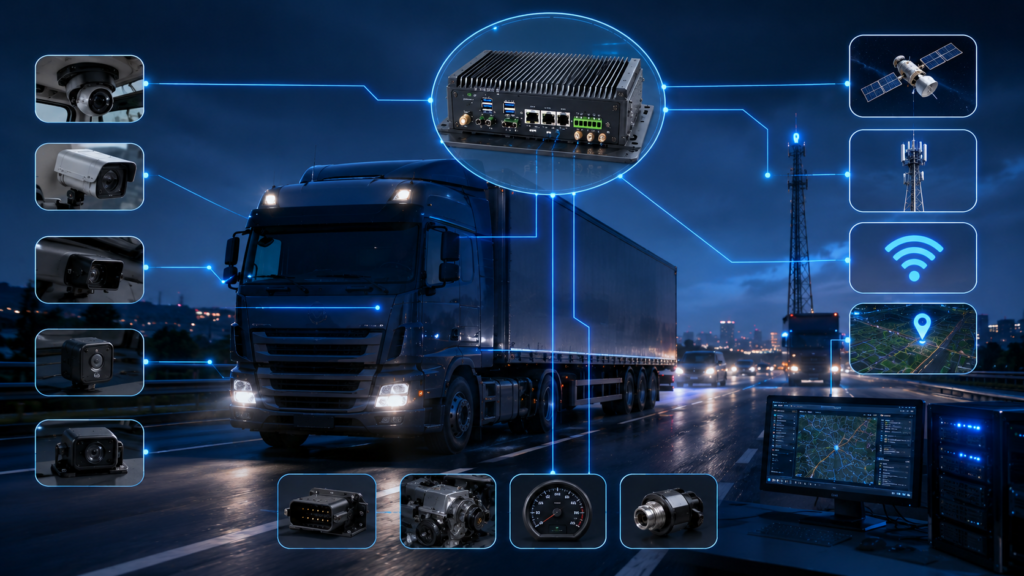
Vehicle mounted industrial computers integrate cameras, GPS, sensors, and wireless communications for intelligent fleet management.
Solution Architecture
A typical vehicle mounted computing deployment consists of multiple layers.
Layer 1: Vehicle Device Layer
This layer includes:
- Cameras
- Sensors
- GPS modules
- CAN Bus interfaces
- Vehicle control systems
- Driver assistance systems
These devices generate operational data.
Layer 2: Communication Layer
Vehicle communication infrastructure may include:
- 4G LTE
- 5G
- Wi-Fi
- Bluetooth
- GPS
- Vehicle communication protocols
This layer enables connectivity between the vehicle and external systems.
Layer 3: Vehicle Mounted Industrial Computer Layer
The industrial computer serves as the local edge computing platform.
Functions include:
- Data acquisition
- Edge analytics
- Video processing
- AI inference
- Communication management
- Local storage
- System control
This layer provides real-time intelligence within the vehicle.
Layer 4: Application Layer
Applications may include:
- Fleet management systems
- Telematics platforms
- Video management software
- Driver monitoring systems
- Predictive maintenance applications
- Route optimization software
The vehicle computer supports these applications.
Layer 5: Central Management Layer
Enterprise integration enables:
- Fleet operation centers
- Cloud analytics platforms
- Reporting systems
- Dispatch management
- Asset tracking platforms
This layer provides centralized visibility and control.
Key Features
Rugged Industrial Design
Vehicle mounted industrial computers are designed to withstand demanding mobile environments.
Key characteristics include:
- Shock resistance
- Vibration resistance
- Rugged construction
- Industrial-grade components
- Reliable operation
These capabilities improve long-term deployment reliability.
Fanless Architecture
Fanless systems provide several advantages:
- Reduced maintenance
- Improved reliability
- Better dust protection
- Silent operation
Fanless designs are particularly valuable in vehicle environments.
Wide Voltage Input Support
Vehicle power systems vary significantly.
Industrial computers commonly support:
- 9V–36V DC
- 12V DC
- 24V DC
- Ignition control
This flexibility simplifies deployment across different vehicle platforms.
Rich Communication Interfaces
Vehicle applications require extensive connectivity.
Common interfaces include:
- Gigabit Ethernet
- USB
- RS232
- RS485
- CAN Bus
- Digital I/O
- Wireless communications
These interfaces support integration with vehicle systems.
Edge AI Capabilities
Many modern deployments utilize artificial intelligence.
Applications include:
- Driver monitoring
- Video analytics
- Object detection
- Route optimization
- Fleet intelligence
Vehicle mounted computers provide local AI processing capabilities.
GPS and Wireless Connectivity
Integrated communication options may include:
- GPS
- GNSS
- 4G LTE
- 5G
- Wi-Fi
- Bluetooth
These capabilities support mobile operations and fleet connectivity.
Long Product Lifecycle
Vehicle deployments often remain operational for many years.
Industrial platforms provide:
- Long-term availability
- Stable hardware platforms
- Extended support programs
This reduces lifecycle management costs.
Deployment Scenarios
Fleet Management
Vehicle mounted industrial computers support:
- Vehicle tracking
- Route optimization
- Driver behavior analysis
- Fleet monitoring
These capabilities improve operational efficiency.
Public Transportation
Transit agencies utilize industrial computers for:
- Passenger information systems
- Fleet management
- Video surveillance
- Vehicle diagnostics
These systems enhance operational visibility and passenger safety.
Emergency Response Vehicles
Police, fire, and emergency medical services deploy vehicle computers for:
- Dispatch communications
- Navigation
- Video management
- Incident reporting
Reliable mobile computing supports emergency operations.
Mining and Construction Equipment
Heavy equipment operators use industrial computers for:
- Equipment monitoring
- Telematics
- Predictive maintenance
- Operational analytics
These capabilities improve productivity and equipment utilization.
Railway Systems
Vehicle mounted computers support:
- Train monitoring
- Communications
- Passenger information systems
- Safety monitoring
These functions enhance railway operations.
Autonomous and Intelligent Vehicles
Advanced vehicle systems utilize industrial computers for:
- AI processing
- Sensor fusion
- Edge computing
- Real-time decision-making
These capabilities support next-generation mobility solutions.
Business Benefits
Improved Operational Visibility
Real-time vehicle data enables organizations to monitor fleet performance more effectively.
Increased Efficiency
Automation and intelligent analytics help optimize routes, reduce fuel consumption, and improve resource utilization.
Enhanced Safety
Vehicle monitoring systems support safer operations through driver assistance, video analytics, and real-time alerts.
Reduced Downtime
Predictive maintenance capabilities help identify issues before failures occur.
Better Decision-Making
Real-time access to operational information improves responsiveness and management effectiveness.
Scalable Digital Transformation
Vehicle mounted industrial computers provide a foundation for future connected vehicle and intelligent mobility initiatives.
Why CoreIPC
CoreIPC provides rugged industrial computing platforms designed for vehicle-mounted deployments, fleet management systems, transportation applications, public safety vehicles, mining equipment, and intelligent mobile infrastructure. Our industrial computers deliver fanless operation, wide voltage input support, industrial-grade reliability, rich connectivity, and long lifecycle availability. With flexible OEM/ODM customization capabilities and extensive experience in embedded computing, CoreIPC helps customers deploy reliable vehicle computing solutions that support modern mobile operations, edge computing, and intelligent transportation applications.
Frequently Asked Questions
1. What is a vehicle mounted industrial computer?
A vehicle mounted industrial computer is a rugged computing platform designed for installation in vehicles, mobile equipment, and transportation systems. It supports data processing, communications, monitoring, and edge computing applications.
2. Why are industrial computers used in vehicles?
Industrial computers provide reliability, shock resistance, vibration tolerance, wide voltage input support, and long lifecycle availability required for vehicle environments.
3. What industries use vehicle mounted computers?
Common industries include transportation, logistics, mining, construction, public safety, railways, utilities, agriculture, and autonomous vehicle development.
4. Can vehicle mounted computers support AI applications?
Yes. Many platforms support AI-powered video analytics, driver monitoring, object detection, predictive maintenance, and intelligent fleet management applications.
5. What power inputs are commonly supported?
Vehicle mounted industrial computers typically support wide-range DC input options such as 9V–36V or 12V/24V vehicle power systems.
6. Are fanless systems suitable for vehicle deployments?
Yes. Fanless systems improve reliability and reduce maintenance requirements in harsh vehicle environments.
7. What communication technologies are commonly integrated?
Common technologies include GPS, GNSS, Wi-Fi, Bluetooth, 4G LTE, 5G, Ethernet, CAN Bus, and serial communications.
8. How do vehicle computers support fleet management?
They collect and process vehicle data, enable tracking, monitor driver behavior, support diagnostics, and communicate with fleet management platforms.
9. Can vehicle mounted industrial computers operate in extreme temperatures?
Yes. Industrial-grade platforms are designed to operate across wide temperature ranges commonly encountered in mobile environments.
10. What should be considered when selecting a vehicle mounted industrial computer?
Key considerations include environmental durability, power input requirements, connectivity options, processing performance, expansion capabilities, and lifecycle support.
Conclusion
A Vehicle Mounted Industrial Computer provides the rugged computing foundation required for modern mobile operations. By enabling real-time communications, edge computing, fleet management, vehicle monitoring, AI analytics, and intelligent transportation applications, these platforms help organizations improve safety, efficiency, reliability, and operational visibility. As connected vehicle technologies continue to evolve, vehicle mounted industrial computers will remain essential components supporting the future of intelligent mobility and mobile automation.
Contact Us
Looking for a reliable Vehicle Mounted Industrial Computer for fleet management, transportation, public safety, mining, or intelligent vehicle applications?
CoreIPC provides industrial computers, embedded computers, industrial motherboards, and customized computing solutions designed for rugged mobile environments and edge computing deployments.
Contact our engineering team today to discuss your project requirements and discover the ideal vehicle-mounted computing platform for your application.