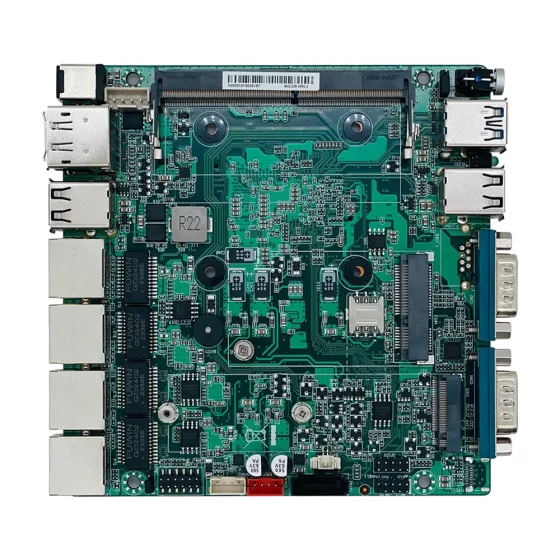
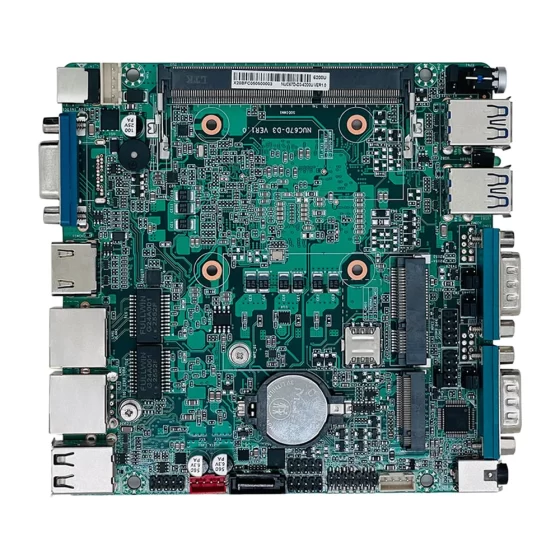
CoreIPC 산업용 컴퓨팅 솔루션

스마트 제조를 위한 MES 통합 플랫폼: 연결된 공장 운영을 위한 산업용 컴퓨팅
요약
A MES integration platform is the digital bridge between production equipment, 작업 현장 운영자, 제조 실행 소프트웨어, 및 엔터프라이즈 비즈니스 시스템.
스마트 제조 환경에서, 공장에는 격리된 기계와 수동 보고 이상의 것이 필요합니다.. PLC로부터 안정적인 데이터 흐름이 필요합니다., 센서, 바코드 스캐너, RFID 리더, 검사 시스템, 생산 터미널, 산업 네트워크를 MES 시스템으로.
산업용 컴퓨터와 임베디드 컴퓨터 플랫폼이 필수적인 곳입니다.. 기계를 연결하는 데 필요한 로컬 컴퓨팅 계층을 제공합니다., 생산 데이터 수집, 장비 주변의 공정 정보, MES 소프트웨어와 제조 기록 동기화.
잘 설계된 MES 통합 플랫폼은 제조업체가 생산 가시성을 향상하는 데 도움이 됩니다., 수동 보고 감소, 추적성 강화, 레거시 장비를 최신 디지털 시스템과 연결.
하지만, MES 통합은 소프트웨어 문제만이 아닙니다. 또한 안정적인 산업용 하드웨어에 따라 달라집니다., 유연한 I/O, 긴 수명주기 가용성, 안정적인 네트워킹, and practical deployment across real factory environments.
This article explains how industrial computers support MES integration platforms, what challenges manufacturers face, how the system architecture works, and which hardware features matter most for smart manufacturing deployment.
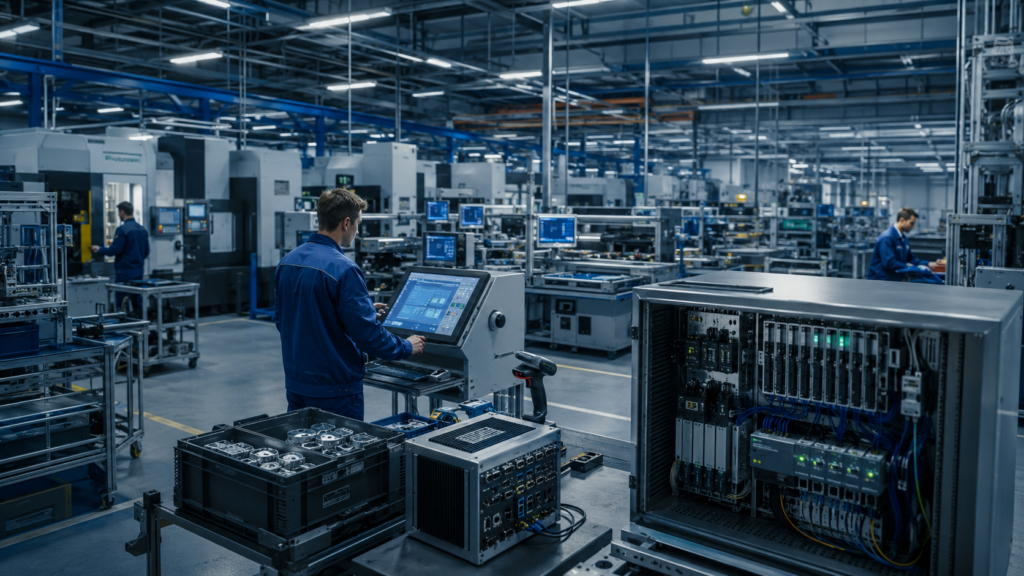
Industrial computers collect shop-floor data from machines, 스캐너, PLC, and operator stations.
산업 개요
Smart Manufacturing Requires Connected Production Data
Smart manufacturing depends on accurate and timely production data.
Factories need to know what is happening on each line, machine, 워크스테이션, inspection area, and material flow process. Without reliable data collection, MES software cannot provide accurate work order tracking, production status, 품질 기록, or traceability.
A MES integration platform connects these production activities into one digital workflow.
It collects data from equipment and operators, then transfers that data to MES software, 데이터베이스, 대시보드, 및 엔터프라이즈 시스템. This allows manufacturers to move from manual reporting to real-time production visibility.
MES Is Becoming a Shop-Floor Integration System
Traditional MES systems were often treated as production management software.
오늘, MES is increasingly connected to factory equipment, 자동화 시스템, 품질 검사, warehouse operations, and operator terminals. This makes the hardware integration layer more important than before.
Typical MES-connected devices may include:
- PLC 컨트롤러
- CNC 기계
- Assembly stations
- Barcode scanners
- RFID 리더
- Label printers
- Machine vision cameras
- 테스트 장비
- Industrial displays
- Production dashboards
- Local servers and databases
To connect these devices reliably, factories need industrial-grade computing platforms deployed close to the production process.
Why Industrial Computers Are Important
상업용 PC는 사무실 환경에서 작동할 수 있습니다., but MES integration usually happens near machines and production lines.
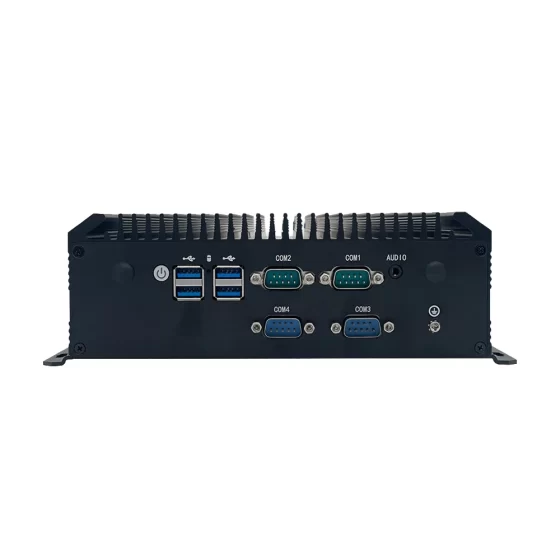
Industrial computers are designed for continuous operation, 산업용 I/O, cabinet installation, fanless cooling, 안정적인 네트워킹, 및 장기 배포.
An industrial computer can work as a MES terminal, machine data gateway, edge computing node, quality inspection workstation, or protocol integration platform.
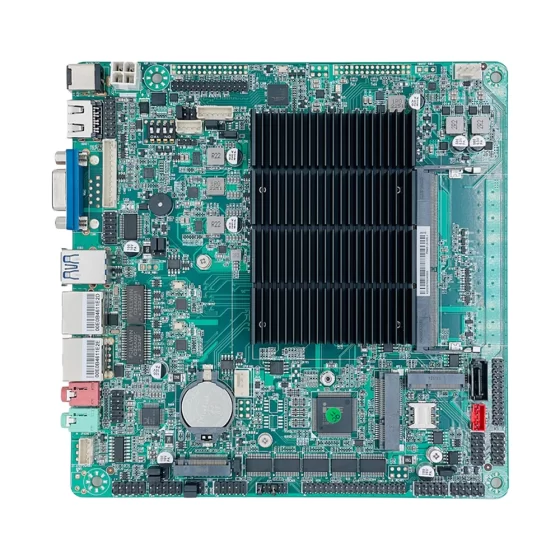
An embedded computer can be installed inside cabinets, 기계, production workstations, or OEM equipment. This makes it suitable for compact MES integration tasks where space, 신뢰할 수 있음, and interface flexibility are important.

Industrial PCs help connect mixed factory equipment to MES platforms.
주요 과제
Mixed Equipment and Legacy Machines
Many factories use equipment from different vendors and different generations.
Some machines support modern Ethernet-based communication. Others may only provide RS232, RS485, USB, 건식 접촉 신호, or no direct digital interface at all.
This creates a common MES integration challenge: the system must connect both new and old equipment without disrupting production.
A practical MES integration platform must support different communication methods and allow gradual digitalization of existing production assets.
Unstable Shop-Floor Environments
MES integration hardware is often installed in demanding environments.
A computer may be mounted inside a control cabinet, near a conveyor, beside a CNC machine, or at an operator workstation. These locations may expose the device to dust, 진동, 열, 전기적 소음, 케이블 운동, and unstable power.
If the integration computer fails, 데이터 수집이 중단될 수 있습니다. Operators may lose access to work instructions. 품질 기록이 불완전해질 수 있음.
This is why industrial-grade reliability is important for MES deployment.
Data Accuracy and Real-Time Visibility
MES systems depend on complete and accurate production data.
바코드 스캔이 누락된 경우, machine status updates are delayed, or test results are not uploaded correctly, the MES system cannot provide reliable visibility.
Manufacturers may face problems such as:
- Incomplete traceability records
- Delayed production reporting
- Incorrect work order status
- Missing quality inspection data
- Manual correction workload
- Difficulty finding root causes
A reliable industrial computer helps reduce these risks by keeping data acquisition stable at the production point.
Network Segmentation and Security
MES integration platforms often connect machine networks with factory IT networks.
This creates security and network design requirements. A machine network may need to remain isolated from office systems, while MES data still needs to reach servers and enterprise platforms.
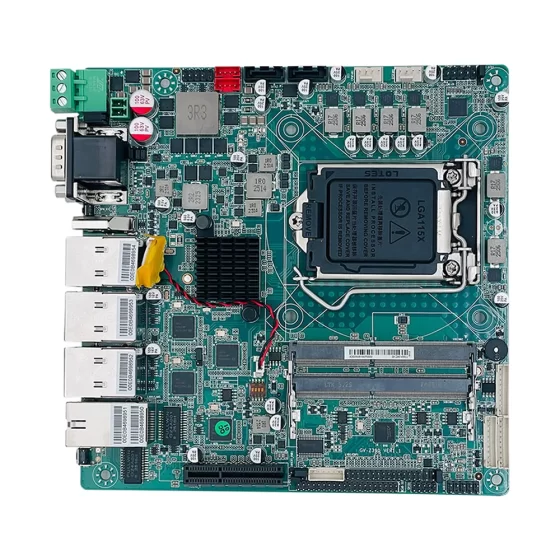
Multiple LAN ports can be useful in this situation.
One LAN port can connect to PLCs or machines, while another connects to the MES server or factory network. This separation improves network organization and can support more controlled data flow.
Scaling from Pilot Line to Full Factory
Many MES projects begin with a small pilot line.
After successful testing, the same system may need to expand to multiple production lines, workshops, plants, or customer sites.
If the hardware platform is not stable or long-term available, scaling becomes difficult. 소프트웨어 이미지, 드라이버, mounting accessories, 예비 부품, and support procedures may need to be rebuilt repeatedly.
A standardized industrial computing platform helps simplify this expansion.
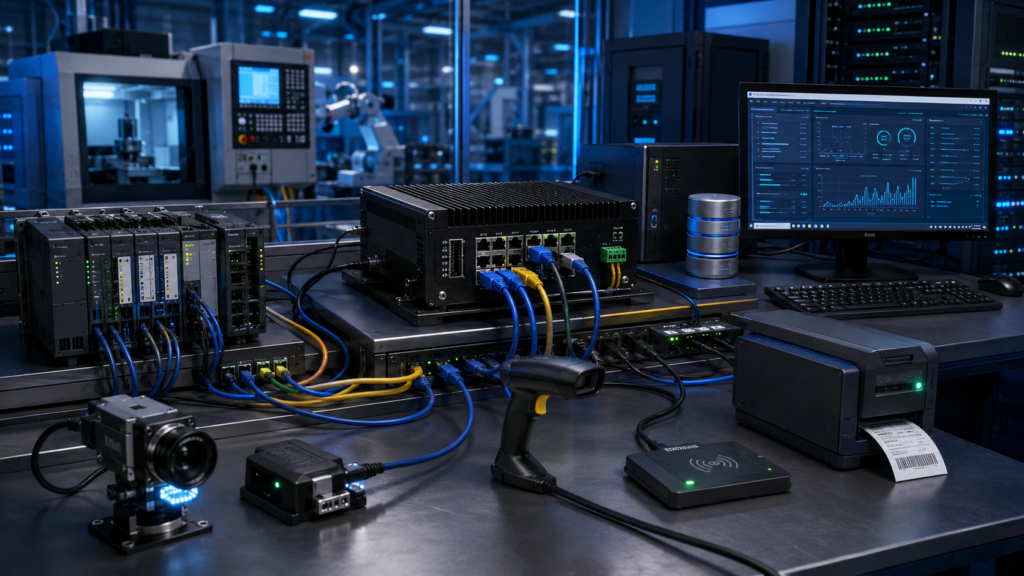
Industrial computers act as edge nodes between factory devices and MES software.
MES Integration Platform Solution Architecture
Machine and Device Layer
The machine and device layer includes the physical equipment that generates production data.
여기에는 PLC가 포함될 수 있습니다., 컨트롤러, CNC systems, 센서, 바코드 스캐너, RFID 리더, weighing devices, 테스트 장비, 카메라, 미터, 생산 도구.
These devices generate many types of data, 포함:
- 기계 상태
- 사이클 시간
- Production quantity
- Alarm information
- 운영자 확인
- 제품ID
- 자재 배치 번호
- Test result
- Inspection image
- Process parameter
The MES integration platform must collect this information from different interfaces and convert it into usable production data.
산업용 엣지 컴퓨팅 레이어
The industrial edge computing layer is where industrial computers and embedded computers are deployed.
This layer is usually located close to machines, 생산 라인, 캐비닛, 검사소, or operator terminals.
이 레이어에서는, the industrial computer may perform tasks such as:
- Running MES client applications
- Collecting data from machines
- Connecting barcode and RFID devices
- Communicating with PLCs
- Managing local peripherals
- Buffering data during network interruption
- Converting protocols
- Uploading records to MES software
- Displaying work instructions
- Supporting operator interaction
This layer improves reliability because production data does not depend entirely on remote servers.
MES Application Layer
The MES application layer manages production workflows.
It may include work order execution, 라우팅 제어, 생산 추적, quality management, 추적성, operator management, 장비상태, 보고, and dashboard visualization.
Industrial computers send shop-floor data to this layer and receive instructions from MES software.
예를 들어, the MES system may send work instructions to an operator terminal. The industrial computer displays the instructions, 스캔 결과를 기록합니다, and sends completion data back to the MES server.
Enterprise System Layer
MES platforms are often connected with ERP, WMS, PLM, SCADA, or business intelligence systems.
This connection allows production data to support business planning, inventory control, 품질 분석, 유지 관리 계획, and delivery management.
The MES integration platform does not replace enterprise software. 대신에, it provides the accurate shop-floor data foundation required for these systems to work effectively.
Local Resilience and Data Buffering
In real factories, network interruptions may happen.
A strong MES integration platform should support local resilience. The industrial computer can temporarily store data, continue collecting production records, and synchronize with the MES server after the connection is restored.
This is especially useful for factories where production cannot stop because of temporary network instability.
주요 특징
산업 등급 신뢰성
The most important requirement for MES integration hardware is stable operation.
A MES integration computer may run continuously across multiple shifts. It may be installed near production equipment where downtime can affect reporting, 추적성, and process control.
Important reliability features include:
- 팬리스 시스템 옵션
- 산업용 마더보드 디자인
- SSD 스토리지 지원
- 견고한 인클로저 구조
- 안정적인 열 설계
- 넓은 전압 입력 옵션
- 안전한 장착 방법
- 긴 수명주기 계획
The goal is not only computing performance. The goal is dependable operation in real factory conditions.
Flexible I/O for Factory Devices
MES integration often requires many types of I/O.
A single workstation may need to connect a touchscreen, scanner, RFID reader, label printer, serial device, Ethernet cable, USB device, and sometimes digital I/O.
유용한 인터페이스에는 다음이 포함될 수 있습니다.:
- 다중 LAN 포트
- USB 2.0 및 USB 3.0
- RS232
- RS485
- HDMI
- 디스플레이포트
- GPIO
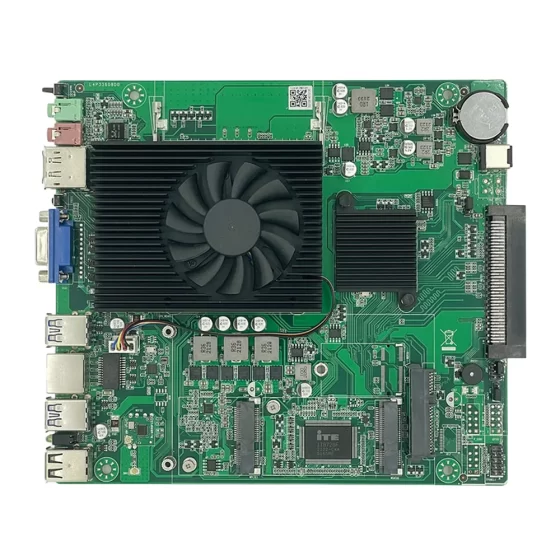
- M.2 확장
- 미니 PCIe 확장
- 무선 모듈 지원
The right I/O configuration reduces the need for external adapters and improves system reliability.
Multiple Network Ports
Multiple LAN ports are valuable in many MES integration platforms.
They allow one computer to connect different network zones. 예를 들어, one port may connect to machine controllers, while another connects to the MES server network.
This helps support:
- Machine network separation
- Factory IT network connection
- Gateway applications
- Data acquisition from isolated equipment
- More controlled communication paths
For smart manufacturing systems, network design is just as important as software configuration.
Fanless and Compact System Design
A fanless industrial computer is often suitable for MES integration because it reduces dust intake and removes one mechanical failure point.
Compact embedded computers are useful when installation space is limited.
They can be mounted inside control cabinets, 디스플레이 뒤, 워크스테이션 아래, or directly inside equipment.
This makes them suitable for both factory retrofits and OEM machine integration.
스토리지 및 데이터 보호
MES integration platforms may store operating system files, MES client software, 로그, temporary production records, 검사 이미지, 및 로컬 데이터베이스.
SSD storage is commonly used because it offers better shock resistance and faster response than traditional mechanical drives.
For applications with frequent logging or image storage, storage endurance and capacity should be reviewed carefully.
Operating System and Peripheral Compatibility
MES software may run on Windows, 리눅스, browser-based systems, or custom industrial software environments.
Before large deployment, 하드웨어는 대상 운영 체제에서 테스트되어야 합니다., 장치 드라이버, 스캐너, 프린터, 카메라, security software, remote access tools, and MES applications.
This helps avoid compatibility problems during rollout.
배포 시나리오
MES Operator Terminals
Operator terminals are one of the most common MES integration scenarios.
An industrial computer can be connected to a touchscreen, barcode scanner, 건반, RFID reader, and label printer.
At the station, operators can view work instructions, scan materials, confirm production steps, 기록 결함, 생산결과 제출.
This reduces paper-based workflows and improves data accuracy.
Machine Data Collection Gateways
An industrial computer can work as a machine data collection gateway.
PLC에 연결될 수 있음, CNC 기계, 센서, 미터, 또는 컨트롤러. The system can collect machine status, 출력량, 알람 데이터, 사이클 시간, and process values.
This is especially useful when machines cannot communicate directly with MES software.
품질 검사소
Quality inspection is a key part of MES integration.
An embedded computer or industrial PC can connect to cameras, 측정 도구, 테스트 장비, 바코드 스캐너, 그리고 프린터.
It can associate inspection results with product IDs, store temporary records, and upload quality data to the MES system.
This helps manufacturers improve traceability and quality analysis.
SMT and Electronics Manufacturing
Electronics manufacturing often requires detailed traceability.
MES integration may track PCB serial numbers, component batches, 검사 결과, test records, rework status, and packaging information.
Industrial computers can be deployed near SMT lines, AOI 장비, ICT testers, functional test stations, repair benches, and packing areas.
Stable computing hardware is important because each process step may generate critical traceability data.
CNC and Machinery Workshops
CNC workshops often include machines from different generations.
Some machines may support Ethernet communication, while others require serial communication or external monitoring devices.
An industrial computer with flexible I/O can help collect machine status, 생산 횟수, operator input, and alarm records.
This allows mechanical processing workshops to connect existing machines into the MES workflow.
Warehouse and Material Management
MES integration also extends to material flow.
Industrial computers can be used in receiving areas, line-side warehouses, material preparation zones, and finished goods stations.
By connecting scanners, RFID 리더, 계량 장비, 그리고 라벨 프린터, the system can improve material traceability and reduce manual entry errors.
OEM Equipment Integration
Machine builders can integrate embedded computers or industrial motherboards directly into their equipment.
This allows machines to support MES connectivity, data reporting, 운영자 인터페이스, 원격 진단, and production tracking functions.
OEM용, this creates more value for customers who need equipment ready for smart manufacturing environments.
비즈니스 이점
Improved Production Visibility
A MES integration platform helps manufacturers understand what is happening on the factory floor.
Industrial computers collect data from machines and operators, then send this information to MES dashboards and databases.
Production teams can see work order progress, machine status, 출력량, 다운타임 이유, and quality results more quickly.
This improves decision-making and reduces response time.
Stronger Product Traceability
Traceability depends on accurate data collection at each process point.
Industrial computers help collect product IDs, 자재 배치, 운영자 조치, process parameters, test results, and inspection records.
이는 품질 관리를 지원합니다., 고객 감사, warranty analysis, and root cause investigation.
For industries with strict quality requirements, traceability is one of the most important benefits of MES integration.
Reduced Manual Reporting
Manual reporting is slow and error-prone.
A MES integration platform allows production data to be captured directly from machines, 스캐너, 운영자, 및 검사 장비.
이렇게 하면 서류작업이 줄어듭니다, improves data consistency, and shortens the time required to understand production status.
기존 장비의 더 나은 활용
Factories do not always need to replace existing machines to build smart manufacturing systems.
산업용 컴퓨터는 직렬 포트를 통해 레거시 장비를 연결할 수 있습니다., 이더넷, USB, or external gateways.
This allows manufacturers to digitalize existing production assets step by step.
Scalable Smart Factory Deployment
A standardized industrial computing platform supports scalable MES deployment.
When the same hardware platform is used across multiple lines or factories, it becomes easier to manage software images, 예비 부품, maintenance procedures, training, 및 기술 지원.
This is important for manufacturers expanding from pilot projects to full production rollout.
Foundation for Industrial IoT and Analytics
MES integration creates the data foundation for more advanced smart manufacturing applications.
Once machines and production processes are connected, manufacturers can build equipment monitoring, quality analytics, 예측 유지 관리, 산업용 IoT 대시보드, and process optimization systems.
Industrial computers provide the edge computing layer required for this long-term development.
왜 CoreIPC인가?
CoreIPC provides industrial computing platforms for manufacturing, 오토메이션, 기계 연결성, 및 임베디드 시스템 통합. For MES integration platforms, CoreIPC는 안정적인 산업용 컴퓨터 하드웨어에 중점을 둡니다., 임베디드 컴퓨터 솔루션, 유연한 I/O 구성, 컴팩트한 시스템 디자인, 및 OEM/ODM 맞춤형 지원. CoreIPC는 시스템 통합자를 돕습니다., 장비 제작자, and manufacturing teams select computing platforms that match real shop-floor requirements, 기계 인터페이스 포함, 장착 방법, 전원 입력, 열적 조건, 수명주기 계획, and deployment scalability.
자주 묻는 질문
1. What is a MES integration platform?
A MES integration platform connects production equipment, 운영자, industrial computers, and MES software into one manufacturing data workflow.
It collects data from machines, 스캐너, 센서, PLC, 검사소, and operator terminals. Then it transfers this data to MES databases, 대시보드, 및 엔터프라이즈 시스템. The goal is to improve production visibility, 추적성, 품질 관리, and manufacturing execution.
2. Why does a MES integration platform need industrial computers?
Industrial computers provide the reliable shop-floor hardware layer required for MES integration.
They can connect factory devices, run MES client software, 생산 데이터 수집, display work instructions, and communicate with MES servers. Compared with office PCs, industrial computers are better suited for factory environments where dust, 진동, 열, long operating hours, and industrial interfaces are common.
3. How is an embedded computer used in MES integration?
임베디드 컴퓨터는 기계 근처에 설치 가능, 캐비닛 내부, 디스플레이 뒤, 또는 OEM 장비 내부.
It may collect PLC data, connect barcode scanners, communicate with sensors, buffer production records, or run local MES applications. Because embedded computers are compact and reliable, they are useful for machine-side integration and space-limited smart manufacturing systems.
4. What interfaces are commonly needed for MES integration?
Common MES integration interfaces include LAN, USB, RS232, RS485, HDMI, 디스플레이포트, GPIO, M.2, 및 미니 PCIe.
USB is often used for barcode scanners, RFID 리더, 카메라, 프린터, and keyboards. Serial ports may connect older machines, 미터, or PLCs. Multiple LAN ports can separate machine communication from MES server communication.
5. Can MES integration connect legacy factory equipment?
예. Many MES integration projects focus on connecting legacy machines.
Industrial computers can collect data through RS232, RS485, 이더넷, USB, 센서, 또는 외부 게이트웨이 모듈. This allows factories to digitalize older equipment without replacing all machines. It also helps manufacturers gradually build smart manufacturing capabilities.
6. Why are multiple LAN ports useful in MES integration?
Multiple LAN ports allow one industrial computer to connect different network zones.
예를 들어, one LAN port may connect to PLCs or machine controllers, while another connects to the MES server or factory network. 이러한 분리는 네트워크 구성을 개선할 수 있습니다., 보안 설계 지원, and reduce unnecessary interference between machine traffic and business system traffic.
7. Is a fanless industrial computer suitable for MES applications?
예. A fanless industrial computer is often suitable for MES applications because it reduces dust intake and removes a common mechanical failure point.
This is useful in production areas where maintenance access is limited or dust may affect standard computers. The final selection should still consider processor workload, 주변 온도, enclosure airflow, and mounting location.
8. How does MES integration improve traceability?
MES integration improves traceability by capturing production data at each process step.
Industrial computers can collect product serial numbers, material batch data, 운영자 조치, 기계 매개변수, 검사 결과, and test records. When this information is linked to the MES system, manufacturers can track product history more accurately and support quality analysis.
9. What should be considered before deploying MES integration hardware?
배포 전, manufacturers should review machine interfaces, 주변기기, 네트워크 설계, 운영 체제 호환성, mounting space, 전원 입력, 환경 조건, 저장 요구 사항, 및 수명주기 요구 사항.
It is also important to test the hardware with real MES software, 스캐너, 프린터, PLC 통신, and remote maintenance tools before large-scale rollout.
10. Can OEM machine builders use industrial computers for MES-ready equipment?
예. OEM machine builders can use embedded computers, 산업용 PC, or industrial motherboards to make equipment ready for MES integration.
This allows machines to support data reporting, 운영자 인터페이스, 원격 진단, 생산 추적, 및 고객 MES 연결성. OEM용, integrated computing hardware can improve product value and simplify deployment for end users.
결론
A MES integration platform is a critical foundation for smart manufacturing.
It connects machines, 운영자, 스캐너, inspection equipment, 생산 터미널, and enterprise systems into a reliable manufacturing data workflow. Without stable shop-floor computing hardware, MES software cannot collect accurate data or support real-time production visibility.
Industrial computer and embedded computer platforms provide the edge computing layer required for this integration. They support machine communication, operator interaction, 로컬 데이터 처리, network separation, and long-term deployment in real factory environments.
제조업체의 경우, 시스템 통합업체, 및 OEM 장비 제조업체, selecting the right hardware platform is essential. The decision should consider I/O configuration, networking, 설치, power design, thermal performance, 저장, 운영 체제 호환성, 및 수명주기 계획.
CoreIPC supports MES integration platform projects with industrial computing solutions designed for practical smart manufacturing deployment. 올바른 하드웨어 기반을 갖춘 경우, factories can improve visibility, 추적성, equipment connectivity, and long-term digital manufacturing scalability.
문의하기
산업용 컴퓨터를 찾고 계시다면, 임베디드 컴퓨터, or industrial motherboard for a MES integration platform?
프로젝트 요구 사항을 논의하려면 CoreIPC에 문의하세요., 기계 인터페이스 포함, I/O 구성, 장착 방법, 프로세서 플랫폼, 전원 입력, 운영 환경, 수명주기 요구 사항, 및 OEM/ODM 사용자 정의 옵션.