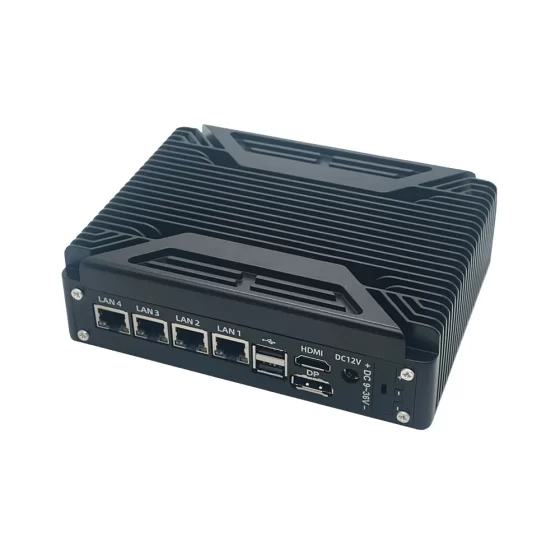
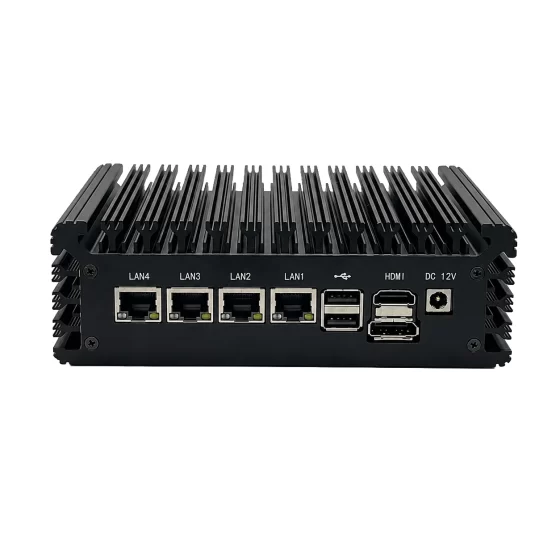
CoreIPC Industrial Computing Solutions

Real-Time AI Processing System: Real Time AI Processing for Industrial Automation
Executive Summary
A real time ai processing system provides the industrial computing foundation for fast AI inference, machine vision inspection, robotic guidance, process monitoring, defect detection, and automation response in modern manufacturing environments.
Many industrial AI applications require decisions within very short time windows. A vision system may need to reject a defective product before it leaves the inspection station. A robotic cell may need object position data before the next motion cycle. A monitoring system may need to detect abnormal equipment behavior before it causes downtime.
An industrial computer or embedded computer can perform local AI processing close to cameras, sensors, PLCs, robots, conveyors, and machines. This helps reduce latency, lower network dependency, and improve production reliability.
Compared with cloud-only AI processing, real-time edge AI systems allow factories to process data locally and send only useful results, alarms, summaries, or selected records to MES, SCADA, quality databases, or cloud platforms.
Compared with standard commercial PCs, industrial computers are better suited for factory deployment because they provide rugged mechanical design, flexible I/O, stable networking, reliable storage, fanless options, and long lifecycle support.
This article explains how real time ai processing systems work, what deployment challenges manufacturers face, how the solution architecture is structured, and which hardware features matter when selecting an industrial computer or embedded computer for real-time AI workloads.
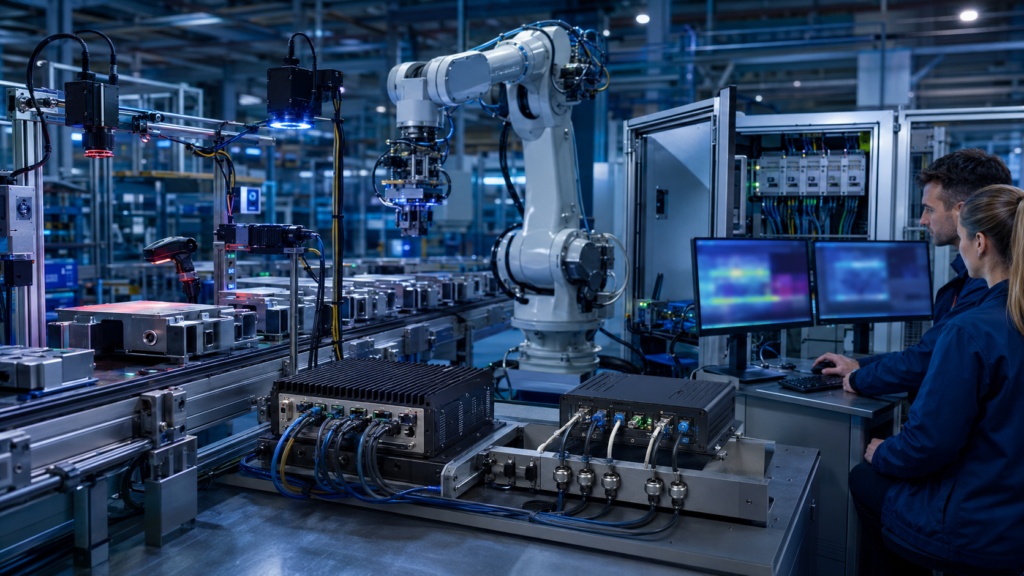
Real-Time AI Factory Deployment
Industry Overview
AI Is Moving from Offline Analysis to Real-Time Production
Early industrial AI projects often focused on offline analysis.
Images, sensor logs, or production records were collected first and analyzed later. This approach is useful for engineering review, model development, and process study.
However, modern factories increasingly need AI to support live production.
Real-time AI can help with:
- Defect rejection
- Machine vision inspection
- Robot guidance
- Conveyor sorting
- Barcode and OCR recognition
- Predictive maintenance alerts
- Safety zone awareness
- Equipment monitoring
- Process anomaly detection
- Packaging verification
- Logistics routing
These applications require local computing hardware that can process data quickly and communicate with automation systems reliably.
Why Real-Time Processing Matters
In industrial automation, delay can directly affect production results.
If AI inference is too slow, a defective product may pass the reject point. If robot guidance data arrives late, the robot may miss the correct picking window. If an equipment alarm is delayed, maintenance teams may respond too late.
Real-time AI processing helps convert data into action within the production cycle.
The system must handle image capture, preprocessing, model inference, result calculation, data storage, and PLC communication fast enough for the application.
Industrial Computing Is the Hardware Foundation
A real-time AI system depends on more than a model.
It needs stable industrial computing hardware that can run AI workloads continuously, connect to industrial devices, manage data, and operate in real factory environments.
Industrial computers and embedded computers provide this foundation.
They can support camera interfaces, multiple LAN ports, USB connectivity, serial ports, GPIO, digital I/O, SSD or NVMe storage, display output, and expansion modules.
This makes them suitable for machine-side AI inspection, robotic cells, automated sorting systems, production monitoring, and OEM smart equipment.

Real-Time AI Deployment Challenges
Key Challenges
Low-Latency AI Inference
Real-time AI systems must process data quickly.
The required response time depends on the application. A high-speed inspection line may need results within milliseconds or a short production cycle. A predictive maintenance system may allow longer analysis windows but still needs timely alerts.
Latency may come from several stages:
- Image capture
- Sensor sampling
- Data transfer
- Preprocessing
- AI model inference
- Post-processing
- PLC communication
- Result storage
- Network upload
The industrial computer must be selected according to the full processing pipeline, not only the AI model itself.
Multi-Source Data Processing
Real-time AI systems often collect data from many sources.
A single deployment may include cameras, sensors, PLCs, robots, barcode readers, motion controllers, and production databases.
Common data sources include:
- Industrial cameras
- 3D cameras
- High-speed cameras
- Vibration sensors
- Temperature sensors
- PLC signals
- Robot controllers
- Conveyor encoders
- Barcode readers
- Energy meters
- Machine controllers
The computer must collect and process this data without unstable timing or communication bottlenecks.
Camera Bandwidth and Frame Stability
Machine vision is one of the most common real-time AI applications.
Camera bandwidth must be planned carefully. A system using multiple high-resolution cameras may generate large data streams that require stable LAN, USB, PCIe, or frame grabber support.
Important factors include:
- Camera count
- Resolution
- Frame rate
- Image bit depth
- Interface type
- Trigger timing
- Network separation
- Storage speed
- AI inference workload
A powerful processor cannot solve the problem if images are not acquired reliably.
Industrial Control Integration
Real-time AI results must connect with production action.
The system may need to send pass, fail, alarm, position, classification, or routing results to PLCs, robots, conveyors, reject mechanisms, or SCADA systems.
This requires reliable industrial communication.
Useful interfaces may include:
- LAN
- RS232
- RS485
- GPIO
- Digital input
- Digital output
- USB
- HDMI
- DisplayPort
- M.2
- PCIe
The right I/O configuration reduces external converters and improves system reliability.
Long-Term Stability Under Continuous Workload
Real-time AI systems often run across multiple shifts.
The computer may operate inside a cabinet, near a production line, inside an inspection machine, or beside a robotic cell.
These environments may include vibration, dust, heat, electrical noise, limited airflow, and cable stress.
Industrial-grade hardware helps maintain stable operation under continuous AI workload and factory conditions.

Real-Time AI Processing Architecture
Real Time AI Processing System Solution Architecture
Data Acquisition Layer
The data acquisition layer captures images, sensor values, machine status, and production signals.
This layer may include:
- Cameras
- Sensors
- PLCs
- Robots
- Encoders
- Lighting controllers
- Barcode readers
- Motion controllers
- Industrial gateways
- Production equipment
The quality and timing of this data directly affect real-time AI performance.
If data acquisition is unstable, AI results may become delayed, incomplete, or unreliable.
Industrial Edge Computing Layer
The industrial edge computing layer is where the industrial computer or embedded computer performs local processing.
At this layer, the system may:
- Receive camera images
- Collect sensor data
- Run AI inference
- Process machine vision algorithms
- Detect defects or anomalies
- Calculate robot coordinates
- Send results to PLCs
- Store local records
- Display dashboards
- Upload selected data
This layer reduces dependence on remote servers and allows AI decisions to happen close to the equipment.
AI Inference Layer
The AI inference layer contains the models and runtime environment.
Depending on the application, it may include:
- Object detection models
- Defect detection models
- OCR models
- Segmentation models
- Anomaly detection models
- Predictive maintenance models
- Video analytics models
- Sensor fusion logic
The computing platform must support the required operating system, drivers, AI framework, camera SDKs, GPU or accelerator modules, and industrial communication software.
Automation Response Layer
The automation response layer connects AI output with real production action.
For example:
- A defect result triggers a reject mechanism.
- A robot receives object coordinates.
- A conveyor sorter receives lane information.
- A monitoring system sends an alarm.
- A PLC receives a pass or fail signal.
- A dashboard displays production status.
This layer turns AI processing into practical automation value.
Factory Data Integration Layer
Real-time AI systems also need to connect with higher-level software.
The industrial computer may send selected records to:
- MES
- SCADA
- ERP
- Quality databases
- WMS
- Cloud platforms
- Industrial IoT dashboards
- Maintenance platforms
- Local historian systems
Instead of uploading all raw data, the system can upload results, exceptions, alarms, images, summaries, and traceability records.
Key Features
Real-Time AI Performance
The most important feature is stable real-time performance.
The system must process data within the required cycle time.
Selection should consider:
- CPU performance
- GPU or AI accelerator support
- Memory capacity
- Camera bandwidth
- Storage speed
- Network latency
- AI model complexity
- Operating system support
- Thermal design
- Long-running stability
For lightweight workloads, an embedded computer may be enough. For multi-camera or deep learning systems, an edge AI computer or industrial PC with stronger acceleration may be required.
Multiple Camera and Sensor Interfaces
Real-time AI platforms must support reliable device connectivity.
Useful hardware options may include:
- USB 3.0
- Multiple LAN ports
- 2.5GbE or 10GbE options
- RS232
- RS485
- GPIO
- Digital input
- Digital output
- PCIe expansion
- M.2 expansion
- HDMI or DisplayPort
These interfaces support cameras, sensors, lighting controllers, PLCs, barcode readers, robots, and local displays.
Local Storage and Data Buffering
Real-time AI systems may generate many records.
The computer may store:
- Defect images
- Inference logs
- Video clips
- Sensor history
- Local databases
- AI model files
- Alarm records
- Production reports
- Temporary buffers
SSD or NVMe storage is commonly preferred because it provides fast access and better shock resistance than mechanical drives.
For data-heavy applications, storage capacity, sustained write speed, write endurance, and backup strategy should be reviewed carefully.
Network Separation
Real-time systems often need multiple networks.
One network may connect cameras. Another may connect PLCs. Another may connect MES or cloud systems.
Multiple LAN ports can support:
- Camera traffic separation
- Machine network communication
- Factory IT connection
- Remote maintenance
- Cloud upload
- Security segmentation
- Multi-line deployment
Good network architecture reduces traffic conflict and improves system stability.
Rugged and Fanless Design
Fanless industrial computers are useful in many real-time AI deployments.
They reduce dust intake and remove one common mechanical failure point.
However, AI workloads can generate heat. For high-performance AI systems, thermal planning is important.
Designers should review:
- Processor workload
- GPU or accelerator use
- Ambient temperature
- Cabinet airflow
- Enclosure design
- Mounting method
- Power input
- Cable routing
Stable thermal design helps keep AI performance consistent.
Long Lifecycle and Maintainability
Real-time AI systems often become part of production infrastructure.
Frequent hardware changes can create validation issues with AI software, camera drivers, GPU drivers, operating systems, and automation interfaces.
Industrial computing platforms with lifecycle planning help manufacturers and machine builders maintain consistent systems across multiple machines, lines, and factory sites.

Real-Time AI Production Operations
Deployment Scenarios
Real-Time Vision Inspection
Real-time AI processing is widely used for machine vision inspection.
The system captures images, runs AI inference, detects defects, and sends pass or fail results to a PLC.
Applications include electronics inspection, packaging inspection, food inspection, pharmaceutical inspection, battery inspection, and semiconductor AOI.
Robotic Guidance
Robots can use real-time AI processing for object recognition, part localization, bin picking, and inspection.
The industrial computer processes camera or 3D sensor data and sends coordinates to the robot controller.
This supports flexible automation and faster robotic decision-making.
Conveyor Sorting
Sorting systems need fast decisions.
An AI computer can recognize products, parcels, labels, barcodes, or object categories and send routing information to PLCs or diverters.
This is useful in logistics, packaging, e-commerce fulfillment, and production material handling.
Predictive Maintenance Alerts
Real-time AI can analyze machine data from vibration, temperature, current, pressure, or PLC status.
The system can detect abnormal patterns and generate alerts locally.
This helps maintenance teams respond earlier to equipment problems.
Video Analytics
Industrial video analytics can monitor production flow, equipment areas, safety zones, logistics movement, or remote facilities.
The industrial computer processes video streams locally and sends only event records or alerts to monitoring systems.
This reduces network load and improves response time.
Packaging Verification
Packaging lines often require fast checks for labels, barcodes, date codes, caps, seals, cartons, and final package quality.
A real-time AI processing system can inspect each package and trigger reject actions through PLC communication.
This helps reduce shipment errors and improve traceability.
Industrial IoT Edge Processing
Industrial IoT deployments can use real-time AI to analyze sensor data near machines.
An embedded computer can collect data, detect anomalies, buffer records, and upload selected results to dashboards or cloud platforms.
This supports smarter machine monitoring and factory visibility.
OEM Intelligent Equipment
Machine builders can integrate real-time AI computers into inspection machines, robotic systems, smart gateways, sorting equipment, and automated production equipment.
The computing platform can provide AI inference, image processing, PLC communication, local storage, HMI display, and factory data output.
Business Benefits
Faster Production Decisions
Real-time AI processing allows decisions to happen near the production equipment.
This reduces delay and helps the system respond within the required cycle time.
Fast local processing is valuable for inspection, sorting, robot guidance, monitoring, and alarms.
Reduced Cloud Dependency
Factories do not need to send every image, video stream, or sensor record to the cloud.
The industrial computer can process data locally and upload only selected results.
This reduces bandwidth usage and improves production resilience.
Improved Quality Control
Real-time AI helps detect defects earlier and more consistently.
The system can inspect products during production and trigger immediate actions when defects appear.
This reduces downstream quality risk and supports stronger production control.
Better Automation Integration
Industrial computers can connect AI results with PLCs, robots, conveyors, sensors, and factory software.
This turns AI models into practical automation systems.
The result can be faster reject control, better robot guidance, automated sorting, and improved monitoring.
Stronger Traceability
AI results can be linked with product IDs, timestamps, defect categories, images, station IDs, model versions, and production records.
This creates useful traceability for audits, engineering review, quality analysis, and process improvement.
Scalable Smart Factory Deployment
A standardized real-time AI processing platform makes it easier to deploy AI across multiple lines, machines, and factories.
Consistent hardware simplifies software images, driver validation, spare parts planning, maintenance training, and lifecycle support.
This helps manufacturers move from pilot AI projects to scalable production deployment.
Why CoreIPC
CoreIPC provides industrial computing platforms for edge AI, machine vision, industrial automation, robotics, and embedded system integration. For real time ai processing applications, CoreIPC focuses on reliable industrial computer hardware, embedded computer solutions, flexible I/O configurations, compact system design, local storage capability, and OEM/ODM customization support. CoreIPC helps system integrators, machine builders, and manufacturers select computing platforms that match real deployment requirements, including AI workload, camera interfaces, network design, PLC communication, storage needs, mounting methods, power input, thermal conditions, and lifecycle planning.
Frequently Asked Questions
1. What is a real-time AI processing system?
A real-time AI processing system uses local computing hardware to run AI inference and generate results within a required production time window.
It may process camera images, sensor values, PLC data, video streams, or robot vision data. The system then sends results to automation equipment, dashboards, or factory software.
2. Why use an industrial computer for real-time AI processing?
An industrial computer is designed for continuous operation in factory environments.
It supports rugged installation, industrial I/O, camera connectivity, reliable networking, local storage, and long lifecycle deployment. These features make it suitable for real-time AI systems installed near machines, conveyors, robots, and inspection stations.
3. How is an embedded computer used in real-time AI systems?
An embedded computer can be installed inside machines, inspection systems, control cabinets, or compact automation equipment.
It can collect data, run AI inference, communicate with PLCs, display local results, and upload selected records. Its compact size is useful for machine builders and distributed edge deployments.
4. What applications need real-time AI processing?
Applications include machine vision inspection, robotic guidance, conveyor sorting, packaging verification, video analytics, predictive maintenance, barcode recognition, safety monitoring, and industrial IoT edge processing.
Any application that needs fast AI decisions near production equipment can benefit from real-time AI processing.
5. Does real-time AI processing require a GPU?
Not always. Some lightweight AI models can run on CPU-based industrial computers.
A GPU or AI accelerator may be needed for high-resolution images, multiple cameras, video analytics, deep learning models, or strict cycle-time requirements. Hardware should be selected based on real model testing.
6. What interfaces are important for real-time AI computers?
Important interfaces may include multiple LAN ports, USB 3.0, 2.5GbE, 10GbE, RS232, RS485, GPIO, digital input, digital output, HDMI, DisplayPort, M.2, PCIe, SATA, and NVMe storage support.
These interfaces help connect cameras, sensors, PLCs, robots, lighting controllers, alarms, and factory networks.
7. Can fanless industrial computers support real-time AI?
Fanless industrial computers can support many moderate real-time AI workloads.
However, high-performance AI inference, multi-camera processing, or GPU-based workloads may generate significant heat. CPU workload, accelerator use, cabinet airflow, ambient temperature, and mounting method should be reviewed before deployment.
8. How does real-time AI connect with PLCs?
The AI computer can communicate with PLCs through Ethernet, serial communication, digital I/O, or supported industrial software interfaces.
The PLC may trigger image capture or send machine status. After processing, the AI computer can return pass, fail, alarm, position, or classification results.
9. Can real-time AI systems connect with MES or SCADA?
Yes. Industrial computers can send AI results, alarms, inspection records, production data, and system status to MES, SCADA, quality databases, dashboards, or cloud platforms.
This connects machine-side AI decisions with higher-level manufacturing workflows.
10. What should be tested before deployment?
Before deployment, the system should be tested with real cameras, sensors, AI models, PLC communication, production cycle times, storage workload, network architecture, and long-running operation.
Thermal stability, inference latency, frame acquisition, I/O response, local buffering, and data upload should also be validated.
Conclusion
A real time ai processing system is a practical foundation for industrial AI applications that require low latency, local inference, automation response, and reliable edge deployment.
By placing an industrial computer or embedded computer close to cameras, sensors, PLCs, robots, conveyors, and production systems, manufacturers can process data locally, reduce cloud dependency, improve response time, and connect AI results with real production action.
The right platform should be selected according to real deployment requirements, including AI workload, camera interface, sensor input, I/O configuration, network architecture, storage needs, expansion requirements, mounting method, power input, thermal conditions, operating system support, and lifecycle planning.
CoreIPC supports real-time AI processing projects with industrial computing platforms designed for practical factory and equipment deployment. With the right hardware foundation, manufacturers and machine builders can build reliable, scalable, and production-ready AI systems for smart manufacturing.
Contact Us
Looking for an industrial computer, embedded computer, or edge AI platform for real-time AI processing?
Contact CoreIPC to discuss your project requirements, including AI workload, camera interface, sensor input, PLC communication, network design, storage needs, mounting method, power input, operating environment, lifecycle needs, and OEM/ODM customization options.