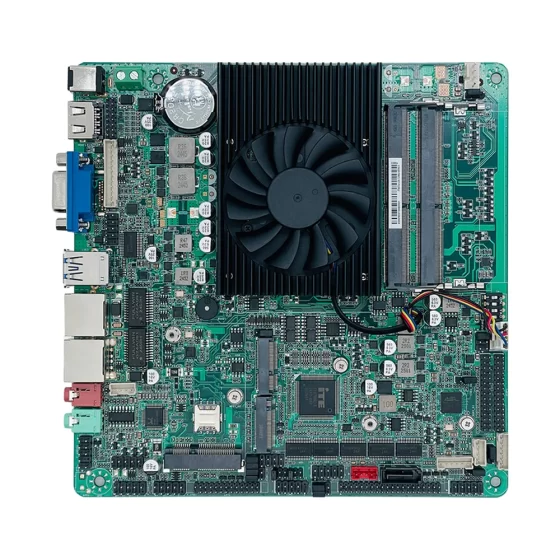
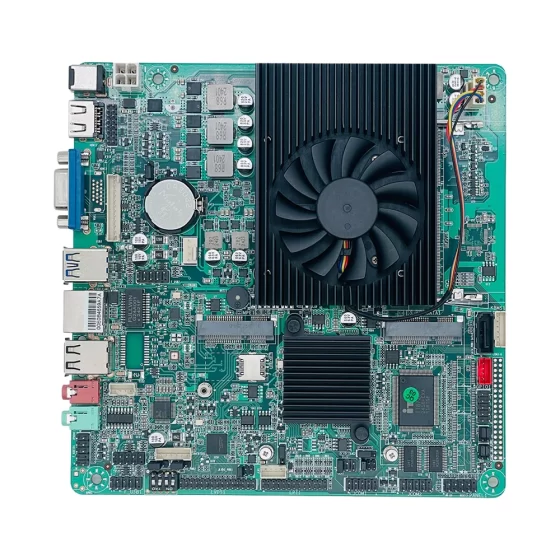
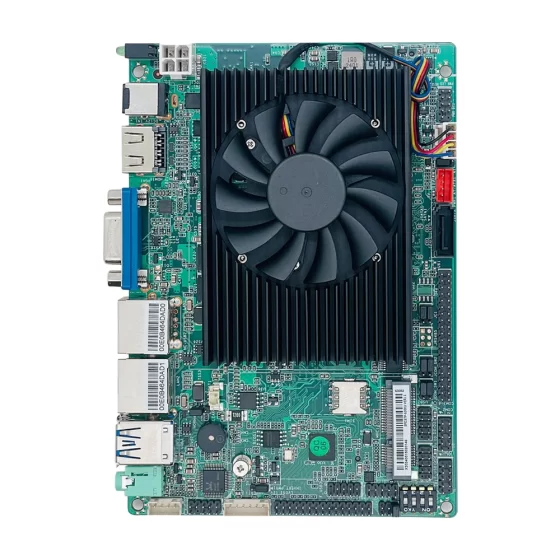
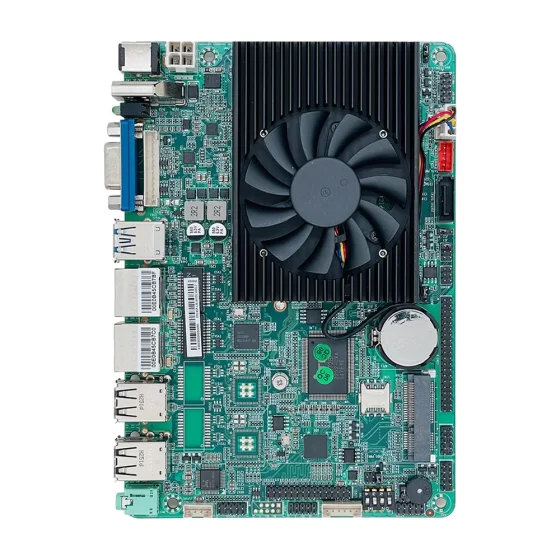
Soluciones de informática industrial CoreIPC

Plataforma de integración MES para fabricación inteligente: Computación industrial para operaciones de fábrica conectadas
Resumen ejecutivo
A MES integration platform is the digital bridge between production equipment, shop-floor operators, manufacturing execution software, and enterprise business systems.
En entornos de fabricación inteligentes, factories need more than isolated machines and manual reporting. They need reliable data flow from PLCs, sensores, escáneres de códigos de barras, Lectores RFID, sistemas de inspección, production terminals, and industrial networks into the MES system.
This is where industrial computer and embedded computer platforms become essential. They provide the local computing layer required to connect machines, recopilar datos de producción, process information near the equipment, and synchronize manufacturing records with MES software.
A well-designed MES integration platform helps manufacturers improve production visibility, reducir los informes manuales, fortalecer la trazabilidad, and connect legacy equipment with modern digital systems.
Sin embargo, MES integration is not only a software challenge. It also depends on stable industrial hardware, E/S flexibles, disponibilidad de ciclo de vida largo, redes confiables, and practical deployment across real factory environments.
This article explains how industrial computers support MES integration platforms, ¿Qué desafíos enfrentan los fabricantes?, how the system architecture works, and which hardware features matter most for smart manufacturing deployment.
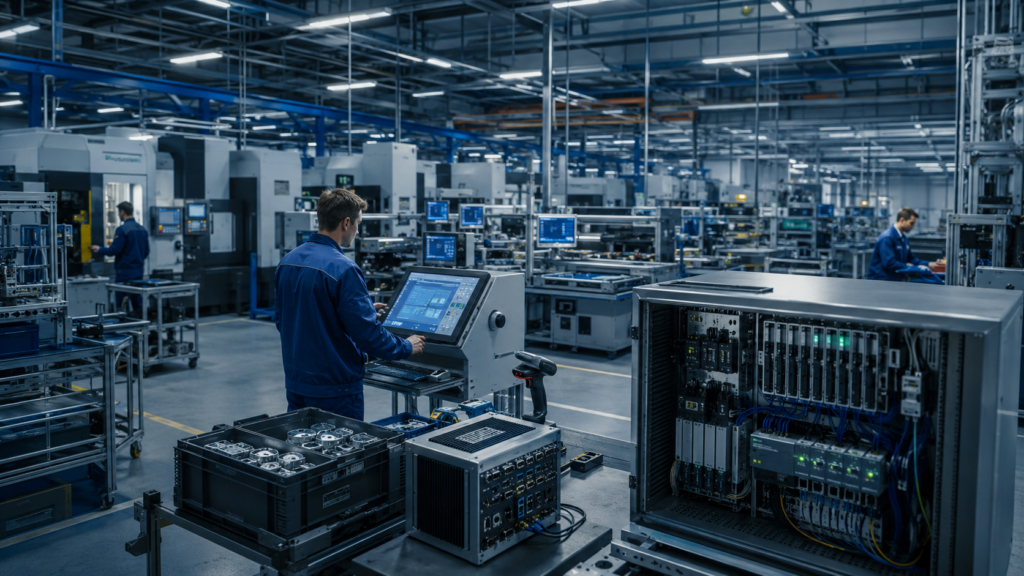
Industrial computers collect shop-floor data from machines, escáneres, PLC, y estaciones de operador.
Descripción general de la industria
Smart Manufacturing Requires Connected Production Data
Smart manufacturing depends on accurate and timely production data.
Factories need to know what is happening on each line, máquina, workstation, inspection area, and material flow process. Without reliable data collection, MES software cannot provide accurate work order tracking, estado de producción, registros de calidad, or traceability.
A MES integration platform connects these production activities into one digital workflow.
It collects data from equipment and operators, then transfers that data to MES software, bases de datos, tableros, y sistemas empresariales. This allows manufacturers to move from manual reporting to real-time production visibility.
MES Is Becoming a Shop-Floor Integration System
Traditional MES systems were often treated as production management software.
Hoy, MES is increasingly connected to factory equipment, sistemas de automatización, inspección de calidad, warehouse operations, and operator terminals. This makes the hardware integration layer more important than before.
Typical MES-connected devices may include:
- Controladores PLC
- maquinas cnc
- Assembly stations
- Escáneres de códigos de barras
- Lectores RFID
- Impresoras de etiquetas
- Cámaras de visión artificial
- Instrumentos de prueba
- Industrial displays
- Paneles de producción
- Local servers and databases
To connect these devices reliably, factories need industrial-grade computing platforms deployed close to the production process.
Why Industrial Computers Are Important
Las PC comerciales pueden funcionar en entornos de oficina, but MES integration usually happens near machines and production lines.
Industrial computers are designed for continuous operation, E/S industriales, instalación del gabinete, fanless cooling, redes estables, y despliegue a largo plazo.
An industrial computer can work as a MES terminal, machine data gateway, edge computing node, estación de trabajo de inspección de calidad, or protocol integration platform.
An embedded computer can be installed inside cabinets, maquinas, production workstations, o equipo OEM. This makes it suitable for compact MES integration tasks where space, fiabilidad, and interface flexibility are important.

Industrial PCs help connect mixed factory equipment to MES platforms.
Desafíos clave
Mixed Equipment and Legacy Machines
Many factories use equipment from different vendors and different generations.
Some machines support modern Ethernet-based communication. Others may only provide RS232, RS485, USB, señales de contacto seco, or no direct digital interface at all.
This creates a common MES integration challenge: the system must connect both new and old equipment without disrupting production.
A practical MES integration platform must support different communication methods and allow gradual digitalization of existing production assets.
Unstable Shop-Floor Environments
MES integration hardware is often installed in demanding environments.
A computer may be mounted inside a control cabinet, near a conveyor, beside a CNC machine, or at an operator workstation. These locations may expose the device to dust, vibración, calor, ruido electrico, movimiento de cables, and unstable power.
If the integration computer fails, la recopilación de datos puede detenerse. Operators may lose access to work instructions. Los registros de calidad pueden quedar incompletos.
This is why industrial-grade reliability is important for MES deployment.
Data Accuracy and Real-Time Visibility
MES systems depend on complete and accurate production data.
Si se omiten los escaneos de códigos de barras, machine status updates are delayed, or test results are not uploaded correctly, the MES system cannot provide reliable visibility.
Manufacturers may face problems such as:
- Incomplete traceability records
- Delayed production reporting
- Incorrect work order status
- Missing quality inspection data
- Manual correction workload
- Difficulty finding root causes
A reliable industrial computer helps reduce these risks by keeping data acquisition stable at the production point.
Network Segmentation and Security
MES integration platforms often connect machine networks with factory IT networks.
This creates security and network design requirements. A machine network may need to remain isolated from office systems, while MES data still needs to reach servers and enterprise platforms.
Multiple LAN ports can be useful in this situation.
One LAN port can connect to PLCs or machines, while another connects to the MES server or factory network. This separation improves network organization and can support more controlled data flow.
Scaling from Pilot Line to Full Factory
Many MES projects begin with a small pilot line.
After successful testing, the same system may need to expand to multiple production lines, talleres, plantas, or customer sites.
If the hardware platform is not stable or long-term available, scaling becomes difficult. Software images, conductores, mounting accessories, piezas de repuesto, and support procedures may need to be rebuilt repeatedly.
A standardized industrial computing platform helps simplify this expansion.
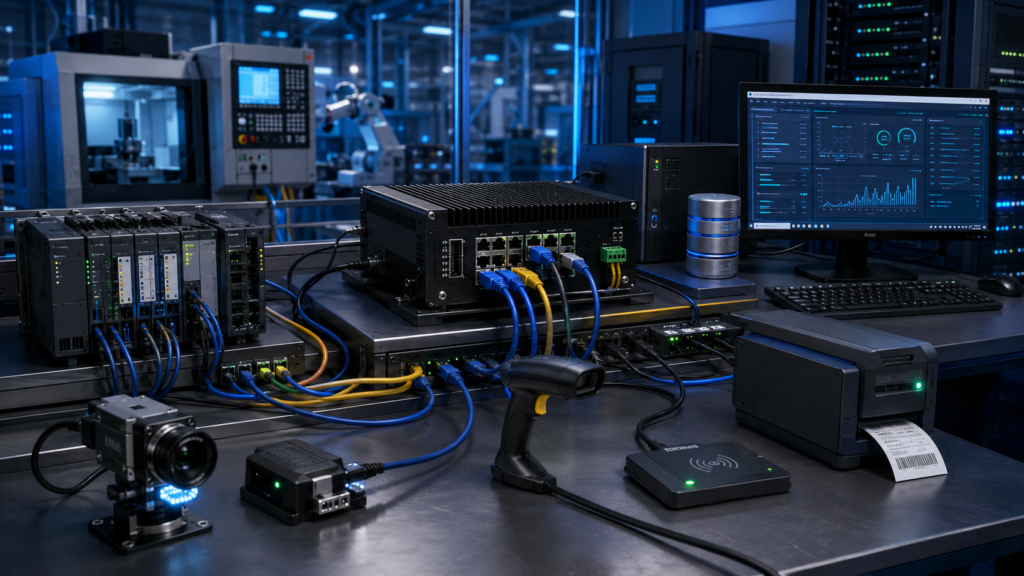
Industrial computers act as edge nodes between factory devices and MES software.
MES Integration Platform Solution Architecture
Capa de máquina y dispositivo
The machine and device layer includes the physical equipment that generates production data.
Esto puede incluir PLC, controladores, CNC systems, sensores, escáneres de códigos de barras, Lectores RFID, dispositivos de pesaje, instrumentos de prueba, camaras, metros, and production tools.
These devices generate many types of data, incluido:
- Estado de la máquina
- tiempo de ciclo
- Production quantity
- Alarm information
- Confirmación del operador
- ID del producto
- Número de lote de material
- Resultado de la prueba
- Imagen de inspección
- Parámetro de proceso
The MES integration platform must collect this information from different interfaces and convert it into usable production data.
Capa de computación de borde industrial
The industrial edge computing layer is where industrial computers and embedded computers are deployed.
This layer is usually located close to machines, líneas de producción, gabinetes, estaciones de inspección, or operator terminals.
en esta capa, El ordenador industrial puede realizar tareas como:
- Running MES client applications
- Collecting data from machines
- Connecting barcode and RFID devices
- Communicating with PLCs
- Managing local peripherals
- Buffering data during network interruption
- Converting protocols
- Uploading records to MES software
- Displaying work instructions
- Supporting operator interaction
This layer improves reliability because production data does not depend entirely on remote servers.
MES Application Layer
The MES application layer manages production workflows.
It may include work order execution, control de enrutamiento, seguimiento de producción, gestión de calidad, trazabilidad, operator management, estado del equipo, informar, y visualización del tablero.
Industrial computers send shop-floor data to this layer and receive instructions from MES software.
Por ejemplo, the MES system may send work instructions to an operator terminal. The industrial computer displays the instructions, registra los resultados del escaneo, and sends completion data back to the MES server.
Enterprise System Layer
MES platforms are often connected with ERP, WMS, PLM, SCADA, o sistemas de inteligencia empresarial.
This connection allows production data to support business planning, control de inventario, análisis de calidad, planificación de mantenimiento, y gestión de entregas.
The MES integration platform does not replace enterprise software. En cambio, it provides the accurate shop-floor data foundation required for these systems to work effectively.
Local Resilience and Data Buffering
In real factories, network interruptions may happen.
A strong MES integration platform should support local resilience. The industrial computer can temporarily store data, continue collecting production records, and synchronize with the MES server after the connection is restored.
This is especially useful for factories where production cannot stop because of temporary network instability.
Características clave
Confiabilidad de grado industrial
The most important requirement for MES integration hardware is stable operation.
A MES integration computer may run continuously across multiple shifts. It may be installed near production equipment where downtime can affect reporting, trazabilidad, and process control.
Las características importantes de confiabilidad incluyen:
- Opciones de sistema sin ventilador
- Diseño de placas base industriales
- Soporte de almacenamiento SSD
- Estructura de recinto resistente
- Diseño térmico estable
- Opciones de entrada de amplio voltaje
- Métodos de montaje seguros
- Planificación de ciclo de vida largo
The goal is not only computing performance. The goal is dependable operation in real factory conditions.
Flexible I/O for Factory Devices
MES integration often requires many types of I/O.
A single workstation may need to connect a touchscreen, escáner, Lector RFID, label printer, serial device, Ethernet cable, USB device, and sometimes digital I/O.
Las interfaces útiles pueden incluir:
- Múltiples puertos LAN
- USB 2.0 y USB 3.0
- RS232
- RS485
- hdmi
- DisplayPort
- GPIO
- Expansión M.2
- Expansión mini PCIe
- Soporte de módulo inalámbrico
The right I/O configuration reduces the need for external adapters and improves system reliability.
Multiple Network Ports
Multiple LAN ports are valuable in many MES integration platforms.
They allow one computer to connect different network zones. Por ejemplo, one port may connect to machine controllers, while another connects to the MES server network.
This helps support:
- Machine network separation
- Factory IT network connection
- Aplicaciones de puerta de enlace
- Data acquisition from isolated equipment
- More controlled communication paths
For smart manufacturing systems, network design is just as important as software configuration.
Fanless and Compact System Design
A fanless industrial computer is often suitable for MES integration because it reduces dust intake and removes one mechanical failure point.
Compact embedded computers are useful when installation space is limited.
They can be mounted inside control cabinets, detrás de las pantallas, debajo de las estaciones de trabajo, or directly inside equipment.
This makes them suitable for both factory retrofits and OEM machine integration.
Almacenamiento y protección de datos
MES integration platforms may store operating system files, MES client software, registros, temporary production records, Imágenes de inspeccion, y bases de datos locales.
SSD storage is commonly used because it offers better shock resistance and faster response than traditional mechanical drives.
For applications with frequent logging or image storage, storage endurance and capacity should be reviewed carefully.
Operating System and Peripheral Compatibility
MES software may run on Windows, linux, browser-based systems, or custom industrial software environments.
Before large deployment, El hardware debe probarse con el sistema operativo de destino., controladores de dispositivos, escáneres, impresoras, camaras, software de seguridad, remote access tools, and MES applications.
This helps avoid compatibility problems during rollout.
Escenarios de implementación
MES Operator Terminals
Operator terminals are one of the most common MES integration scenarios.
An industrial computer can be connected to a touchscreen, barcode scanner, teclado, Lector RFID, e impresora de etiquetas.
At the station, operators can view work instructions, scan materials, confirm production steps, registrar defectos, y enviar resultados de producción.
This reduces paper-based workflows and improves data accuracy.
Machine Data Collection Gateways
An industrial computer can work as a machine data collection gateway.
Puede conectarse a PLC, maquinas cnc, sensores, metros, o controladores. The system can collect machine status, cantidad de salida, datos de alarma, tiempo de ciclo, y valores de proceso.
This is especially useful when machines cannot communicate directly with MES software.
Estaciones de inspección de calidad
Quality inspection is a key part of MES integration.
An embedded computer or industrial PC can connect to cameras, herramientas de medición, instrumentos de prueba, escáneres de códigos de barras, e impresoras.
It can associate inspection results with product IDs, almacenar registros temporales, and upload quality data to the MES system.
This helps manufacturers improve traceability and quality analysis.
SMT and Electronics Manufacturing
Electronics manufacturing often requires detailed traceability.
MES integration may track PCB serial numbers, component batches, resultados de la inspección, registros de prueba, rework status, and packaging information.
Industrial computers can be deployed near SMT lines, Equipo AOI, ICT testers, functional test stations, repair benches, and packing areas.
Stable computing hardware is important because each process step may generate critical traceability data.
CNC and Machinery Workshops
CNC workshops often include machines from different generations.
Some machines may support Ethernet communication, while others require serial communication or external monitoring devices.
An industrial computer with flexible I/O can help collect machine status, recuentos de producción, operator input, y registros de alarma.
This allows mechanical processing workshops to connect existing machines into the MES workflow.
Warehouse and Material Management
MES integration also extends to material flow.
Las computadoras industriales se pueden utilizar en áreas de recepción, line-side warehouses, zonas de preparación de materiales, y estaciones de productos terminados.
By connecting scanners, Lectores RFID, equipo de pesaje, e impresoras de etiquetas, the system can improve material traceability and reduce manual entry errors.
Integración de equipos OEM
Machine builders can integrate embedded computers or industrial motherboards directly into their equipment.
This allows machines to support MES connectivity, data reporting, interfaz del operador, diagnóstico remoto, and production tracking functions.
Para fabricantes de equipos originales, this creates more value for customers who need equipment ready for smart manufacturing environments.
Beneficios comerciales
Visibilidad de producción mejorada
A MES integration platform helps manufacturers understand what is happening on the factory floor.
Industrial computers collect data from machines and operators, then send this information to MES dashboards and databases.
Production teams can see work order progress, estado de la máquina, cantidad de salida, razones de tiempo de inactividad, and quality results more quickly.
This improves decision-making and reduces response time.
Stronger Product Traceability
Traceability depends on accurate data collection at each process point.
Industrial computers help collect product IDs, lotes de materiales, acciones del operador, parámetros del proceso, resultados de la prueba, y registros de inspección.
Esto apoya el control de calidad., auditorías de clientes, análisis de garantía, e investigación de causa raíz.
For industries with strict quality requirements, traceability is one of the most important benefits of MES integration.
Informes manuales reducidos
Manual reporting is slow and error-prone.
A MES integration platform allows production data to be captured directly from machines, escáneres, operadores, y equipo de inspección.
Esto reduce el papeleo., improves data consistency, and shortens the time required to understand production status.
Mejor uso del equipo existente
Factories do not always need to replace existing machines to build smart manufacturing systems.
Las computadoras industriales pueden conectar equipos heredados a través de puertos serie, Ethernet, USB, o puertas de enlace externas.
This allows manufacturers to digitalize existing production assets step by step.
Implementación escalable de fábrica inteligente
A standardized industrial computing platform supports scalable MES deployment.
When the same hardware platform is used across multiple lines or factories, it becomes easier to manage software images, piezas de repuesto, maintenance procedures, capacitación, y soporte técnico.
This is important for manufacturers expanding from pilot projects to full production rollout.
Foundation for Industrial IoT and Analytics
MES integration creates the data foundation for more advanced smart manufacturing applications.
Once machines and production processes are connected, manufacturers can build equipment monitoring, análisis de calidad, mantenimiento predictivo, Cuadros de mando industriales de IoT, and process optimization systems.
Industrial computers provide the edge computing layer required for this long-term development.
Por qué CoreIPC
CoreIPC proporciona plataformas informáticas industriales para la fabricación, automatización, conectividad de la máquina, e integración de sistemas integrados. For MES integration platforms, CoreIPC se centra en hardware informático industrial confiable, soluciones informáticas integradas, Configuraciones de E/S flexibles, diseño de sistema compacto, y soporte de personalización OEM/ODM. CoreIPC ayuda a los integradores de sistemas, constructores de equipos, y los equipos de fabricación seleccionan plataformas informáticas que coincidan con los requisitos reales del taller., incluyendo interfaces de máquina, métodos de montaje, entrada de energía, condiciones termicas, planificación del ciclo de vida, and deployment scalability.
Preguntas frecuentes
1. What is a MES integration platform?
A MES integration platform connects production equipment, operadores, computadoras industriales, and MES software into one manufacturing data workflow.
It collects data from machines, escáneres, sensores, PLC, estaciones de inspección, and operator terminals. Then it transfers this data to MES databases, tableros, y sistemas empresariales. The goal is to improve production visibility, trazabilidad, control de calidad, and manufacturing execution.
2. Why does a MES integration platform need industrial computers?
Industrial computers provide the reliable shop-floor hardware layer required for MES integration.
They can connect factory devices, run MES client software, recopilar datos de producción, mostrar instrucciones de trabajo, and communicate with MES servers. En comparación con las PC de oficina, industrial computers are better suited for factory environments where dust, vibración, calor, long operating hours, and industrial interfaces are common.
3. How is an embedded computer used in MES integration?
Se puede instalar una computadora integrada cerca de las máquinas., dentro de los gabinetes, detrás de las pantallas, o dentro de equipos OEM.
It may collect PLC data, connect barcode scanners, communicate with sensors, buffer production records, or run local MES applications. Because embedded computers are compact and reliable, they are useful for machine-side integration and space-limited smart manufacturing systems.
4. What interfaces are commonly needed for MES integration?
Common MES integration interfaces include LAN, USB, RS232, RS485, hdmi, DisplayPort, GPIO, M.2, y Mini PCIe.
USB is often used for barcode scanners, Lectores RFID, camaras, impresoras, and keyboards. Serial ports may connect older machines, metros, or PLCs. Multiple LAN ports can separate machine communication from MES server communication.
5. Can MES integration connect legacy factory equipment?
Sí. Many MES integration projects focus on connecting legacy machines.
Industrial computers can collect data through RS232, RS485, Ethernet, USB, sensores, o módulos de puerta de enlace externos. Esto permite a las fábricas digitalizar equipos más antiguos sin reemplazar todas las máquinas.. It also helps manufacturers gradually build smart manufacturing capabilities.
6. Why are multiple LAN ports useful in MES integration?
Multiple LAN ports allow one industrial computer to connect different network zones.
Por ejemplo, one LAN port may connect to PLCs or machine controllers, while another connects to the MES server or factory network. Esta separación puede mejorar la organización de la red., soporte de diseño de seguridad, and reduce unnecessary interference between machine traffic and business system traffic.
7. Is a fanless industrial computer suitable for MES applications?
Sí. A fanless industrial computer is often suitable for MES applications because it reduces dust intake and removes a common mechanical failure point.
This is useful in production areas where maintenance access is limited or dust may affect standard computers. The final selection should still consider processor workload, temperatura ambiente, flujo de aire del gabinete, y ubicación de montaje.
8. How does MES integration improve traceability?
MES integration improves traceability by capturing production data at each process step.
Industrial computers can collect product serial numbers, material batch data, acciones del operador, parámetros de la máquina, resultados de la inspección, y registros de pruebas. When this information is linked to the MES system, manufacturers can track product history more accurately and support quality analysis.
9. What should be considered before deploying MES integration hardware?
Antes del despliegue, manufacturers should review machine interfaces, dispositivos periféricos, diseño de red, compatibilidad del sistema operativo, mounting space, entrada de energía, condiciones ambientales, necesidades de almacenamiento, y requisitos del ciclo de vida.
It is also important to test the hardware with real MES software, escáneres, impresoras, comunicación PLC, and remote maintenance tools before large-scale rollout.
10. Can OEM machine builders use industrial computers for MES-ready equipment?
Sí. OEM machine builders can use embedded computers, PC industriales, or industrial motherboards to make equipment ready for MES integration.
This allows machines to support data reporting, interfaz del operador, diagnóstico remoto, seguimiento de producción, y conectividad MES del cliente. Para fabricantes de equipos originales, integrated computing hardware can improve product value and simplify deployment for end users.
Conclusión
A MES integration platform is a critical foundation for smart manufacturing.
It connects machines, operadores, escáneres, inspection equipment, production terminals, and enterprise systems into a reliable manufacturing data workflow. Without stable shop-floor computing hardware, MES software cannot collect accurate data or support real-time production visibility.
Industrial computer and embedded computer platforms provide the edge computing layer required for this integration. They support machine communication, interacción del operador, procesamiento de datos locales, network separation, and long-term deployment in real factory environments.
For manufacturers, integradores de sistemas, and OEM equipment builders, selecting the right hardware platform is essential. The decision should consider I/O configuration, networking, montaje, diseño de energía, rendimiento térmico, almacenamiento, compatibilidad del sistema operativo, y planificación del ciclo de vida.
CoreIPC supports MES integration platform projects with industrial computing solutions designed for practical smart manufacturing deployment. Con la base de hardware adecuada, factories can improve visibility, trazabilidad, equipment connectivity, and long-term digital manufacturing scalability.
Contáctenos
Busco ordenador industrial, computadora integrada, or industrial motherboard for a MES integration platform?
Póngase en contacto con CoreIPC para analizar los requisitos de su proyecto., incluyendo interfaces de máquina, configuración de E/S, método de montaje, plataforma del procesador, entrada de energía, entorno operativo, necesidades del ciclo de vida, y opciones de personalización OEM/ODM.