Soluciones de informática industrial CoreIPC

IoT industrial para almacenes inteligentes: Plataforma de almacén industrial IoT para operaciones logísticas conectadas
Resumen ejecutivo
Los sistemas de almacén industrial de IoT proporcionan la base informática para el almacenamiento conectado, manipulación automatizada de materiales, visibilidad del inventario, monitoreo de equipos, escaneo de código de barras, Seguimiento RFID, detección ambiental, Coordinación AGV y AMR, y gestión de operaciones de almacén en tiempo real.
Los almacenes modernos ya no son simples espacios de almacenamiento. A menudo incluyen sistemas de transporte., líneas de clasificación, lectores de códigos de barras, Dispositivos RFID, puntos de inspección visual, estaciones de pesaje, AGV, AMR, montacargas, sensores, dispositivos de control de acceso, interruptores industriales, plataformas WMS, software WCS, paneles de control en la nube, y sistemas de monitoreo locales.
Para hacer que estos sistemas funcionen juntos, Los almacenes necesitan informática de punta y conectividad de datos confiables..
Una computadora industrial o una computadora integrada puede actuar como puerta de enlace de IoT industrial local o plataforma de borde de almacén.. Puede recopilar datos de equipos de almacén., conectar diferentes dispositivos, procesar registros localmente, datos en buffer durante interrupciones de la red, Admite acceso remoto seguro, y enviar información estructurada a WMS, WCS, ERP, plataformas en la nube, o paneles de control locales.
En comparación con las PC de oficina o las pasarelas de consumo, Las computadoras industriales son más adecuadas para entornos de almacén porque admiten una instalación robusta., múltiples puertos LAN, comunicación en serie, GPIO, almacenamiento local, opciones de diseño sin ventilador, entrada de energía estable, y disponibilidad de ciclo de vida prolongado.
Este artículo explica cómo el IoT industrial respalda las operaciones de almacén inteligentes., ¿Qué desafíos de implementación aparecen en entornos logísticos reales?, cómo funciona la arquitectura de la solución, y qué características de hardware son importantes al seleccionar una computadora industrial o una computadora integrada para aplicaciones de IoT de almacén inteligente.
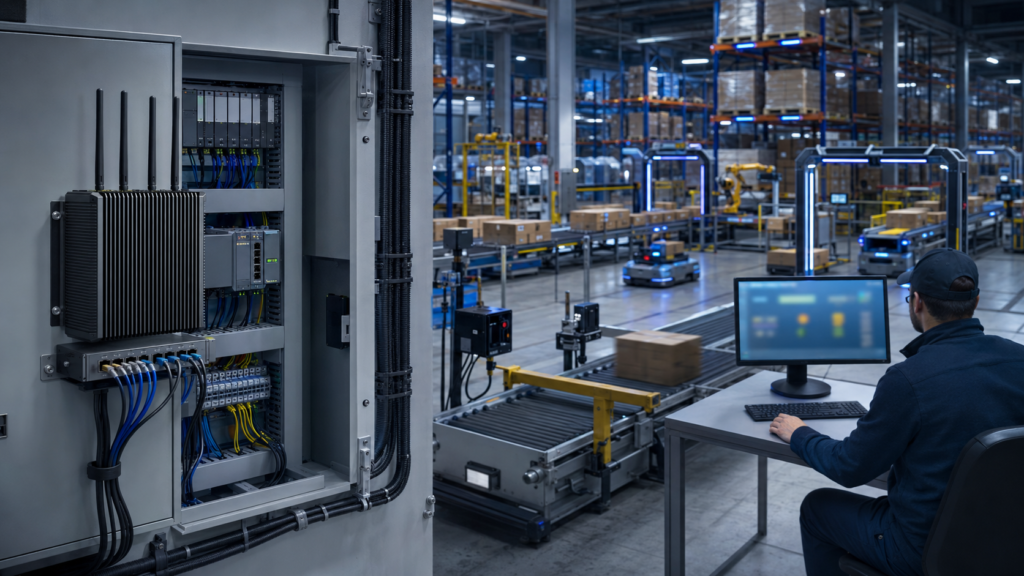
Recopilación de datos de almacén inteligente
Descripción general de la industria
Los almacenes son cada vez más automatizados
Los almacenes están bajo presión para mover mercancías más rápido, reducir los errores de selección, mejorar la precisión del inventario, y respaldar el cumplimiento de pedidos en tiempo real.
Para lograr esto, Muchas instalaciones están adoptando sistemas de automatización conectados..
Las tecnologías comunes de almacén inteligente incluyen:
- Escaneo de códigos de barras
- Seguimiento RFID
- control del transportador
- Sistemas de clasificación
- Robots AGV y AMR
- Sistemas de almacenamiento automatizados
- Inspección de visión
- Pesaje y dimensionamiento
- Monitoreo ambiental
- Sistemas de gestión de almacenes.
- Sistemas de control de almacén
- Paneles de operaciones en la nube
Estos sistemas generan grandes cantidades de datos operativos..
Sin una capa industrial de IoT confiable, Estos datos pueden permanecer fragmentados entre dispositivos., maquinas, y plataformas de software.
IoT industrial conecta equipos de almacén
IoT industrial ayuda a conectar equipos de almacén físico con sistemas de software.
Permite a los operadores del almacén recopilar y utilizar datos de los transportadores., escáneres, robots, sensores, metros, camaras, puertas, sistemas de pesaje, y controladores locales.
El objetivo es mejorar la visibilidad de:
- movimiento de inventario
- Estado del equipo
- Rendimiento de clasificación
- Precisión de recogida
- operación de robots
- Condiciones del transportador
- Uso de energía
- Condiciones ambientales
- Eventos de alarma
- Necesidades de mantenimiento
- Flujo de procesamiento de pedidos
Una plataforma de almacén industrial iot convierte equipos desconectados en una operación logística más coordinada.
La informática industrial es la base del borde
Los sistemas de almacén inteligentes necesitan informática fiable cerca del equipo.
Se pueden instalar ordenadores industriales y ordenadores integrados en armarios de control., sistemas de clasificación, zonas transportadoras, bastidores de almacén, áreas de carga, muelles de carga, instalaciones de cadena de frio, y nodos logísticos remotos.
Estos ambientes pueden incluir polvo., vibración, variación de temperatura, tensión del cable, poder inestable, y largas horas de funcionamiento.
Las plataformas informáticas industriales proporcionan la base de hardware para una implementación estable de IoT en almacenes.
Admiten E/S flexibles, segmentación de red, almacenamiento local, procesamiento de bordes, y funcionamiento a largo plazo.

Desafíos de implementación de IoT en almacenes inteligentes
Desafíos clave
Conexión de muchos dispositivos de almacén
Un almacén inteligente puede incluir muchos dispositivos diferentes de diferentes proveedores..
Una sola instalación puede utilizar lectores de códigos de barras, Lectores RFID, sensores, transportadores, controladores de robots, estaciones de pesaje, camaras, dispositivos de control de acceso, e interruptores industriales.
Estos sistemas pueden utilizar diferentes interfaces y protocolos..
Una plataforma de IoT de almacén debe admitir una conectividad práctica, incluido:
- Ethernet
- USB
- RS232
- RS485
- GPIO
- Entrada digital
- Salida digital
- Módulos inalámbricos
- Interfaces de cámara
- Salida de pantalla local
- Ampliación de almacenamiento
La conectividad flexible del dispositivo ayuda a reducir la complejidad de la integración.
Integración de sistemas WMS y WCS
Los sistemas de gestión de almacenes y los sistemas de control de almacenes a menudo necesitan datos de equipos en tiempo real..
Un WMS puede necesitar el estado del inventario, recogiendo resultados, recibiendo registros, y datos de envío. Un WCS puede necesitar el estado del transportador, actividad clasificadora, tareas de robot, eventos del escáner, y alarmas de equipos.
La plataforma industrial de IoT debe recopilar datos de dispositivos físicos y enviar información estructurada a sistemas de software..
Esto puede requerir:
- Normalización de datos
- Alineación de marca de tiempo
- Filtrado de eventos
- Mapeo del estado del equipo
- Manejo de códigos de barras y registros RFID
- Almacenamiento en búfer local
- Integración API o base de datos
- Gestión de comunicación de plataforma.
Una computadora integrada confiable puede servir como puente local entre el equipo del almacén y las plataformas de software..
Manejo de un gran volumen de datos
Los almacenes inteligentes pueden generar un gran volumen de datos.
Los lectores de códigos de barras pueden procesar miles de artículos por hora. Las cámaras pueden capturar imágenes continuamente.. Los sensores pueden informar el estado del equipo en tiempo real. Los AMR pueden enviar datos de posición y tareas.. Los transportadores pueden generar eventos de estado frecuentes.
La plataforma informática debe dimensionarse según:
- Recuento de dispositivos
- Recuento de puntos de datos
- Frecuencia de escaneo
- Carga de trabajo de la cámara
- Velocidad de datos del robot
- Tamaño de la base de datos local
- Ancho de banda de red
- Frecuencia de carga
- Carga de trabajo de procesamiento perimetral
- Requisitos de retención de almacenamiento
Los sistemas con poca potencia pueden crear retrasos, pérdida de datos, o integración inestable.
Mantenimiento de la operación durante interrupciones de la red
Las operaciones de almacén no pueden detenerse porque una conexión a la nube o un vínculo empresarial se vuelve inestable.
Una plataforma de IoT de almacén inteligente debería admitir el almacenamiento en búfer local y el comportamiento de almacenamiento y reenvío.
Esto ayuda a preservar:
- Escanear registros
- Ordenar eventos
- Registros de movimiento de inventario
- Registros de tareas del robot
- Alarmas de equipos
- Datos ambientales
- Registros de acceso
- Registros de mantenimiento
Cuando se recupera la conexión de red, Los datos almacenados en el búfer se pueden cargar en WMS., WCS, ERP, plataformas en la nube, o bases de datos locales.
Respaldo de respuesta en tiempo real
Algunas operaciones de almacén necesitan una respuesta local rápida.
Los ejemplos incluyen la validación del escáner., señales de parada del transportador, alertas de estado del clasificador, monitoreo de zona de robot, Advertencias de temperatura de la cadena de frío., y detección de fallas en el equipo.
Si todos los datos deben ir a la nube antes de actuar, la respuesta puede demorarse.
La computación perimetral permite que una lógica importante se ejecute localmente.
Una computadora industrial puede procesar eventos del almacén cerca del equipo y enviar solo resultados seleccionados a sistemas de nivel superior..
Protección de redes de almacenes
Los sistemas de almacén inteligentes a menudo conectan dispositivos operativos con software empresarial y plataformas en la nube..
Esto crea requisitos de seguridad..
Es posible que la plataforma IoT deba separarse:
- Red de equipos de almacén
- Red informática de oficina
- Red de cámaras
- Red de robots
- Red de escáner
- Red WMS o WCS
- Red de mantenimiento remoto
- Enlace ascendente en la nube
- Red de gestión
Múltiples puertos LAN y políticas de comunicación controladas ayudan a reducir la exposición innecesaria.

Arquitectura de almacén industrial de IoT
Arquitectura de solución de almacén industrial de IoT
Capa de dispositivo de almacén
La capa de dispositivo de almacén incluye el equipo físico que genera datos o requiere control..
Esta capa puede incluir:
- Lectores de códigos de barras
- Lectores RFID
- Transportadores
- Ordena
- Sistemas de pesaje
- Sistemas de dimensionamiento
- AGV
- AMR
- Terminales de carretillas elevadoras
- Cámaras industriales
- Sensores ambientales
- Dispositivos de control de acceso
- Controladores PLC
- HMI locales
Estos dispositivos proporcionan datos operativos en tiempo real para la visibilidad y automatización del almacén..
Capa de borde de IoT industrial
La capa perimetral de IoT industrial es la capa informática local.
en esta capa, el ordenador industrial o el ordenador integrado pueden:
- Recopilar registros del escáner
- Recibir datos de sensores
- Conectar sistemas robóticos
- Monitorear el estado del transportador
- Procesar eventos locales
- Datos del búfer
- Convertir protocolos
- Almacenar registros
- Aplicar reglas de seguridad
- Reenviar información seleccionada a sistemas de software
Esta capa conecta las operaciones del almacén físico con las plataformas digitales..
Capa de procesamiento de datos
La capa de procesamiento de datos mejora los datos sin procesar antes de que lleguen a sistemas de nivel superior..
La plataforma podrá procesar:
- Eventos de código de barras
- Lecturas RFID
- Registros de movimiento de inventario
- Alarmas del transportador
- Eventos de clasificación
- Estado de la tarea del robot
- Registros ambientales
- Uso de energía
- Datos de salud del equipo
- Eventos del muelle de carga
Procesando datos localmente, la plataforma reduce el uso de ancho de banda y mejora el tiempo de respuesta.
Capa de integración de software de almacén
La plataforma industrial IoT conecta equipos de almacén con sistemas de software.
Puede enviar datos estructurados a:
- WMS
- WCS
- ERP
- MES
- Paneles de control en la nube
- Bases de datos locales
- Plataformas de mantenimiento
- Sistemas de gestión de flotas
- Plataformas de gestión energética
- Sistemas de monitoreo de seguridad
Esta integración ayuda a los gerentes de almacén a ver lo que sucede en tiempo real y coordinar las operaciones de manera más efectiva..
Capa de seguridad y gestión
La capa de seguridad y gestión ayuda a mantener la conectividad del almacén fiable y controlada.
Puede incluir:
- Segmentación de red
- Políticas de firewall
- Acceso remoto seguro
- Permisos de usuario
- Registro local
- Copia de seguridad de configuración
- Monitoreo del estado del dispositivo
- Monitoreo del estado del almacenamiento
- Diagnóstico remoto
- Gestión de actualizaciones
Esta capa ayuda a reducir el riesgo y simplificar el mantenimiento a largo plazo..
Características clave
Conectividad multidispositivo
Las plataformas de almacén industrial de IoT deben conectar muchos tipos de equipos.
Las opciones de E/S importantes pueden incluir:
- LAN
- USB
- RS232
- RS485
- GPIO
- Entrada digital
- Salida digital
- hdmi
- DisplayPort
- M.2
- PCIe
- Almacenamiento SATA o NVMe
Las interfaces industriales nativas reducen la necesidad de convertidores externos.
Esto mejora la confiabilidad y hace que la instalación en los gabinetes de control del almacén sea más limpia..
Diseño de red multiLAN
Múltiples puertos LAN son valiosos para la implementación de IoT en almacenes.
Permiten que diferentes redes permanezcan separadas.
Las configuraciones útiles pueden incluir:
- Red de equipos
- Red de escáner
- Red de cámaras
- Red de robots
- Red WMS o WCS
- Red informática de fábrica o almacén
- Red de mantenimiento remoto
- Red de gestión
El diseño de LAN múltiple mejora la organización del tráfico y admite límites de seguridad más sólidos.
Almacenamiento local y almacenamiento en búfer de datos
El almacenamiento local es importante para la continuidad de los datos del almacén inteligente.
La plataforma puede almacenar:
- Escanear registros
- Eventos RFID
- Ordenar registros
- Datos de tareas del robot
- Alarmas del transportador
- Registros ambientales
- Bases de datos locales
- Cargar buffers
- Registros de acceso remoto
- Archivos de diagnóstico
Generalmente se prefiere el almacenamiento SSD o NVMe porque proporciona un acceso rápido y una mejor resistencia a los golpes que las unidades mecánicas..
El diseño del almacenamiento debe considerar el período de retención., escribe resistencia, flujo de trabajo de respaldo, y comportamiento de interrupción de la red.
Rendimiento del procesamiento perimetral
La plataforma podrá recopilar, proceso, almacenar, y reenviar datos al mismo tiempo.
La selección de hardware debe considerar:
- rendimiento de la CPU
- Capacidad de memoria
- Recuento de dispositivos
- Recuento de puntos de datos
- Tasa de eventos del escáner
- Carga de trabajo de la cámara
- Volumen de datos del robot
- Carga de trabajo de base de datos local
- Velocidad de almacenamiento
- Soporte del sistema operativo
Para almacenes más grandes, El sistema debe probarse con conexiones de dispositivos reales y volumen de tráfico..
Diseño robusto y sin ventilador
Los entornos de almacén pueden ser polvorientos y propensos a vibraciones.
Las computadoras industriales sin ventilador reducen la entrada de polvo y eliminan un punto común de falla mecánica.
Los gabinetes resistentes ayudan a proteger el sistema de las vibraciones., tensión del cable, impacto de la instalación, y funcionamiento continuo.
El diseño térmico aún debe revisarse cuidadosamente, especialmente cuando el sistema maneja la recopilación continua de datos, procesamiento local, y el almacenamiento escribe.
Acceso remoto seguro
Los sistemas de almacén inteligentes a menudo necesitan soporte remoto.
Integradores de sistemas, proveedores de equipos, y los equipos de TI del almacén pueden necesitar acceso a puertas de enlace, escáneres, transportadores, robots, o paneles de control locales.
El acceso remoto debe controlarse mediante:
- Autenticación de usuario
- Soporte VPN o túnel seguro
- Permisos de acceso
- Registro de sesión
- Ventanas de mantenimiento
- Segmentación de red
- Copia de seguridad de configuración
- Reglas de acceso de emergencia
Esto respalda la eficiencia del mantenimiento sin exponer toda la red del almacén..
Opciones inalámbricas y de expansión
Algunos sistemas de almacén requieren conectividad o expansión inalámbrica.
Las interfaces M.2 y PCIe pueden admitir módulos inalámbricos, tarjetas de red adicionales, expansión de almacenamiento, o módulos personalizados.
Esto es útil para áreas de almacén distribuidas., integración de equipos móviles, y productos de puerta de enlace OEM.
La capacidad de expansión ayuda a que la misma plataforma sirva para diferentes aplicaciones de almacén.
Largo ciclo de vida y mantenibilidad
Los sistemas de IoT de almacén pueden permanecer en servicio durante años.
El hardware consistente ayuda a mantener las imágenes del software, conductores, piezas de repuesto, plantillas de configuración, y procedimientos de validación.
Las plataformas informáticas industriales con planificación del ciclo de vida ayudan a los integradores de sistemas y operadores de almacenes a implementar soluciones estables en muchas instalaciones..

Operaciones de IoT de almacén inteligente
Escenarios de implementación
Recopilación de datos de códigos de barras y RFID
Un almacén inteligente puede utilizar códigos de barras y dispositivos RFID en la recepción, almacenamiento, cosecha, embalaje, y zonas de envío.
Una plataforma industrial de IoT puede recopilar estos registros, eventos de marca de tiempo, almacenar datos localmente, y enviar información estructurada a sistemas WMS o ERP.
Esto mejora la precisión y la trazabilidad del inventario..
Monitoreo de transportadores y sistemas de clasificación
Los transportadores y los sistemas de clasificación generan datos continuos de estado y alarma..
Una computadora integrada puede recopilar señales de los controladores, sensores, escáneres, y dispositivos locales.
Puede proporcionar monitoreo local y enviar eventos seleccionados a WCS o plataformas de mantenimiento..
Esto ayuda a mejorar la visibilidad del equipo..
Soporte de operación AGV y AMR
Los AGV y AMR necesitan una comunicación confiable con los sistemas de tareas, plataformas de flota, estaciones de carga, e infraestructura de almacén.
Una computadora industrial puede soportar la conectividad IoT local, segmentación de red, e intercambio de datos entre sistemas robóticos y plataformas de almacén.
Esto respalda una logística asistida por robots más segura y confiable..
Monitoreo de almacén de cadena de frío
Los almacenes de cadena de frío necesitan un control continuo de la temperatura y la humedad.
Una computadora integrada puede recopilar datos de sensores ambientales, almacenar registros locales, generar alertas locales, y enviar datos a la nube o a sistemas de gestión de instalaciones.
El almacenamiento en búfer local ayuda a preservar los registros durante las interrupciones de la red.
Monitoreo inteligente del muelle de carga
Las operaciones del muelle de carga pueden incluir cámaras., sensores, control de acceso, escáneres de códigos de barras, y sistemas de programación de camiones.
Una puerta de enlace de IoT de almacén puede recopilar datos de los equipos del muelle y reenviar eventos seleccionados a los paneles de operaciones..
Esto mejora la visibilidad de la logística de entrada y salida..
Monitoreo de energía del almacén
Los almacenes utilizan iluminación., climatización, transportadores, cargadores, compresores, y sistemas de automatización.
Una plataforma industrial de IoT puede recopilar datos energéticos de medidores y equipos.
Esto apoya el análisis de energía., detección de consumo anormal, y mejora operativa.
Clasificación e inspección basadas en visión
Algunos almacenes utilizan cámaras para la inspección de paquetes., lectura de etiquetas, dimensionamiento, o verificación de clasificación.
Una computadora industrial puede soportar el manejo de datos de cámaras locales, procesamiento de eventos, e integración con sistemas WMS o WCS.
Para cargas de trabajo basadas en IA, Es posible que se requieran plataformas de borde de mayor rendimiento..
Monitoreo de almacenes en múltiples sitios
Los grandes operadores logísticos pueden gestionar numerosos almacenes.
Una plataforma de almacén industrial de IoT estandarizada puede recopilar datos locales en cada sitio y enviar información seleccionada a paneles centralizados..
Esto respalda la visibilidad de múltiples sitios y la gestión de operaciones consistente..
Beneficios comerciales
Visibilidad de inventario mejorada
El IoT industrial ayuda a los almacenes a realizar un seguimiento más preciso del movimiento de mercancías.
Código de barras, RFID, escáner, y los datos del equipo se pueden recopilar automáticamente y compartir con sistemas WMS o ERP.
Esto reduce los puntos ciegos y mejora el control de inventario..
Mejor monitoreo de equipos
Transportadores conectados, tipo de, robots, sensores, y los escáneres proporcionan datos de mantenimiento útiles.
Las plataformas industriales de IoT pueden recopilar el estado de los equipos y registros de alarmas en tiempo real.
Esto ayuda a los equipos de mantenimiento a responder más rápido y reducir el tiempo de inactividad inesperado..
Entrada de datos manual reducida
La recopilación de datos automatizada reduce la dependencia de los registros manuales.
Esto mejora la precisión para recibir, cosecha, clasificación, embalaje, envío, y actualizaciones de inventario.
También reduce el error humano en operaciones de almacén de rápido movimiento..
Respuesta local más rápida
La computación perimetral permite que los sistemas de almacén respondan localmente.
Alertas, cambios de estado del equipo, advertencias ambientales, y los eventos del escáner se pueden procesar cerca de la fuente.
Esto reduce el retraso y mejora la capacidad de respuesta operativa..
Organización de red más sólida
Las plataformas industriales de IoT multiLAN ayudan a separar las redes de robots, redes de escáner, redes de cámaras, TI de oficina, equipo de almacén, y acceso de mantenimiento remoto.
Esto mejora la seguridad y reduce la exposición al tráfico innecesario..
Una mejor estructura de red respalda la automatización escalable del almacén.
Implementación escalable de almacén inteligente
Una plataforma de almacén de IoT industrial estandarizada facilita la implementación en múltiples zonas, almacenes, y sitios de logística.
El hardware consistente simplifica las imágenes de software, plantillas de configuración, entrenamiento de mantenimiento, planificación de repuestos, y gestión del ciclo de vida.
Esto respalda la expansión del almacén inteligente a largo plazo.
Por qué CoreIPC
CoreIPC proporciona plataformas informáticas industriales para IoT industrial, automatización de fábrica, robótica, visión artificial, seguridad de red, e integración de sistemas integrados. Para aplicaciones de almacén inteligentes, CoreIPC se centra en hardware informático industrial confiable, soluciones informáticas integradas, configuraciones de LAN múltiple, comunicación en serie, E/S flexibles, diseño de sistema compacto, opciones de implementación sin ventilador, capacidad de almacenamiento local, y soporte de personalización OEM/ODM. CoreIPC ayuda a los integradores de sistemas, proveedores de automatización de almacenes, y los operadores logísticos seleccionan plataformas informáticas que se ajusten a los requisitos reales de implementación, incluyendo interfaces de dispositivos, carga de trabajo de datos, Recuento de puertos LAN, necesidades de almacenamiento, métodos de montaje, entrada de energía, condiciones termicas, y planificación del ciclo de vida.
Preguntas frecuentes
1. ¿Qué es el IoT industrial para almacenes inteligentes??
IoT industrial para almacenes inteligentes conecta equipos de almacén, sensores, escáneres, robots, camaras, y sistemas de software a través de redes de datos y computación de punta.
Ayuda a recopilar datos operativos., monitorear el equipo, rastrear el movimiento del inventario, automatización de soporte, y enviar información estructurada a WMS, WCS, ERP, plataformas en la nube, o paneles de control locales.
2. Por qué utilizar un ordenador industrial en un almacén inteligente?
Una computadora industrial proporciona hardware resistente y conectividad flexible para entornos de almacén.
Puede admitir múltiples puertos LAN, comunicación en serie, USB, GPIO, almacenamiento local, operación sin ventilador, montaje industrial, entrada de energía estable, y disponibilidad de ciclo de vida prolongado. Estas características lo hacen adecuado para armarios de control., líneas de clasificación, muelles de carga, y sistemas de borde de almacén.
3. ¿Cómo se utiliza una computadora integrada en el IoT del almacén??
Una computadora integrada puede actuar como una puerta de enlace IoT de almacén compacta.
Puede recopilar eventos del escáner., datos del sensor, estado del transportador, información del robot, registros ambientales, y alarmas de equipos. Puede procesar datos localmente y reenviar registros seleccionados a WMS, WCS, ERP, o sistemas en la nube.
4. ¿Qué dispositivos de almacén se pueden conectar??
Una plataforma IoT de almacén puede conectar lectores de códigos de barras, Lectores RFID, sensores, metros, transportadores, tipo de, AGV, AMR, cámaras industriales, sistemas de pesaje, sistemas de dimensionamiento, PLC, HMI, y dispositivos de control de acceso.
La compatibilidad exacta del dispositivo depende de las interfaces., controladores de software, protocolos de comunicacion, y requisitos de integración.
5. ¿Por qué es importante el almacenamiento local en el IoT del almacén??
El almacenamiento local ayuda a prevenir la pérdida de datos durante interrupciones de la red.
La plataforma puede continuar almacenando registros de escaneo., ordenar eventos, registros de tareas del robot, registros ambientales, y alarmas de equipos localmente. Cuando se recupera la conexión, Los datos almacenados en buffer se pueden cargar en sistemas de software de almacén..
6. ¿Por qué son importantes varios puertos LAN para los sistemas de almacén inteligentes??
Múltiples puertos LAN ayudan a separar diferentes redes.
Un puerto puede conectarse a escáneres, otro a las camaras, otro a los robots, otro a WMS o WCS, y otro a redes de mantenimiento o gestión remota. Esto mejora la organización y la seguridad de la red..
7. ¿Puede el IoT industrial soportar sistemas de almacén AGV y AMR??
Sí. Las plataformas industriales de IoT pueden ayudar a intercambiar datos entre AGV, AMR, sistemas de gestión de flotas, estaciones de carga, software de almacén, y sensores locales.
También pueden admitir la segmentación de la red., manejo de datos locales, y monitoreo de equipos para operaciones de almacén asistidas por robots.
8. ¿Pueden las plataformas de IoT de almacén soportar el monitoreo de la cadena de frío??
Sí. Las computadoras integradas pueden recolectar temperatura, humedad, y datos de sensores ambientales de áreas de almacén de cadena de frío.
Pueden almacenar registros locales., generar alertas, y cargar datos en la gestión de instalaciones, paneles de control en la nube, o sistemas de cumplimiento.
9. Qué características de hardware son importantes para las plataformas de almacenes industriales de IoT?
Las características importantes incluyen múltiples puertos LAN, RS232, RS485, USB, GPIO, E/S digitales, memoria confiable, Almacenamiento SSD o NVMe, recinto resistente, diseño sin ventilador, entrada de energía industrial, salida de pantalla, M.2, PCIe, y opciones de expansión.
La configuración final debe coincidir con el número de dispositivos., carga de trabajo de datos, diseño de red, y entorno de instalación.
10. Qué se debe probar antes de la implementación?
Antes del despliegue, La plataforma debe probarse con escáneres reales., sensores, robots, transportadores, camaras, topología de red, software de almacén, tarifas de datos, comportamiento de almacenamiento, y operación de larga duración.
Estabilidad térmica, almacenamiento en búfer de datos, comportamiento de carga, flujo de trabajo de acceso remoto, y los procedimientos de recuperación también deben validarse.
Conclusión
Los sistemas de almacén industrial iot proporcionan una base práctica para operaciones logísticas conectadas, visibilidad del inventario, monitoreo de equipos, Coordinación AGV y AMR, recopilación de datos de códigos de barras y RFID, detección ambiental, y automatización inteligente de almacenes.
Colocando una computadora industrial o una computadora integrada cerca del equipo del almacén, Los integradores de sistemas y los operadores logísticos pueden conectar escáneres., sensores, transportadores, robots, camaras, PLC, plataformas WMS, sistemas WCS, paneles de control en la nube, y herramientas de mantenimiento a través de rutas de comunicación confiables y controladas.
La plataforma de almacén de IoT industrial adecuada debe seleccionarse de acuerdo con los requisitos de implementación reales., incluyendo interfaces de dispositivos, volumen de datos, Recuento de puertos LAN, comunicación en serie, diseño de almacenamiento, requisitos de almacenamiento en búfer, método de montaje, entrada de energía, condiciones termicas, soporte del sistema operativo, y planificación del ciclo de vida.
CoreIPC respalda proyectos de IoT de almacén inteligente con plataformas informáticas industriales diseñadas para un almacén práctico, logística, borde, y despliegue OEM. Con la base de hardware adecuada, Los operadores de almacenes y los proveedores de automatización pueden crear sistemas confiables., escalable, y sistemas logísticos basados en datos.
Contáctenos
Busco ordenador industrial, computadora integrada, o plataforma multi-LAN para la implementación de almacenes industriales de IoT?
Póngase en contacto con CoreIPC para analizar los requisitos de su proyecto., incluyendo interfaces de dispositivos, Recuento de puertos LAN, integración de escáner y sensor, conectividad de robots, carga de trabajo de datos, configuración de almacenamiento, método de montaje, entrada de energía, entorno operativo, necesidades del ciclo de vida, y opciones de personalización OEM/ODM.