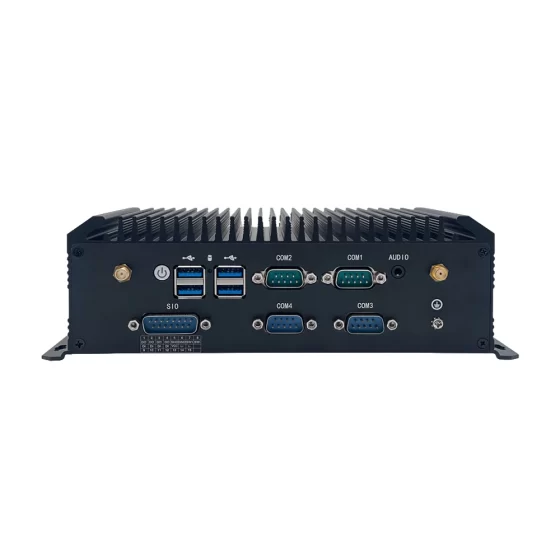
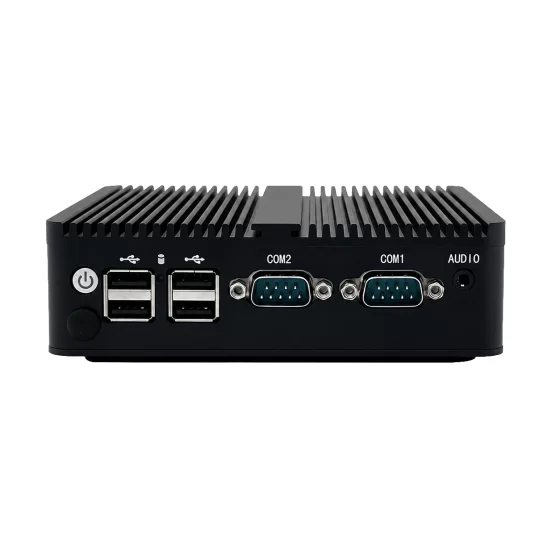
Soluciones de informática industrial CoreIPC

Plataforma de robótica de almacén: Computadora de robótica de almacén para operaciones logísticas automatizadas
Resumen ejecutivo
A warehouse robotics computer provides the industrial computing foundation for AGV and AMR coordination, robot fleet communication, local navigation support, sensor data processing, warehouse automation integration, and real-time logistics visibility.
Modern warehouses increasingly rely on robotic systems to improve picking, clasificación, transporte, reposición, inventory handling, pallet movement, and order fulfillment. AGV, AMR, brazos robóticos, transportadores, sistemas de códigos de barras, Lectores RFID, cámaras industriales, sensores, plataformas WMS, sistemas WCS, and cloud dashboards all need reliable computing and communication.
A warehouse robotics computer built on an industrial computer or embedded computer can connect robots with warehouse infrastructure, procesar datos locales, support fleet coordination, collect device status, redes de segmentos, registros de buffer, and communicate with higher-level warehouse software.
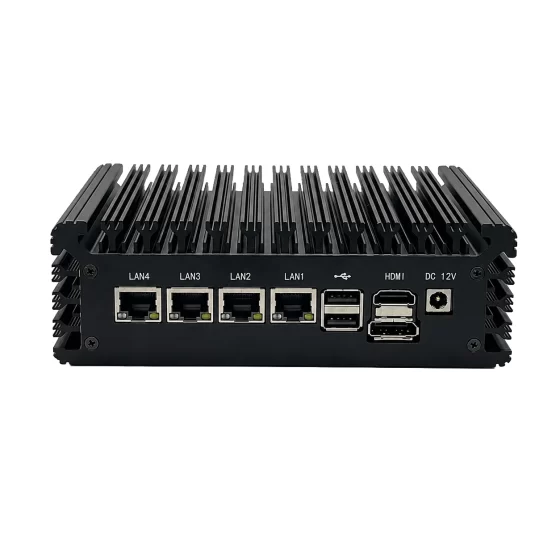
En comparación con PC de oficina estándar o gateways de consumo, industrial computers are better suited for warehouse robotics environments. Soportan instalación robusta, múltiples puertos LAN, comunicación en serie, USB, GPIO, almacenamiento local, opciones de diseño sin ventilador, entrada de energía estable, y disponibilidad de ciclo de vida prolongado.
This article explains how warehouse robotics platforms work, what deployment challenges appear in automated logistics environments, cómo está estructurada la arquitectura de la solución, and which hardware features matter when selecting an industrial computer or embedded computer for warehouse robotics applications.
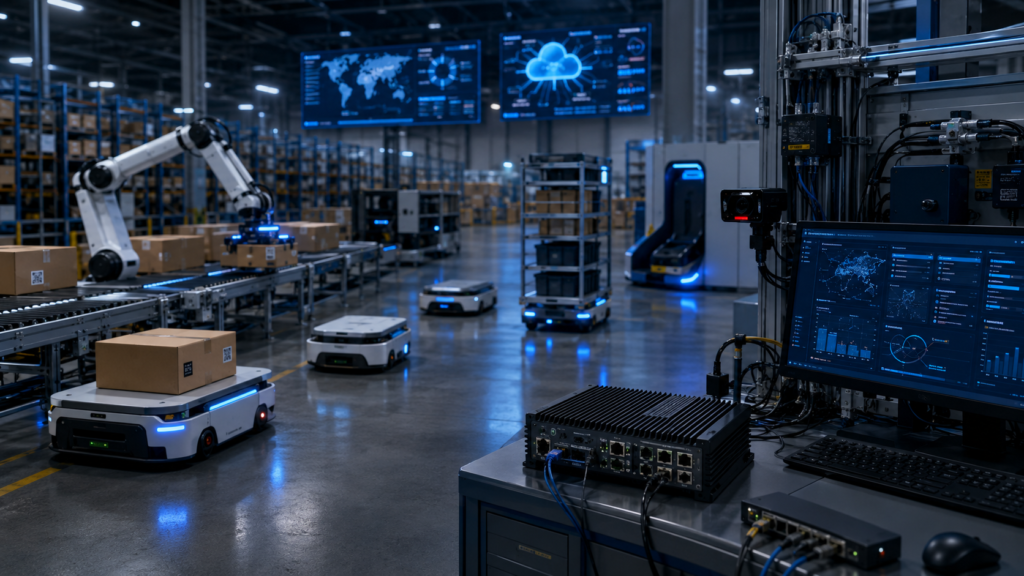
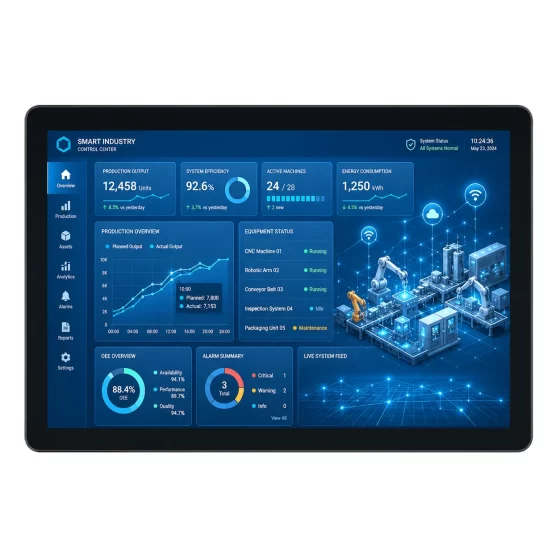
Warehouse robotics computers collect robot, transportador, escáner, RFID, and equipment data for smart logistics platforms.
Descripción general de la industria
Warehouses Are Moving Toward Robotic Automation
Warehouse operations are becoming faster, denser, and more data-driven.
Traditional manual handling is increasingly supported by robots, transportadores, escáneres, and smart warehouse software. These systems help improve efficiency, reduce walking distance, support flexible picking, and increase order processing speed.
Common warehouse robotics systems include:
- AGV
- AMR
- Robotic picking systems
- Robotic palletizing systems
- Conveyor robots
- Sorting robots
- Robots de inspección móviles
- Forklift assistance systems
- Sistemas de almacenamiento automatizados
- Robot charging stations
- Plataformas de gestión de flotas
These systems need reliable edge computing and real-time data exchange.
Warehouse Robots Need Local Computing Infrastructure
Robots do not operate in isolation.
They need to communicate with warehouse control systems, task management platforms, estaciones de carga, escáneres de códigos de barras, sensores, camaras, traffic control zones, access gates, y sistemas de seguridad.
A warehouse robotics computer can act as a local edge platform that connects these systems.
It can support:
- Robot status monitoring
- Fleet data aggregation
- Task communication
- Sensor integration
- Local event processing
- Segmentación de red
- Diagnóstico remoto
- Almacenamiento en búfer de datos
- Warehouse software integration
- Security logging
This makes the computing platform an important part of the robotics infrastructure.
Industrial Computers Support Real Warehouse Deployment
Warehouse environments are not always clean or stable.
Computers may be installed near conveyors, robot charging areas, muelles de carga, líneas de clasificación, gabinetes para equipos, or warehouse racks.
These areas may include dust, vibración, variación de temperatura, poder inestable, tensión del cable, flujo de aire limitado, y funcionamiento continuo.
Las computadoras industriales y las computadoras integradas proporcionan la base de hardware resistente necesaria para estas condiciones..
They help warehouse automation providers build reliable, mantenible, and scalable robot-connected systems.

Multiple robots, transportadores, escáneres, RFID gates, estaciones de carga, transmisiones de cámara, and LAN zones affect warehouse robotics deployment.
Desafíos clave
Coordinating Multiple Robots and Devices
A smart warehouse may include many robots operating at the same time.
Each robot may report position, task status, nivel de batería, fault messages, datos del sensor, and communication status.
The warehouse robotics platform may also need to connect conveyors, puertas, lectores de códigos de barras, camaras, cargadores, and WMS or WCS systems.
This creates a complex data environment.
The computing platform must support stable communication between robots, infraestructura, and warehouse software.
Supporting Real-Time Operational Response
Warehouse robotics often requires fast local response.
A delay in task assignment, zone control, obstacle event handling, or conveyor coordination may reduce efficiency or create operational risk.
Time-sensitive data may include:
- Ubicación del robot
- Task status
- Estado de la batería
- Charging availability
- Conveyor state
- Safety zone events
- Dock activity
- Barcode scan records
- Traffic congestion
- Fault alarms
Edge computing allows important logic to run close to warehouse equipment.
This reduces dependence on remote systems and improves responsiveness.
Integrating with WMS and WCS Platforms
Warehouse robots must work with warehouse software.
A WMS may manage inventory, pedidos, picking tasks, receiving, and shipment records. A WCS may coordinate conveyors, tipo de, robots, escáneres, y equipos de automatización.
The warehouse robotics computer may need to exchange structured data with both systems.
Esto puede incluir:
- Robot task requests
- Pick and place results
- Registros de movimiento de inventario
- Conveyor status
- Ordenar eventos
- Barcode scan data
- Robot fault logs
- Charging station data
- Operation performance records
Reliable software integration depends on stable hardware, almacenamiento local, conectividad de red, and protocol support.
Handling Mixed Interfaces and Systems
Warehouse robotics environments often include equipment from multiple vendors.
Different systems may use Ethernet, USB, comunicación en serie, GPIO, E/S digitales, or wireless modules.
The platform may need to connect:
- Robot fleet controllers
- AGV charging stations
- AMR gateways
- Lectores de códigos de barras
- Lectores RFID
- Conveyor PLCs
- Cámaras industriales
- Sensores de seguridad
- Dispositivos de control de acceso
- Paneles locales
Flexible industrial I/O helps reduce the need for external converters and simplifies deployment.
Maintaining Network Segmentation
Warehouse robotics networks should not always share one flat network.
Robots, escáneres, camaras, WMS servers, office IT devices, remote maintenance systems, and management tools may require separate network zones.
A warehouse robotics computer with multiple LAN ports can help separate:
- Red de robots
- Red de escáner
- Red de cámaras
- Red WMS o WCS
- Red de equipos de almacén
- Red de mantenimiento remoto
- Red de gestión
- Enlace ascendente en la nube
Segmentation improves security, organización del tráfico, and system stability.
Ensuring Continuous Operation
Warehouse robotics systems often run for long hours.
If the computing platform fails, robots may stop receiving tasks, conveyors may lose coordination, dashboards may lose visibility, and maintenance teams may lose diagnostic data.
La implementación confiable requiere:
- Caja robusta
- Opciones de diseño sin ventilador
- Entrada de energía estable
- Almacenamiento confiable
- Montaje seguro
- Estabilidad térmica
- Acceso de recuperación local
- Copia de seguridad de configuración
- Monitoreo remoto
- Soporte de ciclo de vida prolongado
Industrial-grade hardware helps reduce downtime risk.

Warehouse robotics computers connect robot fleets, transportadores, WMS, WCS, plataformas de flota, sistemas en la nube, y bases de datos locales.
Warehouse Robotics Computer Solution Architecture
Robot and Equipment Layer
The robot and equipment layer includes all physical systems involved in warehouse automation.
Esta capa puede incluir:
- AGV
- AMR
- brazos robóticos
- Transportadores
- Sorting lines
- Lectores de códigos de barras
- Lectores RFID
- Cámaras industriales
- Charging stations
- Sensores de seguridad
- Access gates
- Controladores PLC
- HMI locales
These systems generate real-time operational data and require stable communication.
Capa de computación perimetral
La capa de computación de borde es donde opera la computadora industrial o la computadora integrada..
en esta capa, la plataforma puede:
- Collect robot status
- Receive scanner data
- Monitor charging stations
- Procesar eventos locales
- Almacenar registros
- Buffer records
- Admite diagnóstico remoto
- Segment networks
- Forward structured data
- Connect automation devices with warehouse software
This layer provides local computing close to warehouse operations.
Robot Coordination Layer
The robot coordination layer supports communication between robots and control systems.
The platform may exchange:
- Task assignments
- Robot location data
- Estado de la batería
- Route events
- Fault alarms
- Charging requests
- Zone access status
- Conveyor handoff signals
- Pick and delivery confirmations
The goal is to help robots work smoothly with warehouse infrastructure.
Capa de integración de software de almacén
The warehouse robotics computer may connect with higher-level platforms, incluido:
- WMS
- WCS
- ERP
- Sistemas de gestión de flotas
- Paneles de control en la nube
- Bases de datos locales
- Sistemas de mantenimiento
- Sistemas de monitoreo de seguridad
- Plataformas industriales de IoT
This integration allows warehouse managers to track robot activity, inventory movement, estado del equipo, y desempeño operativo.
Capa de seguridad y gestión
The security and management layer helps keep the robotics platform controlled and maintainable.
Puede incluir:
- Segmentación de red
- Acceso remoto seguro
- Políticas de firewall
- Permisos de usuario
- Registro local
- Copia de seguridad de configuración
- Monitoreo del estado del dispositivo
- Monitoreo de almacenamiento
- Diagnóstico remoto
- Gestión de actualizaciones
This layer supports long-term system reliability and safer remote maintenance.
Características clave
Multi-Robot Connectivity
A warehouse robotics platform must support communication with multiple robots and infrastructure systems.
Important connectivity requirements may include:
- Robot fleet network
- Charging station connection
- Conveyor controller connection
- Scanner and RFID integration
- Camera data connection
- WMS or WCS communication
- Acceso de mantenimiento remoto
- Cloud dashboard connection
The system should be sized according to the number of robots, dispositivos, and data flows.
Diseño de red multiLAN
Multiple LAN ports are valuable for warehouse robotics deployment.
They allow different networks to remain separated and controlled.
Las configuraciones útiles pueden incluir:
- Robot LAN
- WMS or WCS LAN
- Camera LAN
- Scanner LAN
- Equipment LAN
- Management LAN
- Remote service LAN
- Enlace ascendente WAN o nube
This improves network organization and helps prevent high-volume traffic from affecting critical robot communication.
Rendimiento del procesamiento perimetral
The platform may need to collect, proceso, almacenar, y reenviar datos continuamente.
La selección de hardware debe considerar:
- rendimiento de la CPU
- Capacidad de memoria
- Robot count
- Recuento de puntos de datos
- Tasa de eventos del escáner
- Carga de trabajo de la cámara
- Carga de trabajo de base de datos local
- Network throughput
- Velocidad de almacenamiento
- Soporte del sistema operativo
Para almacenes más grandes, the platform should be tested with real robot traffic and warehouse software.
Almacenamiento local confiable
El almacenamiento local admite archivos del sistema, registros, robot status records, task events, diagnostic data, upload buffers, y bases de datos locales.
Generalmente se prefiere el almacenamiento SSD o NVMe porque proporciona un acceso rápido y una mejor resistencia a los golpes que las unidades mecánicas..
La planificación del almacenamiento debe considerar:
- Retención de registros
- Robot event records
- Historial de tareas
- Fault data
- Almacenamiento en búfer de datos locales
- Copia de seguridad de configuración
- Escribir resistencia
- Flujo de trabajo de recuperación
Reliable storage improves traceability and maintenance efficiency.
E/S industriales flexibles
Warehouse robotics systems may require different I/O configurations.
Las opciones útiles pueden incluir:
- LAN
- USB
- RS232
- RS485
- GPIO
- Entrada digital
- Salida digital
- hdmi
- DisplayPort
- M.2
- PCIe
- SATA o NVMe
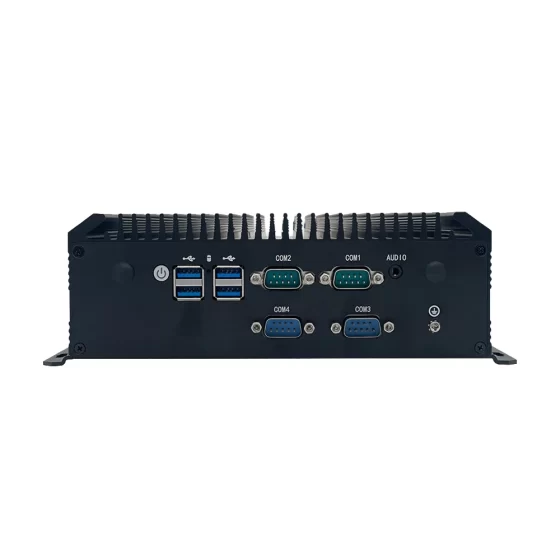
Los puertos serie pueden admitir dispositivos heredados. USB can connect service tools or scanners. GPIO and digital I/O can support alarms, desencadenantes, and device status signals. M.2 and PCIe can support expansion.
Diseño robusto y sin ventilador
Warehouse robotics platforms may be installed in dusty, propenso a vibraciones, or enclosed areas.
Las computadoras industriales sin ventilador reducen la entrada de polvo y eliminan un punto común de falla mecánica.
Los gabinetes resistentes ayudan a proteger contra las vibraciones, tensión del cable, impacto de la instalación, y funcionamiento continuo.
Thermal design should still be reviewed carefully when the system handles continuous communication, local storage writes, and edge processing.
Acceso remoto seguro
Warehouse automation providers often need remote diagnostics.
A warehouse robotics computer can support controlled remote access for engineers, integrators, and maintenance teams.
Remote access should include:
- Autenticación de usuario
- Soporte VPN o túnel seguro
- Permisos de acceso
- Registro de sesión
- Ventanas de mantenimiento
- Segmentación de red
- Copia de seguridad de configuración
- Procedimientos de acceso de emergencia
This supports faster troubleshooting while limiting unnecessary exposure.
Disponibilidad de ciclo de vida prolongado
Warehouse robotics systems may be deployed across many sites and remain in operation for years.
El hardware consistente ayuda a mantener las imágenes del software, robot communication drivers, fleet system integration, piezas de repuesto, y procedimientos de validación.
Long lifecycle availability is important for warehouse automation providers, integradores de sistemas, and logistics operators.
Escenarios de implementación
AGV Fleet Integration
AGV fleets need communication with task systems, traffic rules, estaciones de carga, and warehouse software.
A warehouse robotics computer can collect AGV status, buffer task records, connect infrastructure devices, and forward information to fleet management or WMS systems.
This improves AGV visibility and operational coordination.
AMR Operation Support
AMRs may operate more flexibly than fixed-route AGVs.
They may report maps, posiciones, tasks, battery levels, and obstacle events.
An embedded computer can support local data exchange between AMRs, sensores, warehouse platforms, y paneles de seguimiento.
This supports safer and more reliable AMR deployment.
Robotic Picking Workstations
Robotic picking systems may use cameras, grippers, transportadores, lectores de códigos de barras, and local control systems.
An industrial computer can process equipment data, connect inspection devices, almacenar registros, and communicate with WMS or WCS platforms.
This improves picking automation and traceability.
Conveyor and Robot Handoff
Robots often interact with conveyors, tipo de, loading points, and storage areas.
The warehouse robotics computer can support data exchange between robots and fixed automation systems.
This helps coordinate handoff points and reduces timing conflicts.
Robot Charging Station Monitoring
Robot charging areas are critical to continuous operation.
The platform can monitor charging station status, robot battery events, charger alarms, and usage records.
This helps operators understand fleet readiness and maintenance needs.
Warehouse Safety and Zone Monitoring
Robotic warehouses may require controlled zones for people, robots, montacargas, y equipo.
A computer platform can collect signals from sensors, access controls, dispositivos de seguridad, and robot systems.
This helps improve visibility into zone status and operational events.
Multi-Site Robot Operations
Large logistics operators may deploy robots across many warehouses.
A standardized warehouse robotics platform can collect local site data and send selected information to centralized dashboards.
This supports consistent monitoring, mantenimiento, and performance analysis.
OEM Warehouse Robotics Appliance
Warehouse automation providers can build custom robotics appliances using industrial computers or embedded boards.
The platform can support robot connectivity, device integration, almacenamiento local, acceso remoto, y despliegue robusto.
This helps create repeatable solutions for different customer environments.
Beneficios comerciales
Better Robot Visibility
A warehouse robotics computer helps collect robot status, task progress, nivel de batería, fault records, and operational events.
This gives operators better visibility into robotic warehouse activity.
Improved visibility supports faster decisions and better resource planning.
Improved Automation Coordination
Robots must work with conveyors, escáneres, WMS, WCS, estaciones de carga, e infraestructura de almacén.
A local computing platform helps connect these systems and coordinate data exchange.
This improves automation flow and reduces integration gaps.
Respuesta local más rápida
Edge computing allows important events to be processed near the warehouse floor.
Robot alerts, eventos del escáner, charging issues, and equipment status changes can be handled locally.
This reduces response delay and improves operational stability.
Riesgo de tiempo de inactividad reducido
Industrial computers provide rugged hardware for long-running warehouse robotics systems.
Opciones de diseño sin ventilador, almacenamiento confiable, entrada de energía estable, and secure mounting help reduce maintenance risk.
This supports continuous logistics operations.
Organización de red más sólida
Multi-LAN warehouse robotics platforms help separate robot networks, redes de escáner, redes de cámaras, WMS or WCS systems, y acceso de mantenimiento remoto.
This improves security and reduces unnecessary traffic interference.
A structured network supports scalable automation.
Scalable Robotics Deployment
A standardized warehouse robotics computer platform makes it easier to deploy similar systems across many zones, almacenes, y sitios de clientes.
El hardware consistente simplifica las imágenes de software, plantillas de configuración, planificación de repuestos, entrenamiento de mantenimiento, y gestión del ciclo de vida.
This supports long-term warehouse robotics expansion.
Por qué CoreIPC
CoreIPC proporciona plataformas informáticas industriales para robótica, IoT industrial, visión artificial, IA de vanguardia, automatización industrial, e integración de sistemas integrados. For warehouse robotics computer applications, CoreIPC se centra en hardware informático industrial confiable, soluciones informáticas integradas, configuraciones de LAN múltiple, comunicación en serie, E/S flexibles, diseño de sistema compacto, opciones de implementación sin ventilador, capacidad de almacenamiento local, y soporte de personalización OEM/ODM. CoreIPC helps warehouse automation providers, robot system integrators, y los operadores logísticos seleccionan plataformas informáticas que se ajusten a los requisitos reales de implementación, including robot count, interfaces de dispositivos, carga de trabajo de datos, Recuento de puertos LAN, necesidades de almacenamiento, métodos de montaje, entrada de energía, condiciones termicas, y planificación del ciclo de vida.
Preguntas frecuentes
1. What is a warehouse robotics computer?
A warehouse robotics computer is an industrial computing platform used to connect, monitor, and support robotic warehouse systems.
It may communicate with AGVs, AMR, transportadores, escáneres, estaciones de carga, sensores, plataformas WMS, sistemas WCS, and local dashboards. It helps collect data, procesar eventos, almacenar registros, and support automation coordination.
2. Why use an industrial computer for warehouse robotics?
An industrial computer provides rugged hardware and flexible connectivity for warehouse deployment.
Puede admitir múltiples puertos LAN, comunicación en serie, USB, GPIO, almacenamiento local, operación sin ventilador, montaje industrial, entrada de energía estable, y disponibilidad de ciclo de vida prolongado. These features make it suitable for robot zones, áreas transportadoras, gabinetes, y sistemas de borde de almacén.
3. How is an embedded computer used in warehouse robotics?
An embedded computer can act as a compact local edge platform near robots or automation equipment.
It can collect robot data, procesar eventos locales, connect scanners and sensors, almacenar registros, communicate with WMS or WCS systems, y soporte de diagnóstico remoto.
4. What robots can be supported by a warehouse robotics platform?
A warehouse robotics platform may support AGVs, AMR, robotic picking systems, brazos robóticos, conveyor robots, sorting robots, mobile inspection robots, and automated transport systems.
The exact support depends on robot communication interfaces, software integration, diseño de red, y requisitos de aplicación.
5. Why are multiple LAN ports important for warehouse robotics?
Multiple LAN ports help separate robot networks, equipo de almacén, escáneres, camaras, WMS or WCS systems, management traffic, y acceso de mantenimiento remoto.
This improves network clarity and reduces the chance that high-volume or non-critical traffic affects robot communication.
6. Can warehouse robotics computers support AGV and AMR systems?
Sí. Warehouse robotics computers can support AGV and AMR systems by collecting status data, connecting fleet systems, monitoring charging stations, exchanging task records, and forwarding operational data to warehouse platforms.
They can also support local buffering and remote maintenance.
7. What hardware features matter for warehouse robotics computers?
Las características importantes incluyen múltiples puertos LAN, RS232, RS485, USB, GPIO, E/S digitales, memoria confiable, Almacenamiento SSD o NVMe, recinto resistente, diseño sin ventilador, entrada de energía industrial, salida de pantalla, M.2, PCIe, y opciones de expansión.
The final configuration should match robot count, interfaces de dispositivos, carga de trabajo de datos, y entorno de instalación.
8. Can warehouse robotics computers connect with WMS and WCS platforms?
Sí. A warehouse robotics computer can exchange structured data with WMS and WCS platforms.
It may send robot status, task results, scanner records, eventos transportadores, charging data, fault logs, and equipment status records to warehouse software systems.
9. Can fanless computers support warehouse robotics workloads?
Sí. Fanless industrial computers can support many warehouse robotics workloads because they reduce dust intake and remove one common mechanical failure point.
Sin embargo, thermal design should be reviewed when the system handles continuous robot communication, bases de datos locales, camera data, or edge processing.
10. Qué se debe probar antes de la implementación?
Antes del despliegue, the platform should be tested with real robots, escáneres, transportadores, estaciones de carga, topología de red, software de almacén, tarifas de datos, comportamiento de almacenamiento, y operación de larga duración.
Estabilidad térmica, diagnóstico remoto, segmentación de red, procedimientos de recuperación, and integration with WMS or WCS should also be validated.
Conclusión
A warehouse robotics computer is a practical foundation for AGV and AMR coordination, robot fleet visibility, smart warehouse automation, conveyor integration, scanner data collection, charging station monitoring, and warehouse software connectivity.
By placing an industrial computer or embedded computer near warehouse robotics systems, automation providers and logistics operators can connect robots, escáneres, transportadores, sensores, estaciones de carga, plataformas WMS, sistemas WCS, paneles de control en la nube, y herramientas de mantenimiento a través de rutas de comunicación confiables y controladas.
The right warehouse robotics platform should be selected according to real deployment requirements, including robot count, interfaces de dispositivos, Diseño de puerto LAN, carga de trabajo de datos, configuración de almacenamiento, política de acceso remoto, método de montaje, entrada de energía, condiciones termicas, soporte del sistema operativo, y planificación del ciclo de vida.
CoreIPC supports warehouse robotics computer projects with industrial computing platforms designed for practical logistics, robot, borde, gabinete, y despliegue OEM. Con la base de hardware adecuada, Los operadores de almacenes y los proveedores de automatización pueden crear sistemas confiables., escalable, and data-driven robotic logistics systems.
Contáctenos
Busco ordenador industrial, computadora integrada, or edge platform for warehouse robotics deployment?
Póngase en contacto con CoreIPC para analizar los requisitos de su proyecto., including robot count, interfaces de dispositivos, Configuración del puerto LAN, WMS or WCS integration, carga de trabajo de datos, diseño de almacenamiento, método de montaje, entrada de energía, entorno operativo, necesidades del ciclo de vida, y opciones de personalización OEM/ODM.