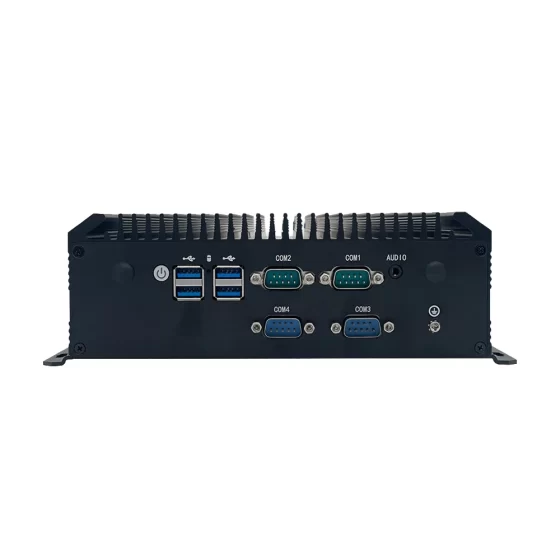
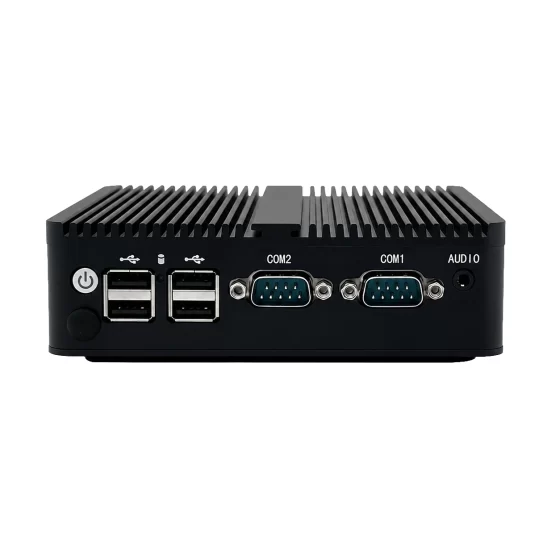
CoreIPC 산업용 컴퓨팅 솔루션

AMR 로봇용 컴퓨터
요약
Autonomous Mobile Robots (AMR) 제조업을 빠르게 변화시키고 있습니다, 창고, 기호 논리학, 건강 관리, 유통 운영. 기존의 자동 가이드 차량과 달리 (AGV), 미리 정의된 경로를 따르는, AMR은 고급 센서를 사용하여 동적으로 탐색합니다., 인공지능, 머신 비전, 실시간 의사결정 알고리즘.
모든 AMR 시스템의 중심에는 센서 데이터 처리를 담당하는 고성능 컴퓨팅 플랫폼이 있습니다., 현지화 수행, 탐색 알고리즘 실행, 모션 시스템 제어, 차량 관리 소프트웨어와 통신. 이러한 까다로운 워크로드에는 까다로운 환경에서도 지속적으로 작동할 수 있는 안정적인 산업용 등급 컴퓨팅 하드웨어가 필요합니다..
AMR 컴퓨터는 로봇의 지능형 제어 센터 역할을 합니다.. LiDAR 센서의 데이터를 통합합니다., 카메라, IMU, 인코더, 초음파 센서, 환경을 실시간으로 이해하는 무선 통신 시스템. 컴퓨터는 지속적으로 주변 환경을 분석합니다., 노선을 계획하다, 장애물을 피한다, 로봇 동작을 조정합니다..
산업으로서 4.0 스마트 물류는 계속 진화하고 있습니다, AMR deployments are expanding worldwide. This article explores the role of industrial computers in AMR systems, key technical requirements, deployment architectures, and how embedded computing platforms support autonomous mobile robotics applications.
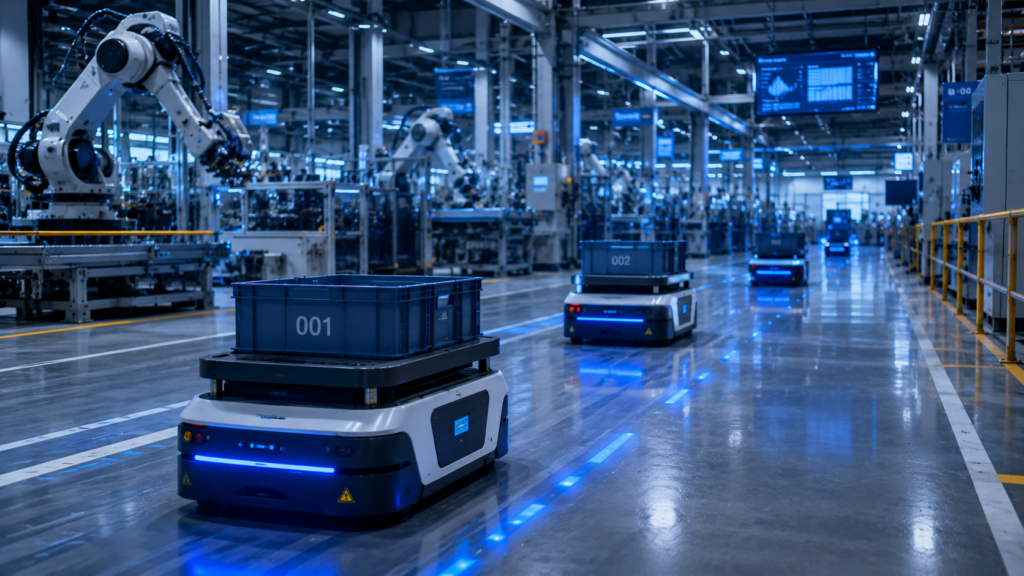
AMR computers enable autonomous mobile robots to perform intelligent material transport, fleet coordination, and logistics automation in Industry 4.0 manufacturing environments.
산업 개요
The Rise of Autonomous Mobile Robots
Manufacturers and logistics providers are increasingly adopting AMRs to automate material transportation and improve operational efficiency.
일반적인 응용 프로그램은 다음과 같습니다:
- Warehouse automation
- Manufacturing logistics
- Hospital delivery systems
- E-commerce fulfillment
- Airport logistics
- Distribution centers
- Smart factories
AMRs improve productivity while reducing manual transportation tasks.
From AGV to AMR
Traditional AGVs typically rely on:
- Magnetic strips
- QR 코드
- Fixed pathways
- Predefined routes
AMRs operate differently.
Modern AMRs utilize:
- SLAM navigation
- LiDAR mapping
- AI perception
- Dynamic path planning
- Autonomous decision-making
These capabilities require significantly greater computing performance.
Robotics and Industry 4.0
AMRs have become essential components of Industry 4.0 ecosystems.
They connect with:
- Manufacturing Execution Systems (MES)
- Warehouse Management Systems (WMS)
- Enterprise Resource Planning (ERP)
- Fleet management software
- Cloud platforms
creating highly connected automation environments.
주요 과제
Real-Time Navigation
AMRs must continuously analyze their surroundings while moving.
Critical functions include:
- Localization
- Mapping
- Path planning
- Motion control
- Collision avoidance
Computing delays can directly impact operational safety.
Sensor Fusion Complexity
Modern AMRs integrate multiple sensors simultaneously.
Typical sensors include:
- LiDAR
- Stereo cameras
- Depth cameras
- IMU
- 인코더
- Ultrasonic sensors
The AMR computer must process and combine all sensor data in real time.
Dynamic Environment Adaptation
Industrial facilities constantly change.
AMRs encounter:
- Personnel
- Forklifts
- Equipment
- Pallets
- Temporary obstacles
Navigation systems must adapt instantly.
AI Processing Requirements
Many AMRs use AI for:
- Object detection
- Human recognition
- Obstacle classification
- Route optimization
These workloads require powerful edge computing capabilities.
Wireless Connectivity
AMRs must communicate continuously with:
- Fleet management systems
- Warehouse systems
- Manufacturing systems
- Cloud platforms
Reliable connectivity is essential.
Continuous Operation
Many AMRs operate:
- 24/7
- Multi-shift environments
- Mission-critical facilities
requiring highly reliable computing hardware.
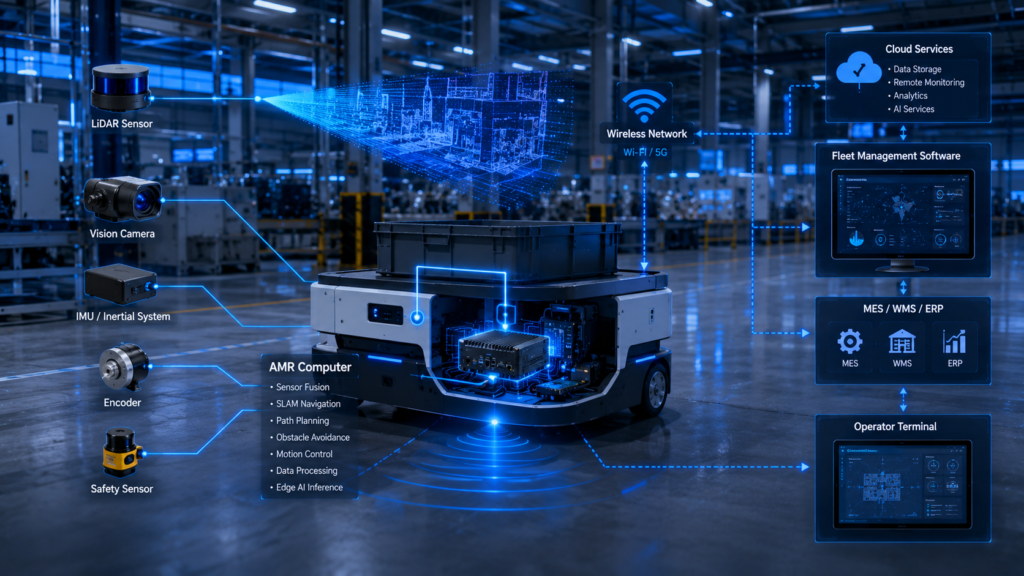
AMR computer architecture integrating sensor fusion, SLAM navigation, 머신 비전, 차량 관리, and enterprise systems for autonomous mobile robot operation.
Solution Architecture
AMR System Architecture
Perception Layer
Environmental information is collected through:
- LiDAR sensors
- 산업용 카메라
- Ultrasonic sensors
- IMU
- 인코더
These devices provide real-time environmental awareness.
Computing Layer
The AMR computer performs:
- Sensor fusion
- Localization
- Mapping
- AI 추론
- Navigation control
- Obstacle avoidance
This layer serves as the robot’s central intelligence platform.
Motion Control Layer
Navigation commands are transmitted to:
- Motor controllers
- Steering systems
- Drive units
- 안전 시스템
to control robot movement.
Connectivity Layer
Communication technologies include:
- 이더넷
- Wi-Fi
- 5G
- MQTT
- OPC UA
for system integration and remote management.
Fleet Management Layer
Enterprise software coordinates:
- Robot assignments
- Traffic management
- Mission scheduling
- Performance monitoring
across multiple robots.
주요 특징
1. High-Performance Processing
AMR computers provide the computing resources required for navigation and robotics applications.
2. LiDAR Integration
Support for LiDAR sensors enables accurate mapping and localization.
3. Machine Vision Processing
Industrial cameras support:
- 객체 인식
- Visual navigation
- Safety monitoring
- AI perception
functions.
4. Sensor Fusion
Multiple sensor inputs are combined to improve environmental awareness and navigation accuracy.
5. Real-Time Decision Making
AMRs continuously analyze conditions and respond to environmental changes.
6. Edge AI Capability
AI acceleration supports:
- Object detection
- Human tracking
- Behavioral analysis
- Intelligent robotics
applications.
7. 컴팩트한 임베디드 디자인
AMR computers fit within mobile robot chassis without consuming excessive space.
8. Fanless Reliability
Fanless systems reduce maintenance requirements and improve reliability.
9. Wireless Connectivity
Support for Wi-Fi and 5G enables real-time communication.
Recommended CoreIPC Products
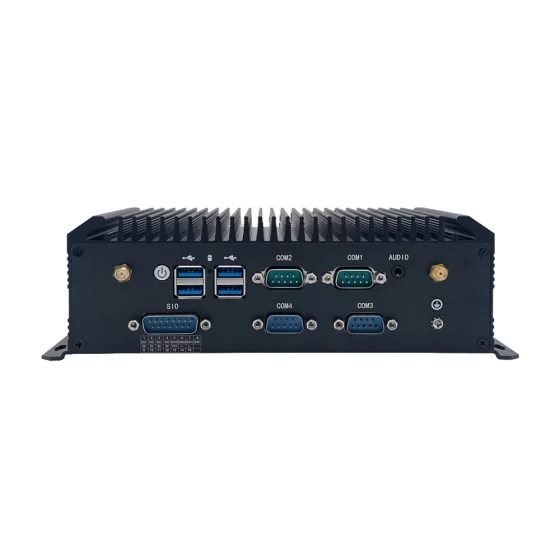
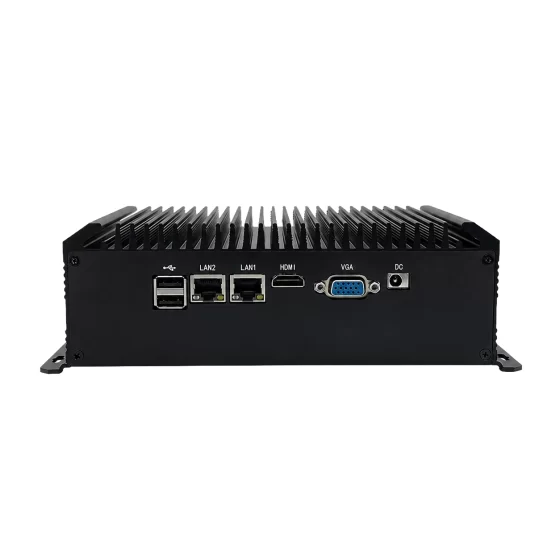
임베디드 컴퓨터
Ideal for:
- Compact AMRs
- Service robots
- Mobile robotics
Benefits:
- Small footprint
- Low power consumption
- Flexible installation
Fanless Industrial PCs
Ideal for:
- Industrial AMRs
- Warehouse robots
- Manufacturing automation
Benefits:
- Rugged construction
- 팬리스 냉각
- Long-term reliability
엣지 AI 컴퓨터
Ideal for:
- AI-powered navigation
- Vision-guided robotics
- 객체 인식
Benefits:
- GPU acceleration
- Real-time AI inference
- Machine vision processing
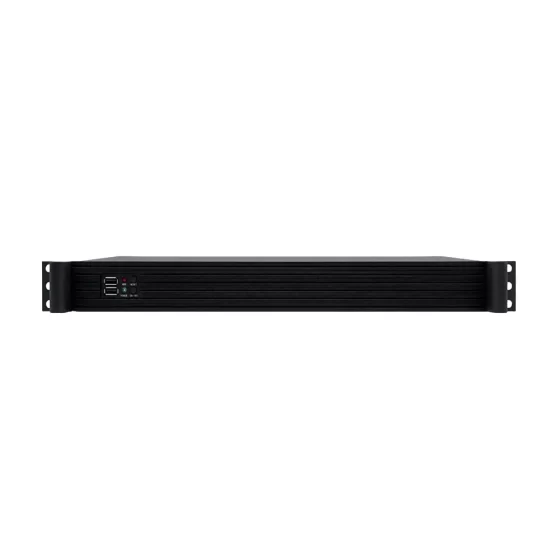
산업용 PC
Ideal for:
- High-performance robotics
- Multi-sensor platforms
- Autonomous navigation
Benefits:
- Expansion flexibility
- Processing performance
- Rich I/O connectivity
Mini-ITX 마더보드
Ideal for:
- Robotics OEM projects
- Custom AMR development
Benefits:
- Flexible integration
- Long lifecycle support
배포 시나리오
Warehouse Automation
AMRs transport:
- Inventory
- Packages
- Materials
through automated warehouse environments.
스마트 제조
Robots deliver:
- Components
- Raw materials
- Finished products
between production stations.
Healthcare Logistics
Hospitals use AMRs to transport:
- Medical supplies
- Pharmaceuticals
- Laboratory samples
efficiently and safely.
E-Commerce Fulfillment
AMRs improve:
- Order picking
- Inventory movement
- Package handling
in fulfillment centers.
Airport Operations
AMRs support:
- Baggage handling
- Equipment transport
- Logistics automation
across transportation facilities.
Service Robotics
AMRs are increasingly used in:
- Hotels
- Commercial buildings
- Public facilities
to provide automated services.
비즈니스 이점
Improved Productivity
AMRs automate repetitive transportation tasks and improve workflow efficiency.
Reduced Labor Costs
Organizations reduce dependence on manual transportation resources.
Enhanced Safety
Autonomous navigation helps reduce workplace transportation risks.
Greater Flexibility
AMRs can adapt to changing layouts without fixed infrastructure.
Better Scalability
Additional robots can be deployed as operational requirements grow.
Increased Operational Visibility
Fleet management systems provide real-time performance monitoring.
왜 CoreIPC인가?
CoreIPC provides industrial computing platforms designed for robotics, AMR systems, 자율 항법, and intelligent automation applications.
CoreIPC capabilities include:
- Industrial computer development
- Embedded system design
- OEM manufacturing
- ODM 맞춤화
- Long lifecycle support
- Industrial-grade reliability
- Edge AI integration
- Global deployment experience
Whether developing warehouse robots, industrial AMRs, healthcare logistics systems, or intelligent service robots, CoreIPC delivers reliable computing platforms for autonomous mobile robotics applications.
자주 묻는 질문
1. What is an AMR computer?
An AMR computer is the central computing platform used to control navigation, localization, 센서 처리, AI 추론, and motion control within an autonomous mobile robot.
2. What is the difference between AMR and AGV?
AGVs follow predefined routes, while AMRs navigate dynamically using sensors and intelligent navigation algorithms.
3. What sensors are commonly used in AMRs?
LiDAR, 카메라, IMU, 인코더, 초음파 센서, and depth cameras are commonly deployed.
4. What is SLAM?
SLAM stands for Simultaneous Localization and Mapping, enabling AMRs to build maps while determining their position.
5. Why is sensor fusion important?
Sensor fusion improves navigation accuracy by combining information from multiple sensor types.
6. Can AMRs use AI?
예. AI is widely used for object detection, obstacle recognition, route optimization, and environmental awareness.
7. Are fanless computers suitable for AMRs?
예. Fanless designs improve reliability and reduce maintenance.
8. What networking technologies are commonly used?
이더넷, Wi-Fi, and 5G are commonly used for communication and fleet management.
9. Can AMR computers support machine vision?
예. Many AMRs use industrial cameras and machine vision software for navigation and perception.
10. What industries use AMRs?
Manufacturing, 기호 논리학, 창고, 건강 관리, airports, 환대, and retail industries commonly deploy AMRs.
11. What is fleet management?
Fleet management software coordinates multiple robots and optimizes task assignments.
12. What should be considered when selecting an AMR computer?
Processing performance, AI capability, 연결성, 신뢰할 수 있음, expansion options, and lifecycle support are important considerations.
결론
AMR computers are the intelligent core of autonomous mobile robotics systems. By enabling sensor fusion, real-time navigation, AI 처리, 장애물 회피, and fleet communication, industrial computing platforms allow AMRs to operate safely and efficiently in dynamic environments. As robotics adoption accelerates across manufacturing, 기호 논리학, 건강 관리, and commercial sectors, selecting the right industrial computer becomes critical for achieving reliable and scalable autonomous operations.
문의하기
Looking for a Computer for AMR Robots?
CoreIPC provides computing platforms for:
- Autonomous Mobile Robots
- Mobile Robotics
- Warehouse Automation
- 스마트 제조
- Edge AI Robotics
- Machine Vision Systems
- OEM Projects
- ODM Projects
- Custom Robotics Hardware Development
Contact CoreIPC today to discuss your AMR project requirements and identify the ideal computing platform for your autonomous robotics deployment.