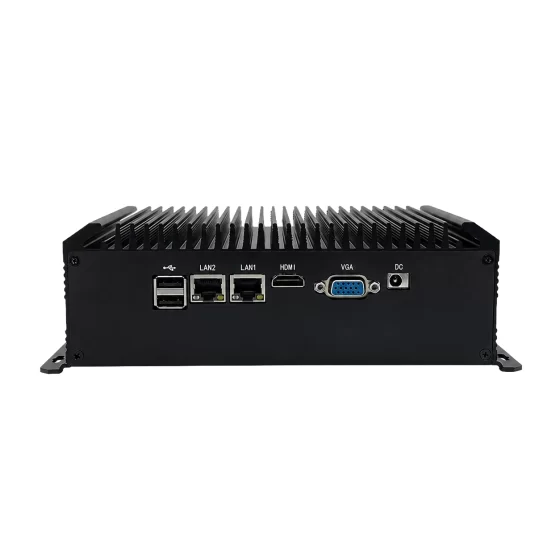
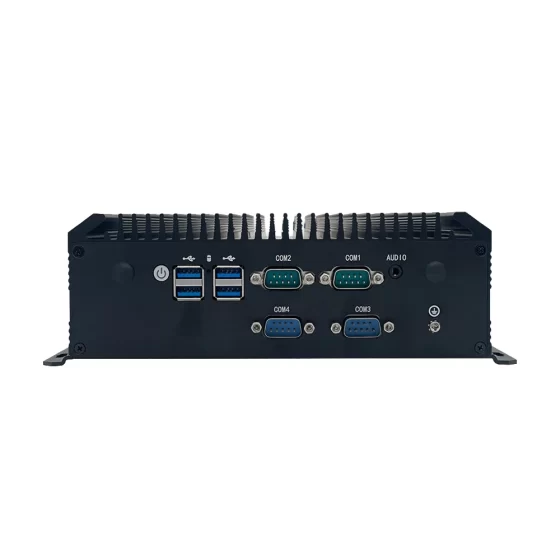
CoreIPC Industrial Computing-Lösungen

Cobot Embedded IPC: Cobot Embedded IPC für kollaborative Roboterautomatisierung
Zusammenfassung
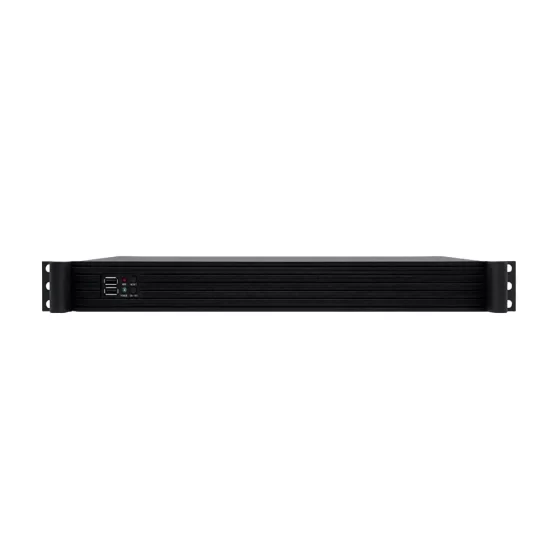
A cobot embedded ipc provides the industrial computing foundation for collaborative robot control support, maschinelles Sehen, Sensordatenverarbeitung, Edge-KI-Inferenz, Sicherheitsüberwachung, human-machine interaction, und Fabriksystemintegration.
Collaborative robots are widely used in modern manufacturing, Logistik, Elektronikbaugruppe, Verpackung, machine tending, Inspektion, and laboratory automation. Unlike traditional industrial robots that often operate behind safety cages, cobots are designed to work closer to human operators and adapt to flexible production environments.
This creates new computing requirements.
A cobot embedded ipc built on an industrial computer or embedded computer can connect robot controllers, vision cameras, force sensors, Greifer, Sicherheitsvorrichtungen, SPS, HMIs, Förderer, und Fabriksoftwaresysteme. It can process local data, run edge logic, support visual guidance, store operation records, und Informationen mit MES austauschen, SCADA, industrielle IoT-Plattformen, oder Cloud-Dashboards.
Im Vergleich zu Standard-Büro-PCs oder Consumer-Embedded-Boards, industrial computing platforms are better suited for cobot deployment because they support rugged installation, kompaktes Design, mehrere LAN- und USB-Schnittstellen, serielle Kommunikation, GPIO, zuverlässige Lagerung, lüfterlose Betriebsmöglichkeiten, stabile strom eingang, und lange Verfügbarkeit über den gesamten Lebenszyklus.
This article explains how cobot embedded IPC systems support collaborative robot automation, what deployment challenges appear in real production environments, wie die Lösungsarchitektur funktioniert, and which hardware features matter when selecting an industrial computer or embedded computer for cobot applications.
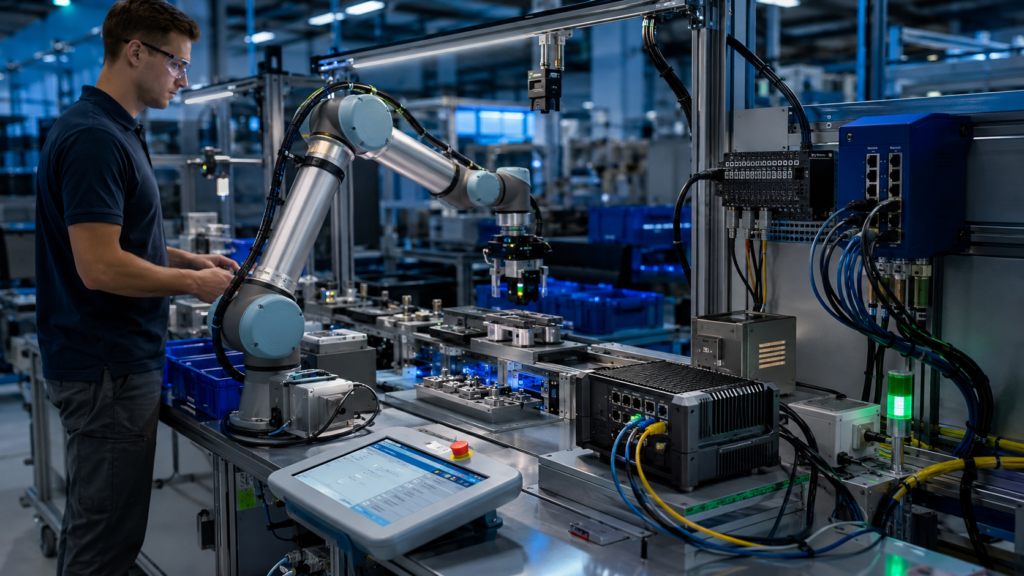
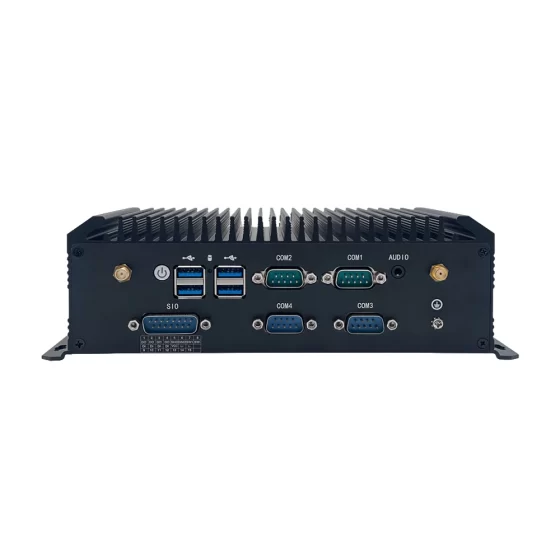
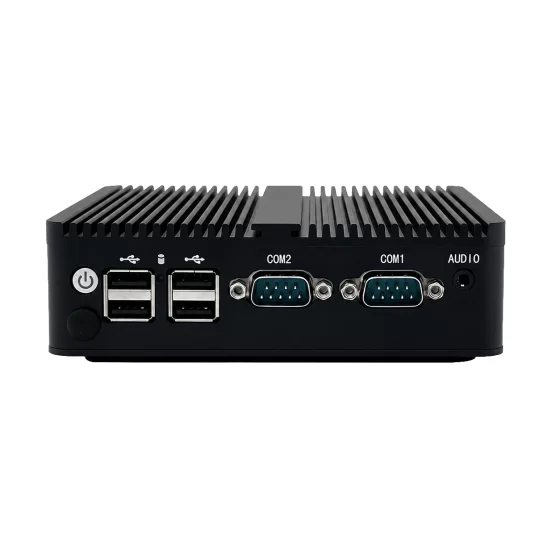
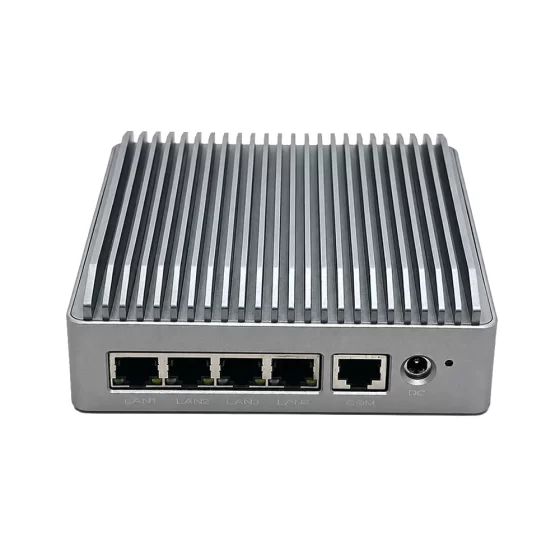
Cobot embedded IPC platforms process robot status, vision data, sensor signals, gripper status, and workcell events.
Branchenüberblick
Collaborative Robots Are Expanding Across Factories
Collaborative robots are becoming an important part of flexible automation.
They are used when manufacturers need automation that can be deployed faster, occupy less space, and work near operators. Cobots can support repetitive tasks, light assembly, screwdriving, Abgabe, Inspektion, Laden, unloading, Sortierung, Verpackung, and testing.
Common cobot applications include:
- Machine tending
- Pick-and-place
- Assembly assistance
- Screwdriving
- Gluing and dispensing
- Product inspection
- Packaging and palletizing
- Laborautomatisierung
- Electronic component handling
- Material transfer
- Vision-guided operation
- Qualitätsüberprüfung
These applications often require more than basic robot motion.
They need local computing, Gerätekonnektivität, real-time data handling, Sehverarbeitung, und Fabrikintegration.
Cobots Need Compact Edge Computing
Cobots are often installed in compact workcells.
The computing platform may need to fit inside a small cabinet, robot base, Maschinengehäuse, Arbeitsplatz, or mobile automation cart.
A cobot embedded IPC can serve as the local computing node for the workcell.
Es kann unterstützen:
- Roboterkommunikation
- Vision camera processing
- Gripper control
- Force sensor data
- Safety device monitoring
- PLC signal exchange
- Local HMI dashboard
- Edge-KI-Inferenz
- Datenprotokollierung
- Ferndiagnose
- MES- oder SCADA-Integration
The goal is to make the cobot cell smarter, more connected, and easier to maintain.
Industrial Computers Provide Long-Term Reliability
Cobot workcells may operate continuously in production environments.
Sie können Staub ausgesetzt sein, Vibration, Temperaturschwankungen, elektrisches Rauschen, begrenzter Schrankraum, and frequent operator interaction.
Industrial computers and embedded computers provide the hardware reliability required for these conditions.
They support stable operation, flexible I/O, robuste Montage, zuverlässige Lagerung, lange Verfügbarkeit über den gesamten Lebenszyklus, and compatibility with industrial control environments.

Compact workcells, Kameras, Sensoren, Greifer, SPS-Signale, Sicherheitsvorrichtungen, and real-time requirements affect cobot IPC deployment.
Wichtigste Herausforderungen
Integrating Multiple Devices in a Small Workcell
A collaborative robot system may include many devices around one compact automation cell.
Dazu können gehören:
- Cobot controller
- Industrial camera
- 3D vision sensor
- Force torque sensor
- Electric gripper
- Vacuum gripper
- SPS
- HMI
- Conveyor controller
- Safety scanner
- Barcode reader
- Digital I/O module
- Local display
- Industrial switch
The embedded IPC must connect these devices reliably while fitting into limited space.
This requires compact hardware, flexible I/O, and well-organized cabling.
Supporting Real-Time Robot Interaction
Cobots may need to respond quickly to sensor signals, vision results, Bedieneraktionen, und Prozessereignisse.
Latency can affect productivity and safety-related workflow design.
Time-sensitive events may include:
- Vision-guided positioning
- Part presence detection
- Force feedback
- Gripper status
- Conveyor handoff
- Safety zone signal
- Barcode confirmation
- Product inspection result
- Operator command
- Alarm event
The computing platform must process local data quickly and communicate reliably with robot and automation systems.
Handling Vision and AI Workloads
Many cobot applications use cameras.
Vision may help the robot identify parts, guide motion, Produkte prüfen, Etiketten lesen, Montage überprüfen, or detect defects.
Some applications also use edge AI for object detection, Einstufung, Posenschätzung, oder Anomalieerkennung.
Hardware requirements depend on:
- Anzahl der Kameras
- Bildauflösung
- Bildrate
- Komplexität des KI-Modells
- Inspektionszykluszeit
- Speicheranforderungen
- Robot communication latency
- Software framework compatibility
The IPC should be selected based on the real vision workload.
Ensuring Safe and Controlled Human-Robot Collaboration
Cobots are designed for collaborative environments, but the full workcell still requires careful system design.
The embedded IPC may not replace certified safety controllers, but it can support monitoring, Protokollierung, Visualisierung, Diagnostik, and data exchange around safety-related devices.
It may connect to:
- Safety scanners
- Light curtains
- Emergency stop circuits
- Door sensors
- Zone sensors
- Robot status signals
- Operator panels
- Alarm outputs
The platform should support stable signal handling, event logging, and clear communication with the control system.
Connecting Cobots with Factory Systems
Cobot cells should not remain isolated.
Manufacturers often need to connect cobot operation data with MES, SCADA, Qualitätssysteme, maintenance systems, oder industrielle IoT-Plattformen.
The embedded IPC may collect:
- Zyklus zählt
- Robot status
- Tool status
- Inspektionsergebnisse
- Fehlerprotokolle
- Product IDs
- Barcode-Datensätze
- Prozesswerte
- Betreiberveranstaltungen
- Maintenance records
Structured data helps improve production visibility and traceability.
Maintaining Long-Term System Stability
Cobot cells may be deployed across many production lines or customer sites.
Frequent hardware changes can create problems with drivers, Kamera-SDKs, Roboterkommunikationssoftware, KI-Laufzeiten, Betriebssysteme, und Validierungsverfahren.
Industrial embedded IPC platforms with lifecycle planning help reduce redesign work and simplify long-term maintenance.

Cobot IPC systems connect robot controllers, Kameras, Sensoren, Greifer, SPS, HMIs, MES, SCADA, und Qualitätssysteme.
Cobot Embedded IPC Solution Architecture
Cobot Workcell Device Layer
The device layer includes the physical systems inside and around the collaborative robot workcell.
Diese Schicht kann umfassen:
- Collaborative robot arm
- Cobot controller
- Grippers
- Force torque sensors
- Industriekameras
- 3D vision sensors
- Beleuchtungssteuerungen
- Safety scanners
- Barcode-Lesegeräte
- SPS
- Förderer
- Operator panels
- Lokale HMIs
Diese Systeme erzeugen Steuersignale, Sensordaten, visual information, und Produktionsveranstaltungen.
Embedded IPC Edge Layer
The embedded IPC edge layer is the local computing layer.
Auf dieser Ebene, B. der Industriecomputer oder der eingebettete Computer:
- Sammeln Sie Sensordaten
- Kamerabilder verarbeiten
- Run edge AI models
- Exchange data with robot controllers
- Kommunizieren Sie mit SPSen
- Store local logs
- Buffer operation records
- Support local HMI functions
- Manage device communication
- Forward structured data to factory systems
This layer provides local intelligence for the cobot workcell.
Robot and Motion Integration Layer
The robot integration layer connects computing results with cobot motion and automation logic.
The IPC may exchange:
- Object coordinates
- Pick position data
- Tool status
- Inspektionsergebnisse
- Trigger signals
- Robot state
- Cycle completion status
- Fault records
- Operator commands
- Prozessparameter
Stable communication with the robot controller and PLC is essential for reliable automation.
Vision and AI Processing Layer
The vision and AI layer turns image data into usable automation results.
The platform may support:
- Objekterkennung
- Part localization
- Pose estimation
- Fehlererkennung
- Etikettenlesung
- Überprüfung der Montage
- Oberflächeninspektion
- Pick point calculation
- Quality classification
- Image record storage
Local processing helps reduce latency and improves cobot workcell responsiveness.
Factory-Software-Integrationsschicht
The embedded IPC may connect the cobot cell with higher-level systems.
Dazu können gehören:
- MES
- SCADA
- ERP
- Qualitätsdatenbanken
- Industrielle IoT-Plattformen
- Lokale Dashboards
- Wartungssysteme
- Cloud-Überwachungssysteme
- Rückverfolgbarkeitsplattformen
This integration allows cobot activity to become part of the broader factory data infrastructure.
Sicherheits- und Verwaltungsschicht
The security and management layer supports stable long-term deployment.
Es kann Folgendes umfassen::
- Netzwerksegmentierung
- Sicherer Fernzugriff
- Benutzerberechtigungen
- Lokale Protokollierung
- Konfigurationssicherung
- Überwachung des Gerätezustands
- Speicherüberwachung
- Ferndiagnose
- Software-Update-Management
This layer helps operators and system integrators maintain cobot systems efficiently.
Hauptmerkmale
Kompaktes eingebettetes Design
Cobot workcells often have limited installation space.
A compact embedded IPC can fit inside a control cabinet, robot base, Arbeitsplatz, or machine enclosure.
Compact design helps reduce system footprint while still providing enough computing power for robot communication, Datenverarbeitung, und Fabrikintegration.
For OEM cobot systems, compact hardware also improves product integration and enclosure flexibility.
Konnektivität für mehrere Geräte
A cobot embedded IPC must support different devices and communication interfaces.
Zu den nützlichen E/A-Optionen können gehören:
- LAN
- USB
- RS232
- RS485
- GPIO
- Digitaler Eingang
- Digitaler Ausgang
- HDMI
- DisplayPort
- M.2
- PCIe
- SATA- oder NVMe-Speicher
Diese Schnittstellen unterstützen Kameras, Sensoren, Greifer, SPS, HMIs, Barcode-Lesegeräte, Beleuchtungssteuerungen, and local service tools.
Camera and Vision Support
Many cobot systems require camera input.
The IPC may connect to industrial cameras through GigE LAN, USB, oder Erweiterungsmodule.
Camera support should be planned according to:
- Anzahl der Kameras
- Schnittstellentyp
- Auflösung
- Bildrate
- Lichtsteuerung
- Trigger signals
- Speicheranforderungen
- Vision software compatibility
For AI-based vision, processing performance and thermal design are also important.
Edge AI and Local Processing
Some cobot applications need local AI inference.
The embedded IPC may run models for object detection, Fehlerklassifizierung, Posenschätzung, OCR, Barcode-Lesung, oder Anomalieerkennung.
Die Auswahl der Hardware sollte berücksichtigt werden:
- CPU-Leistung
- GPU- oder KI-Beschleunigerunterstützung
- Speicherkapazität
- Modellgröße
- Inferenzgeschwindigkeit
- Software framework support
- Thermal conditions
- Long-running workload
Edge AI reduces dependence on remote servers and improves response time.
Multi-LAN-Netzwerkdesign
Mehrere LAN-Ports helfen dabei, verschiedene Kommunikationspfade zu trennen.
A cobot IPC may use separate networks for:
- Robot controller
- Kameranetzwerk
- SPS-Netzwerk
- Fabrik-IT-Netzwerk
- Industrielles IoT-Netzwerk
- Fernwartung
- Lokales Management
This improves traffic organization and reduces the chance that high-bandwidth camera data affects robot communication.
Zuverlässiger lokaler Speicher
Der lokale Speicher unterstützt Betriebssystemdateien, robot logs, Inspektionsprotokolle, Bildaufzeichnungen, KI-Modelle, Konfigurationssicherungen, und Diagnosedaten.
SSD- oder NVMe-Speicher werden häufig bevorzugt, da sie einen schnellen Zugriff und eine bessere Stoßfestigkeit als mechanische Laufwerke bieten.
Die Lagerungsplanung sollte berücksichtigt werden:
- Image retention
- Protokollaufbewahrung
- Speicherung von KI-Modellen
- Inspection data
- Traceability records
- Schreiben Sie Ausdauer
- Backup-Workflow
Reliable storage improves maintainability and production traceability.
Rugged and Fanless Operation
Cobot systems may be installed near moving equipment, Betreiber, Förderer, und Produktionswerkzeuge.
Lüfterlose Industriecomputer reduzieren die Staubaufnahme und beseitigen eine mechanische Fehlerquelle.
Robuste Gehäuse schützen vor Vibrationen, Kabelspannung, und Dauerbetrieb.
Thermal design should be reviewed carefully when the IPC runs AI inference, Sehverarbeitung, or continuous data logging.
Lange Verfügbarkeit über den gesamten Lebenszyklus
Cobot systems often require repeatable deployment.
The same IPC platform may be used across multiple workcells, customer sites, or product generations.
Long lifecycle availability helps maintain consistent software images, Fahrer, Kamera-SDKs, robot integration tools, und Ersatzteile.
This reduces validation work and supports scalable cobot deployment.
Bereitstellungsszenarien
Cobot Pick-and-Place
A cobot embedded IPC can process part detection data, confirm object position, and exchange pick coordinates with the cobot controller.
This supports flexible pick-and-place applications where part position may vary.
It is useful for assembly, Verpackung, Sortierung, and material handling.
Cobot Machine Tending
Cobots are often used to load and unload CNC machines, Prüfgeräte, injection molding machines, und Prüfstationen.
The embedded IPC can connect the robot controller, machine interface, SPS, Sensoren, and local dashboard.
It can store cycle records and support remote diagnostics.
Vision-Guided Cobot Inspection
A cobot can move a camera around a product or position parts for inspection.
The embedded IPC can process images, Führen Sie KI-Modelle aus, Mängel klassifizieren, Prüfprotokolle aufbewahren, and send results to quality systems.
This supports automated visual quality control.
Collaborative Assembly Workstation
Cobots can assist operators with assembly tasks.
The IPC can connect operator panels, Barcode-Lesegeräte, Schraubendreher, Sensoren, und Robotersteuerungen.
It can help manage work instructions, process confirmation, traceability data, und lokale Dashboards.
Cobot Packaging and Palletizing
Packaging and palletizing applications may require barcode verification, product counting, Etikettenprüfung, and robot motion coordination.
An embedded computer can process local data and connect the cobot cell with warehouse or production software.
This improves packaging accuracy and traceability.
Laboratory and Medical Automation
Cobots are also used in laboratories and controlled process environments.
An embedded IPC can support local data processing, Gerätekommunikation, Barcode-Verfolgung, and system monitoring.
The final platform should be selected according to application-specific safety, Einhaltung, and environmental requirements.
Mobile Cobot Workstations
Some cobot systems are mounted on mobile workstations.
A compact embedded IPC can provide local computing, Roboterkommunikation, Sensorintegration, and wireless or wired connectivity.
This supports flexible automation deployment across different production areas.
OEM Cobot Control Appliance
Robot system integrators and OEMs can build custom cobot control appliances using industrial computers or embedded boards.
The platform can support robot communication, Sehverarbeitung, Datenprotokollierung, Ferndiagnose, und kundenspezifische I/O.
This helps create repeatable cobot solutions.
Geschäftsvorteile
Greater Automation Flexibility
A cobot embedded IPC helps collaborative robots adapt to different tasks, products, and workcell layouts.
With local computing, vision support, and flexible I/O, cobot systems can support more than fixed motion.
This improves flexibility for modern production.
Schnellere lokale Entscheidungsfindung
Local edge processing allows vision results, sensor signals, and robot events to be processed near the cobot.
This reduces latency and avoids depending on remote servers for time-sensitive actions.
Fast local response supports smoother automation.
Bessere Rückverfolgbarkeit der Produktion
The IPC can collect robot status, Zyklusaufzeichnungen, Barcode-Daten, Inspektionsergebnisse, tool events, and fault logs.
This data can be shared with MES, SCADA, Qualitätsdatenbanken, oder industrielle IoT-Plattformen.
Better traceability supports quality improvement and maintenance planning.
Easier System Integration
Cobot workcells often include many devices.
An embedded IPC helps connect cameras, Greifer, Sensoren, SPS, HMIs, und Fabriksoftwaresysteme.
This reduces integration gaps and turns the cobot cell into a connected automation node.
More Reliable Field Deployment
Industrial computers provide rugged hardware for production environments.
Lüfterlose Designoptionen, zuverlässige Lagerung, sichere Montage, und die lange Verfügbarkeit über den gesamten Lebenszyklus tragen dazu bei, das Wartungsrisiko zu reduzieren.
This supports long-term cobot operation.
Scalable Cobot Deployment
A standardized embedded IPC platform makes it easier to deploy similar cobot systems across multiple workcells, Linien, Fabriken, und Kundenstandorte.
Konsistente Hardware vereinfacht Software-Images, Konfigurationsvorlagen, Ersatzteilplanung, Validierung, und Lebenszyklusmanagement.
This supports scalable collaborative robot automation.
Warum CoreIPC
CoreIPC bietet industrielle Computerplattformen für die Robotik, maschinelles Sehen, Kanten-KI, Industrielle Automatisierung, Industrielles IoT, und eingebettete Systemintegration. For cobot embedded IPC applications, CoreIPC konzentriert sich auf zuverlässige industrielle Computerhardware, Embedded-Computer-Lösungen, compact embedded design, Multi-LAN-Konfigurationen, flexible I/O, Kamera-Konnektivität, lüfterlose Bereitstellungsoptionen, lokale Speicherfähigkeit, und OEM/ODM-Anpassungsunterstützung. CoreIPC unterstützt Robotersystemintegratoren, Maschinenbauer, und Hersteller wählen Computerplattformen aus, die den tatsächlichen Bereitstellungsanforderungen entsprechen, including robot communication, vision workload, Geräteschnittstellen, Speicherbedarf, Montagemethoden, Leistungsaufnahme, thermische Bedingungen, und Lebenszyklusplanung.
Häufig gestellte Fragen
1. What is a cobot embedded IPC?
A cobot embedded IPC is an industrial computing platform used inside or near a collaborative robot workcell.
It can connect robot controllers, Kameras, Sensoren, Greifer, SPS, HMIs, und Fabriksysteme. It may process vision data, run edge logic, Aufzeichnungen speichern, Unterstützung der Ferndiagnose, and exchange data with MES, SCADA, oder industrielle IoT-Plattformen.
2. Why use an industrial computer for cobot applications?
An industrial computer provides rugged hardware and flexible connectivity for production environments.
Es kann mehrere LAN-Ports unterstützen, USB, serielle Kommunikation, GPIO, zuverlässige Lagerung, lüfterloser Betrieb, compact mounting, stabile strom eingang, und lange Verfügbarkeit über den gesamten Lebenszyklus. These features make it suitable for cobot workcells and OEM robot systems.
3. How is an embedded computer used with collaborative robots?
An embedded computer can act as the local computing node for a cobot system.
It may process camera data, collect sensor signals, communicate with the robot controller, connect PLCs, Protokolle speichern, HMI-Daten anzeigen, and forward structured information to factory software platforms.
4. Can a cobot embedded IPC support machine vision?
Ja. A cobot embedded IPC can connect industrial cameras and run machine vision software for object recognition, part positioning, Barcode-Lesung, assembly verification, and defect inspection.
For AI vision workloads, the platform should be selected according to camera count, Auflösung, Modellkomplexität, and cycle time.
5. Does a cobot embedded IPC replace the robot controller?
Normalerweise, NEIN.
The robot controller manages robot motion and core robot functions. The embedded IPC typically supports external computing tasks such as vision processing, Datenprotokollierung, Geräteintegration, HMI-Funktionen, Ferndiagnose, und Fabriksystemkommunikation.
6. Why are multiple LAN ports important for cobot IPC systems?
Multiple LAN ports help separate robot controller communication, Kameradaten, SPS-Netzwerke, Fabrik-IT, Industrielles IoT, und Fernwartungszugriff.
This improves traffic organization and reduces the chance that high-bandwidth camera data affects robot communication.
7. What hardware features matter for cobot embedded IPC platforms?
Important features include compact design, ausreichende CPU-Leistung, mehrere LAN-Ports, USB, RS232, RS485, GPIO, digitale I/O, zuverlässiges Gedächtnis, SSD- oder NVMe-Speicher, robustes Gehäuse, lüfterloses Design, industrieller Stromeingang, M.2, PCIe, und Anzeigeausgänge.
The final configuration should match the cobot workload and installation environment.
8. Can fanless embedded computers support cobot workloads?
Ja. Fanless embedded computers can support many cobot applications because they reduce dust intake and remove one mechanical failure point.
Jedoch, Sehverarbeitung, KI-Schlussfolgerung, continuous data logging, and high device count can create sustained heat. Thermal design should be validated before deployment.
9. Can cobot embedded IPC systems connect to MES or SCADA?
Ja. A cobot embedded IPC can send robot status, Zyklusdaten, Inspektionsergebnisse, Barcode-Datensätze, Alarm, tool events, und Wartungsprotokolle an MES, SCADA, Qualitätssysteme, oder industrielle IoT-Plattformen.
This supports production traceability and factory visibility.
10. Was sollte vor der Bereitstellung getestet werden??
Vor der Bereitstellung, the platform should be tested with the actual cobot controller, Kameras, Sensoren, Greifer, SPS-Signale, HMI-Software, Datenarbeitslast, Speicherverhalten, und langlebigen Betrieb.
Thermische Stabilität, Kommunikationslatenz, Remote-Zugriffs-Workflow, Wiederherstellungsverfahren, und die Fabriksystemintegration sollten ebenfalls validiert werden.
Abschluss
A cobot embedded ipc is a practical foundation for collaborative robot automation, local edge computing, maschinelles Sehen, Sensorintegration, human-machine interaction, Datenprotokollierung, Ferndiagnose, and factory software connectivity.
By placing an industrial computer or embedded computer inside or near the cobot workcell, manufacturers and system integrators can connect cobot controllers, Kameras, force sensors, Greifer, SPS, HMIs, Förderer, Sicherheitsvorrichtungen, MES-Plattformen, SCADA-Systeme, und industrielle IoT-Dashboards über zuverlässige und kontrollierte Kommunikationspfade.
The right cobot embedded IPC platform should be selected according to real deployment requirements, including robot communication, Anzahl der Kameras, vision workload, AI inference needs, Geräteschnittstellen, LAN-Port-Design, E/A-Anforderungen, Speicherkonfiguration, Montagemethode, Leistungsaufnahme, thermische Bedingungen, Betriebssystemunterstützung, und Lebenszyklusplanung.
CoreIPC supports cobot embedded IPC projects with industrial computing platforms designed for practical robot workcell, maschinenseitig, Kabinett, und OEM-Bereitstellung. Mit der richtigen Hardware-Grundlage, Robotersystemintegratoren und -hersteller können zuverlässig bauen, skalierbar, and intelligent collaborative robot systems.
Kontaktieren Sie uns
Auf der Suche nach einem Industriecomputer, eingebetteter Computer, or compact IPC platform for collaborative robot deployment?
Kontaktieren Sie CoreIPC, um Ihre Projektanforderungen zu besprechen, including robot communication, Kamera-Konnektivität, KI-Arbeitsbelastung, Geräteschnittstellen, LAN-Port-Konfiguration, I/O-Anforderungen, Speicherdesign, Montagemethode, Leistungsaufnahme, Betriebsumgebung, Lebenszyklusanforderungen, und OEM/ODM-Anpassungsoptionen.