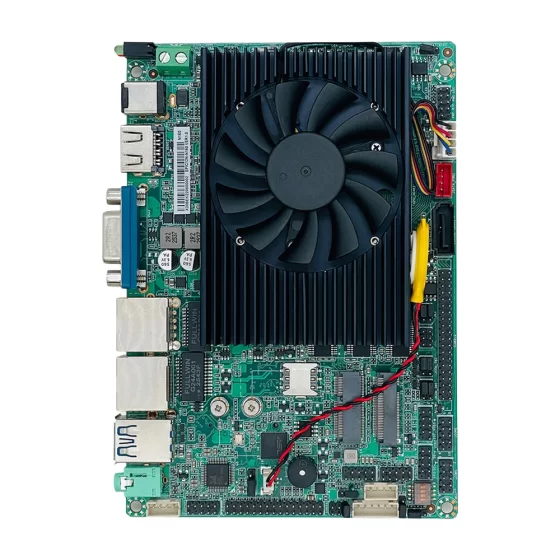
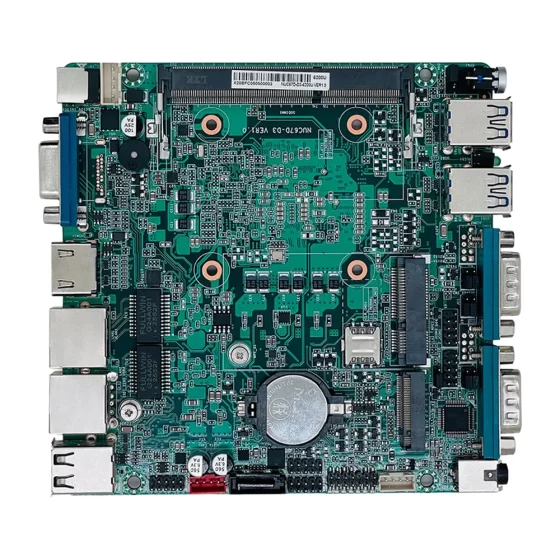
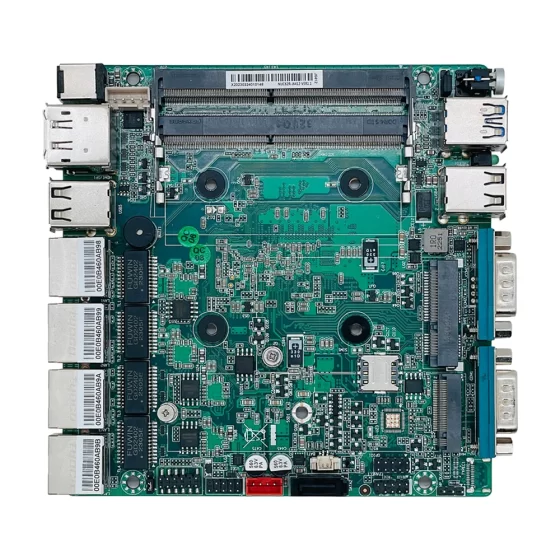
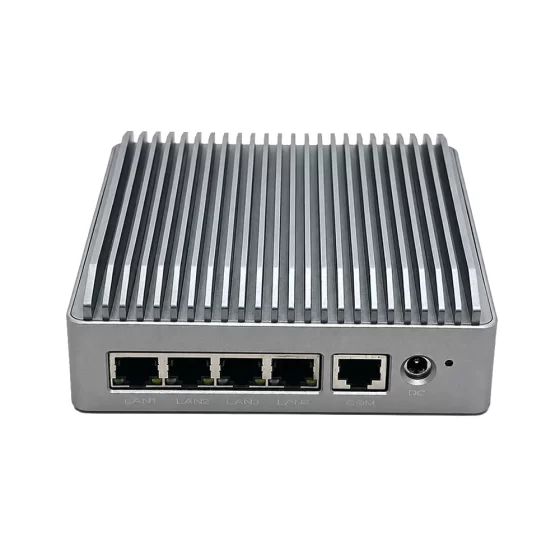
CoreIPC Industrial Computing Solutions

Fanless Industrial Computer for PLC Control Cabinets
Executive Summary
A fanless industrial computer for PLC control cabinets has become a critical component in modern industrial automation systems. As manufacturing facilities continue to adopt Industry 4.0 technologies, Industrial Internet of Things (IIoT) platforms, edge computing, and intelligent production monitoring, traditional PLC-based control systems increasingly require additional computing resources beyond deterministic machine control.
While PLCs remain the foundation of industrial automation, modern factories demand advanced capabilities such as real-time data visualization, industrial networking, protocol conversion, machine vision integration, predictive maintenance, MES connectivity, and cloud communication. A fanless industrial computer installed within a PLC control cabinet provides the computing power necessary to support these functions while maintaining industrial-grade reliability.
Unlike commercial computers, fanless industrial computers are specifically designed to withstand harsh industrial environments, including high temperatures, vibration, dust, humidity, and continuous 24/7 operation. Their compact form factor, flexible I/O interfaces, and maintenance-free design make them ideal for installation inside control cabinets where space, reliability, and thermal performance are critical considerations.
This article explores the role of fanless industrial computers in PLC control cabinet applications, discusses key deployment challenges, examines system architecture, and highlights the business benefits of implementing industrial-grade embedded computing platforms in modern automation systems.
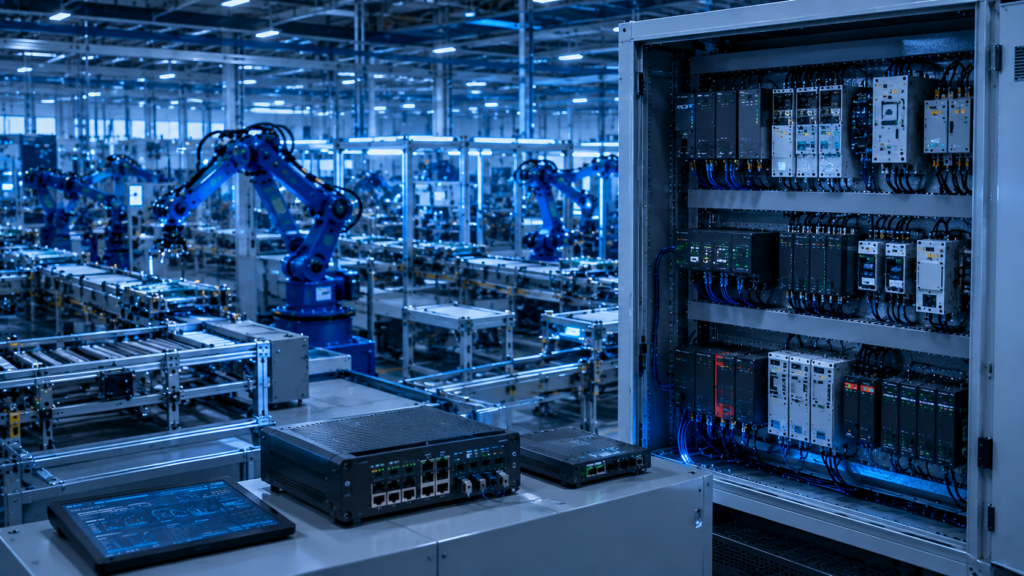
Modern smart factories combine PLC control cabinets, industrial computers, robotics, and automated production systems to achieve efficient and intelligent manufacturing.
Industry Overview
Industrial automation has evolved significantly over the past decade. Traditional PLC control systems were originally designed primarily for machine control, process automation, safety management, and I/O handling. Today, manufacturers face increasing pressure to improve productivity, reduce downtime, optimize energy consumption, and gain deeper insights into production operations.
The rise of Industry 4.0 has accelerated demand for:
- Industrial IoT connectivity
- Edge computing
- Predictive maintenance
- Machine vision inspection
- Manufacturing execution systems (MES)
- Cloud integration
- Real-time production analytics
- Remote monitoring
- Industrial cybersecurity
Modern factories generate vast amounts of operational data from:
- PLCs
- Sensors
- Drives
- Robots
- Vision systems
- HMIs
- SCADA platforms
To leverage this data effectively, manufacturers require computing platforms capable of collecting, processing, analyzing, and transmitting information across multiple systems.
A fanless industrial computer installed inside a PLC control cabinet serves as an intelligent edge computing node that bridges operational technology (OT) and information technology (IT). These systems support data acquisition, industrial communication, visualization, analytics, and enterprise integration while maintaining reliable operation in challenging industrial environments.
As a result, fanless industrial computers have become an essential component of modern control cabinet architectures across industries such as manufacturing, logistics, packaging, food processing, energy management, water treatment, transportation, and smart infrastructure.
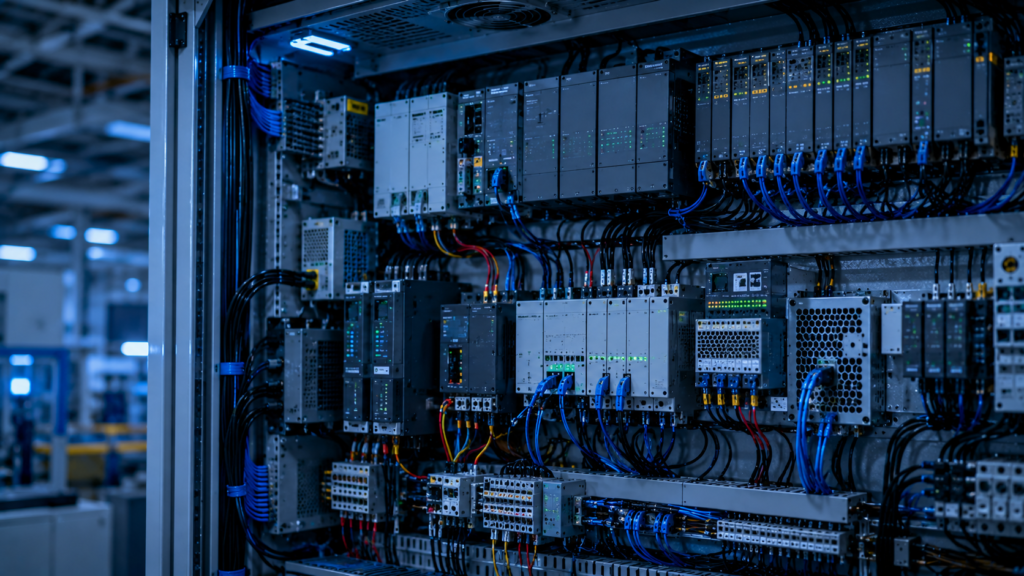
Modern PLC control cabinets must accommodate controllers, networking devices, power systems, and extensive wiring within limited installation space.
Key Challenges
Limited Space Inside Control Cabinets
PLC control cabinets often have limited installation space.
Typical cabinet components include:
- PLC controllers
- Power supplies
- Circuit breakers
- Relays
- Industrial switches
- Drives
- Safety controllers
- Terminal blocks
Any computing platform deployed inside the cabinet must provide high performance while maintaining a compact footprint.
Thermal Management Constraints
Control cabinets frequently operate in environments with elevated temperatures.
Additional challenges include:
- Limited airflow
- High equipment density
- Heat generated by drives and power supplies
- Enclosed cabinet structures
Traditional computers with active cooling fans may suffer reduced reliability under these conditions.
Dust and Contamination
Industrial environments expose equipment to:
- Dust
- Metal particles
- Oil mist
- Moisture
- Chemical contaminants
Fan-based systems can draw contaminants into the enclosure, increasing maintenance requirements and reducing operational reliability.
Increasing Data Processing Requirements
Modern automation systems generate large volumes of operational data.
Manufacturers require computing platforms capable of supporting:
- SCADA applications
- Database management
- Protocol conversion
- Production analytics
- Edge computing
- Industrial IoT gateways
PLCs alone may not provide sufficient processing resources for these workloads.
Long-Term Reliability Expectations
Industrial control systems often operate continuously for years.
Manufacturers expect:
- 24/7 operation
- Minimal maintenance
- High system availability
- Long product lifecycle support
Commercial computing hardware is generally not designed for these requirements.
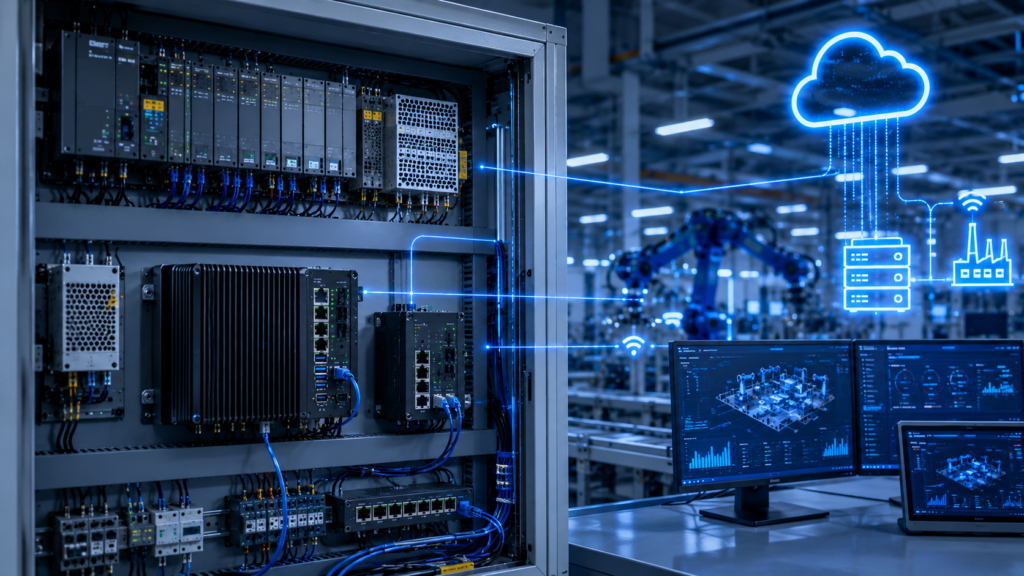
A fanless industrial computer extends PLC control cabinet capabilities by enabling SCADA integration, edge computing, industrial networking, and cloud connectivity.
Solution Architecture
A modern PLC control cabinet architecture combines deterministic control with advanced industrial computing capabilities.
Layer 1: Field Devices
The field layer includes:
- Sensors
- Encoders
- Actuators
- Variable frequency drives
- Safety devices
- Servo systems
- Vision sensors
These devices generate operational data and execute control actions.
Layer 2: PLC Control Layer
The PLC layer performs:
- Machine control
- Motion control
- Process automation
- Alarm handling
- Safety functions
- Equipment sequencing
The PLC remains the primary deterministic control platform.
Layer 3: Fanless Industrial Computer Layer
The fanless industrial computer functions as an intelligent edge computing platform.
Typical responsibilities include:
- Data collection
- Protocol conversion
- Industrial networking
- HMI hosting
- SCADA integration
- Database management
- Analytics processing
- Edge computing
- Machine vision support
Communication protocols may include:
- Modbus TCP
- EtherNet/IP
- PROFINET
- OPC UA
- MQTT
- BACnet
- REST APIs
Layer 4: Manufacturing Operations Layer
This layer includes:
- SCADA systems
- MES platforms
- Quality management software
- Maintenance systems
- Production reporting tools
The industrial computer aggregates and processes data from the PLC layer.
Layer 5: Enterprise and Cloud Layer
Enterprise integration enables:
- ERP connectivity
- Cloud analytics
- Predictive maintenance
- Multi-site monitoring
- Centralized reporting
The industrial computer acts as a secure gateway connecting plant-floor systems to enterprise applications.
Key Features
Fanless Cooling Design
The most important feature of a fanless industrial computer is its passive cooling architecture.
Benefits include:
- No moving parts
- Reduced maintenance
- Improved reliability
- Silent operation
- Better resistance to dust contamination
This makes fanless systems ideal for control cabinet installations.
Compact Form Factor
Control cabinet space is often limited.
Fanless industrial computers are available in compact designs that support:
- DIN-rail mounting
- Wall mounting
- VESA mounting
- Cabinet integration
Compact systems maximize available cabinet space while maintaining functionality.
Wide Temperature Operation
Industrial environments may experience significant temperature variations.
Industrial-grade fanless computers typically support:
- Wide operating temperatures
- Thermal stability
- Continuous operation under demanding conditions
This ensures reliable performance in challenging deployment environments.
Rich Industrial Connectivity
Industrial applications require extensive connectivity options.
Typical interfaces include:
- Multiple Ethernet ports
- USB ports
- RS232
- RS422
- RS485
- Digital I/O
- CAN Bus
- Wi-Fi and cellular options
These interfaces simplify integration with PLCs and industrial equipment.
Edge Computing Capability
Edge computing allows data processing close to the production source.
Benefits include:
- Reduced latency
- Faster response times
- Lower network traffic
- Enhanced reliability
This supports real-time industrial decision-making.
Industrial IoT Support
Modern fanless industrial computers support Industrial IoT deployments through:
- MQTT communication
- Cloud connectivity
- Data aggregation
- Remote management
These capabilities help organizations implement digital transformation initiatives.
Long Lifecycle Availability
Industrial automation projects often remain operational for many years.
Industrial computers typically offer:
- Long-term availability
- Stable hardware platforms
- Consistent software support
- Extended product lifecycles
This minimizes redesign and maintenance costs.
Deployment Scenarios
Machine Automation
Fanless industrial computers are commonly deployed inside machine control cabinets.
Applications include:
- Data logging
- Recipe management
- Operator interfaces
- Production monitoring
Smart Manufacturing
Manufacturers use industrial computers to collect and analyze production data from PLC systems.
Applications include:
- OEE monitoring
- Production analytics
- Quality tracking
- Equipment utilization analysis
SCADA Systems
Fanless industrial computers can host SCADA applications directly within control cabinets.
Benefits include:
- Local visualization
- Real-time monitoring
- Alarm management
- Historical data storage
Industrial IoT Gateways
Control cabinet computers often serve as Industrial IoT gateways.
Functions include:
- Data acquisition
- Cloud connectivity
- Protocol conversion
- Remote monitoring
Machine Vision Inspection
Industrial computers support machine vision workloads such as:
- Defect detection
- Barcode reading
- OCR inspection
- Quality verification
Inspection results can be communicated directly to PLC systems.
Energy Management Systems
Industrial computers help organizations monitor and optimize energy consumption through:
- Utility monitoring
- Power quality analysis
- Energy reporting
- Sustainability initiatives
Business Benefits
Increased System Reliability
Fanless designs eliminate cooling fans, which are among the most common failure points in conventional computers.
This improves overall system reliability and uptime.
Reduced Maintenance Costs
Without fans or air filters, maintenance requirements are significantly reduced.
Organizations benefit from lower operational costs and fewer service interruptions.
Improved Operational Visibility
Industrial computers provide real-time access to production and equipment data.
This supports informed decision-making and process optimization.
Enhanced Scalability
Additional software applications and communication protocols can be deployed without major hardware changes.
This enables future expansion and modernization.
Lower Total Cost of Ownership
Industrial-grade hardware, long lifecycle support, and reduced maintenance requirements contribute to lower overall ownership costs.
Support for Industry 4.0 Initiatives
Fanless industrial computers provide the foundation for:
- Industrial IoT
- Edge computing
- Predictive maintenance
- AI analytics
- Digital transformation
These technologies help manufacturers remain competitive in evolving industrial markets.
Why CoreIPC
CoreIPC provides industrial computing platforms specifically designed for PLC control cabinet deployments. Our fanless industrial computers, embedded computers, and industrial motherboards deliver reliable performance, flexible I/O configurations, long product lifecycles, and industrial-grade durability. Whether supporting machine automation, Industrial IoT, SCADA systems, edge computing, or intelligent manufacturing applications, CoreIPC solutions help system integrators and equipment manufacturers build reliable, scalable, and future-ready automation systems.
Frequently Asked Questions
What is a fanless PLC computer?
A fanless PLC computer is an industrial computer designed to operate inside PLC control cabinets without using cooling fans. It relies on passive heat dissipation and is optimized for industrial environments requiring high reliability and minimal maintenance.
Why are fanless computers preferred in control cabinets?
Fanless systems eliminate moving parts and prevent dust from entering the enclosure. This improves reliability, reduces maintenance, and supports continuous operation in harsh industrial environments.
Can a fanless industrial computer replace a PLC?
Generally, no. PLCs remain the preferred platform for deterministic machine control. Fanless industrial computers are typically used alongside PLCs to provide data processing, visualization, networking, and edge computing capabilities.
What operating temperatures can fanless industrial computers support?
Industrial-grade fanless computers commonly support wide operating temperature ranges and are designed for reliable operation in demanding industrial environments.
Which communication protocols are supported?
Most industrial computers support protocols such as Modbus TCP, EtherNet/IP, PROFINET, OPC UA, MQTT, and other industrial communication standards.
Can fanless industrial computers run SCADA software?
Yes. Many fanless industrial computers are deployed as SCADA servers, HMI platforms, or local visualization systems within industrial control cabinets.
Are fanless industrial computers suitable for Industrial IoT applications?
Yes. They are widely used as Industrial IoT gateways, supporting cloud connectivity, data aggregation, protocol conversion, and remote monitoring applications.
Can these systems support machine vision?
Yes. High-performance fanless industrial computers can support image acquisition, AI inference, barcode reading, OCR inspection, and defect detection applications.
How long do industrial computers typically remain available?
Industrial computing platforms often provide significantly longer product lifecycles than consumer PCs, helping reduce redesign costs and simplify long-term maintenance.
What should be considered when selecting a control cabinet computer?
Key factors include processing performance, operating temperature, mounting options, communication interfaces, environmental specifications, lifecycle availability, and application requirements.
Conclusion
A fanless industrial computer for PLC control cabinets provides the computing foundation necessary for modern industrial automation systems. While PLCs continue to perform deterministic control functions, industrial computers enable advanced capabilities such as edge computing, Industrial IoT connectivity, SCADA integration, machine vision processing, and real-time analytics.
By combining reliable PLC control with industrial-grade embedded computing platforms, manufacturers can improve operational visibility, reduce maintenance requirements, support Industry 4.0 initiatives, and build scalable automation systems that are ready for future technological advancements.
Contact Us
Looking for a fanless industrial computer for your PLC control cabinet project?
CoreIPC provides industrial computers, embedded computers, industrial motherboards, and customized embedded computing solutions designed for industrial automation, Industrial IoT, machine vision, SCADA systems, and intelligent manufacturing environments.
Contact our engineering team to discuss your application requirements and identify the ideal industrial computing platform for your deployment.