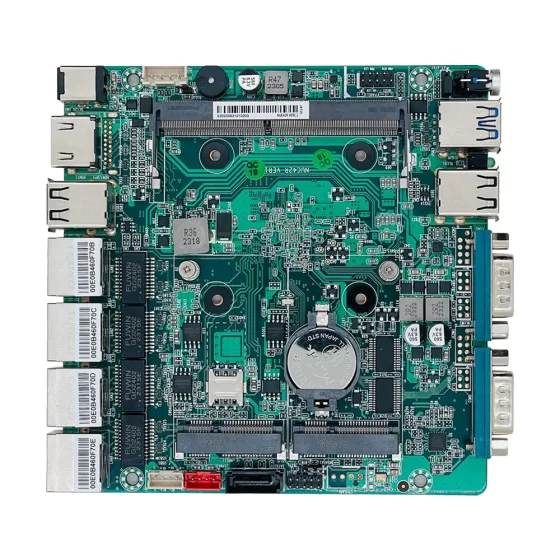
CoreIPC Industrial Computing Solutions

Industrial PC for Automated Production Lines: Production Line Industrial PC for Smart Manufacturing
Executive Summary
A production line industrial pc provides the computing foundation for automated production lines, machine control, data collection, industrial communication, HMI operation, machine vision integration, edge analytics, and factory system connectivity.
Modern production lines are no longer simple mechanical systems. They may include PLCs, servo drives, robots, conveyors, sensors, industrial cameras, barcode readers, inspection systems, HMIs, SCADA platforms, MES systems, and industrial IoT gateways. These systems must work together reliably to support stable output, consistent quality, and real-time production visibility.
An industrial computer or embedded computer can serve as the local computing node for automated production lines. It can connect machines, collect production data, process local events, run HMI software, support inspection systems, buffer records, and exchange information with MES, SCADA, ERP, cloud dashboards, or local databases.
Compared with standard office PCs, industrial computers are better suited for production line deployment because they support rugged construction, multiple LAN ports, serial communication, GPIO, local storage, fanless design options, industrial mounting, stable power input, and long lifecycle availability.
This article explains how production line industrial PC systems support smart manufacturing, what challenges appear in real production environments, how the solution architecture works, and which hardware features matter when selecting an industrial computer or embedded computer for automated production lines.
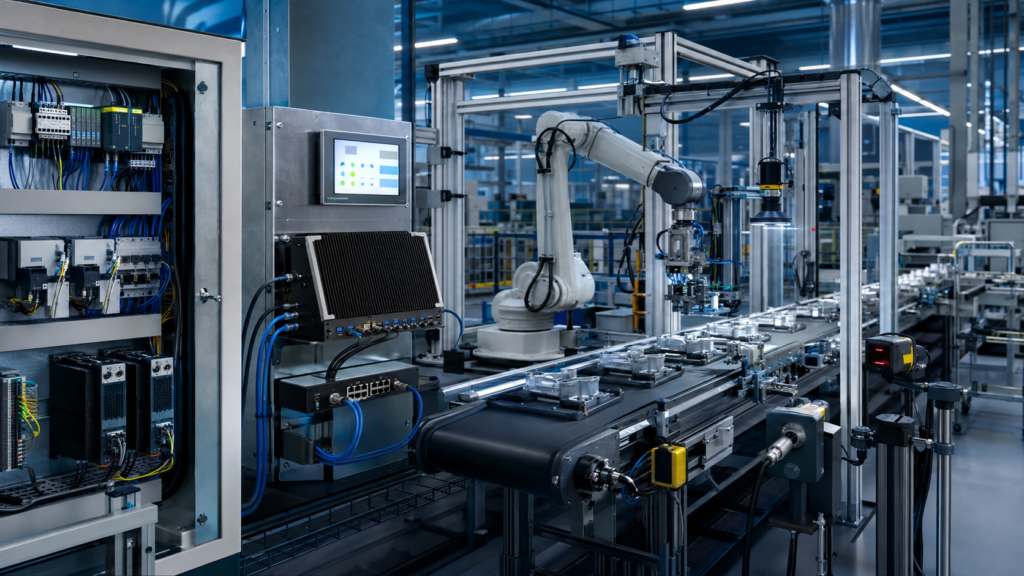
Production Line Industrial PC Data Collection
Industry Overview
Production Lines Are Becoming More Connected
Automated production lines depend on reliable communication between machines, controllers, sensors, and software systems.
A single line may include multiple workstations, conveyors, robotic cells, test equipment, inspection stations, packaging units, labeling systems, and data collection points.
Each part of the line generates useful information.
Common production line data includes:
- Machine status
- Cycle count
- Alarm records
- Sensor values
- Production speed
- Quality results
- Barcode data
- Operator events
- Equipment runtime
- Energy consumption
- Maintenance signals
- Process parameters
A production line industrial PC helps collect and organize this information.
Industrial PCs Connect Control and Data Layers
Traditional automation systems often separate control and data.
PLCs handle machine logic. HMIs display operator information. SCADA systems monitor equipment. MES platforms manage production records.
Modern production lines need better integration between these layers.
An industrial PC can provide a bridge between machine-side automation and factory software platforms. It can collect device data, run local software, process events, store records, display dashboards, and forward information to higher-level systems.
This makes it a key hardware platform for smart manufacturing.
Automated Lines Require Reliable Edge Computing
Production lines often run continuously.
If the computing platform becomes unstable, operators may lose HMI access, production records, inspection data, or machine communication.
The industrial PC must operate reliably near machines, motors, drives, conveyors, and control cabinets.
Industrial computers and embedded computers provide the rugged hardware foundation needed for these environments.
They support compact installation, fanless design options, reliable storage, flexible I/O, and long-term availability.

Production Line Industrial PC Deployment Challenges
Key Challenges
Connecting Multiple Machines and Devices
Automated production lines include many devices from different vendors.
The industrial PC may need to connect:
- PLC controllers
- Servo drives
- Sensors
- Barcode readers
- Industrial cameras
- Robots
- Conveyors
- Test equipment
- HMIs
- I/O modules
- Weighing systems
- Labeling machines
- Industrial switches
These devices may use Ethernet, USB, RS232, RS485, GPIO, digital I/O, or fieldbus communication.
Flexible connectivity is essential for practical production line integration.
Maintaining Stable Production Data Flow
Production data must be collected continuously.
If records are missing, production reports, quality traceability, maintenance analysis, and operational dashboards become unreliable.
A production line industrial PC should support local data buffering and storage.
This helps preserve data during network interruptions or temporary software communication issues.
Important records may include:
- Production counts
- Batch data
- Inspection results
- Alarm logs
- Barcode records
- Operator actions
- Machine runtime
- Process values
- Maintenance events
Reliable data continuity improves factory visibility and traceability.
Supporting HMI and Operator Interaction
Many production lines require local operator interfaces.
An industrial PC may run HMI software, line monitoring dashboards, recipe management screens, alarm interfaces, or maintenance tools.
The system should support stable display output, responsive operation, and easy integration with local controls.
Operator-facing systems must remain reliable because they affect line operation, troubleshooting, and production changeover.
Integrating Machine Vision and Inspection
Automated production lines often use cameras for inspection, alignment, barcode reading, defect detection, label verification, and product counting.
Vision workloads may create additional requirements for processing performance, storage, camera interfaces, and network bandwidth.
The industrial PC may need to connect cameras, lighting controllers, triggers, PLCs, and quality databases.
For AI-based inspection, higher-performance edge AI hardware may be required.
Managing Network Segmentation
Production lines often include control networks, camera networks, factory IT networks, and remote maintenance networks.
A flat network can create reliability and security problems.
Multiple LAN ports help separate:
- PLC network
- Machine network
- Camera network
- Robot network
- HMI network
- SCADA network
- MES network
- Remote maintenance network
- Industrial IoT network
Network segmentation improves traffic organization and reduces unnecessary exposure.
Operating in Harsh Industrial Environments
Production line computers may be installed inside cabinets or near machines.
These environments may include dust, vibration, heat, electrical noise, limited airflow, and continuous operation.
Industrial-grade hardware is important.
Fanless design options, rugged enclosures, reliable SSD or NVMe storage, secure mounting, and stable power input help reduce downtime risk.

Production Line Industrial PC Solution Architecture
Production Line Industrial PC Solution Architecture
Machine and Device Layer
The machine and device layer includes the physical systems on the production line.
This layer may include:
- PLCs
- Sensors
- Servo drives
- Robots
- Conveyors
- Motors
- Cameras
- Barcode readers
- Test equipment
- Actuators
- Safety devices
- I/O modules
These systems generate control signals, production records, quality data, and machine status information.
Edge Computing Layer
The edge computing layer is where the industrial computer or embedded computer operates.
At this layer, the platform may:
- Collect machine data
- Run HMI software
- Process local events
- Store production records
- Buffer data
- Communicate with PLCs
- Connect inspection systems
- Manage line dashboards
- Support remote diagnostics
- Forward data to factory systems
This layer provides local computing close to the production line.
Control and Communication Layer
The communication layer connects the industrial PC with machine devices and automation systems.
It may include:
- Ethernet
- USB
- RS232
- RS485
- Digital I/O
- GPIO
- Industrial Ethernet
- PLC communication
- Camera networks
- Industrial switches
The exact communication design depends on the line architecture and equipment mix.
Data Processing Layer
The data processing layer turns raw machine data into useful production information.
The platform may process:
- Cycle counts
- Alarm events
- Production speed
- Quality results
- Barcode records
- Machine status
- Runtime records
- Process values
- Maintenance signals
- Energy data
Local processing improves response time and reduces the amount of unnecessary data sent to central systems.
Factory System Integration Layer
The production line industrial PC may connect with higher-level factory systems.
These systems may include:
- MES
- SCADA
- ERP
- Quality databases
- Industrial IoT platforms
- Local dashboards
- Maintenance systems
- Cloud monitoring systems
- Traceability platforms
This integration helps production data become part of the factory-wide information system.
Security and Management Layer
The security and management layer supports controlled access and long-term maintainability.
It may include:
- Network segmentation
- Secure remote access
- User permissions
- Local logging
- Configuration backup
- Storage monitoring
- Device health monitoring
- Remote diagnostics
- Software update management
This helps keep production line systems reliable and easier to service.
Key Features
Multi-Device Connectivity
A production line industrial PC must support many device interfaces.
Useful I/O options may include:
- LAN
- USB
- RS232
- RS485
- GPIO
- Digital input
- Digital output
- HDMI
- DisplayPort
- M.2
- PCIe
- SATA or NVMe storage
Native industrial interfaces reduce external converter requirements and simplify control cabinet wiring.
This improves deployment reliability.
Multi-LAN Network Design
Multiple LAN ports are valuable for automated production lines.
They allow different communication paths to remain separated.
A line computer may use separate ports for:
- PLC communication
- Camera traffic
- Robot network
- Factory IT connection
- MES or SCADA integration
- Remote maintenance
- Local management
This improves network stability and helps prevent high-bandwidth traffic from affecting control communication.
HMI and Visualization Support
Many production line systems require local display output.
An industrial PC may support operator dashboards, alarm screens, maintenance panels, recipe selection, and production status visualization.
Display interfaces such as HDMI or DisplayPort can support local HMI screens.
Stable graphics performance and reliable software operation are important for operator-facing systems.
Local Storage and Data Buffering
Local storage supports production records, alarm logs, inspection results, recipe files, configuration backups, and upload buffers.
SSD or NVMe storage is commonly preferred because it provides fast access and better shock resistance than mechanical drives.
Storage design should consider:
- Data retention
- Write endurance
- Backup workflow
- Recovery process
- Inspection record volume
- Local database size
- Network interruption behavior
Reliable storage improves traceability and system recovery.
Machine Vision Integration
Production lines may require camera-based inspection or guidance.
The industrial PC may connect industrial cameras, lighting controllers, barcode readers, and trigger signals.
It may process images locally and send pass/fail results to PLCs, MES, or quality databases.
For advanced inspection, AI acceleration may be considered.
The final hardware should match camera count, resolution, frame rate, and software workload.
Edge Analytics Capability
Production line data can support local analytics.
The system may detect abnormal cycle time, downtime patterns, equipment faults, quality changes, or process deviations.
Edge analytics can help operators respond quickly.
For advanced applications, the industrial PC may run AI models for defect detection, anomaly recognition, or predictive maintenance.
Rugged and Fanless Design
Production line environments can be dusty, vibration-prone, and thermally demanding.
Fanless industrial computers reduce dust intake and remove one common mechanical failure point.
Rugged enclosures help protect against vibration, cable stress, cabinet installation impact, and continuous operation.
Thermal design should be validated based on real workload and cabinet conditions.
Long Lifecycle Availability
Production line systems may remain in service for many years.
Consistent hardware helps maintain software images, drivers, HMI applications, camera SDKs, spare parts, and validation procedures.
Long lifecycle availability is important for machine builders, system integrators, and manufacturers deploying the same platform across multiple lines.

Automated Production Line Monitoring Operations
Deployment Scenarios
Assembly Line Control
Assembly lines may include PLCs, sensors, robots, conveyors, screwdrivers, barcode readers, and operator stations.
A production line industrial PC can collect line data, run HMI software, store records, and connect the line with MES or SCADA systems.
This supports traceable and connected assembly operations.
Packaging Line Automation
Packaging lines often include conveyors, labelers, sealers, checkweighers, barcode scanners, cameras, and PLCs.
An industrial computer can collect data from these devices and provide local monitoring.
It can support recipe management, inspection records, and production reporting.
Electronics Manufacturing Line
Electronics production requires precise data collection, inspection, and traceability.
An embedded computer can connect test equipment, cameras, barcode readers, PLCs, and MES systems.
This supports quality control and production visibility.
Food and Beverage Production Line
Food and beverage lines may require stable monitoring of conveyors, sensors, checkweighers, labeling systems, packaging machines, and inspection equipment.
An industrial PC can collect process data, support HMI functions, and store production records.
The final system should be selected according to hygiene zone and enclosure requirements.
Automotive Production Line
Automotive lines often include robots, fixtures, conveyors, inspection stations, barcode systems, and assembly tools.
A production line industrial PC can collect equipment data, connect quality systems, and support line-level dashboards.
This improves visibility and traceability.
Machine Vision Inspection Station
Inspection stations may use cameras, lighting, triggers, barcode readers, and quality databases.
An industrial computer can process images, store inspection records, and send results to PLCs or MES platforms.
This supports automated quality control.
Multi-Line Factory Data Collection
A factory may use multiple industrial computers to collect data from different lines.
Each computer can act as a local edge node and forward structured information to central systems.
This supports scalable smart factory deployment.
OEM Production Line Equipment
Machine builders can integrate industrial computers or embedded boards into custom production line equipment.
The platform can support control software, HMI, data logging, machine vision, remote diagnostics, and customer-specific I/O.
This helps create repeatable automation systems.
Business Benefits
Improved Production Visibility
A production line industrial PC helps collect machine status, cycle records, alarm logs, quality results, and operator events.
This gives production teams better visibility into line performance.
Better visibility supports faster troubleshooting and continuous improvement.
Better Quality Traceability
Production lines often require traceability across products, batches, inspections, and process steps.
The industrial PC can collect barcode data, inspection results, machine records, and operator actions.
This supports quality analysis and customer reporting.
Reduced Downtime Risk
Industrial computers provide rugged hardware for continuous line operation.
Fanless design options, reliable storage, stable power input, secure mounting, and long lifecycle availability help reduce system failure risk.
This supports production uptime.
Faster Local Response
Edge computing allows important production events to be processed near the line.
Alarms, inspection results, cycle time changes, and equipment status updates can be handled locally.
This improves response time and reduces dependence on remote systems.
Easier Factory Integration
The industrial PC helps connect machines, PLCs, cameras, sensors, HMIs, MES, SCADA, and industrial IoT platforms.
This reduces information silos and helps manufacturers build more connected factories.
Scalable Automation Deployment
A standardized industrial PC platform can be deployed across multiple production lines and factories.
Consistent hardware simplifies software images, configuration templates, spare parts planning, maintenance training, and lifecycle management.
This supports long-term smart manufacturing expansion.
Why CoreIPC
CoreIPC provides industrial computing platforms for industrial automation, machine vision, industrial IoT, edge AI, robotics, and embedded system integration. For production line industrial PC applications, CoreIPC focuses on reliable industrial computer hardware, embedded computer solutions, flexible I/O, multi-LAN configurations, compact system design, fanless deployment options, local storage capability, and OEM/ODM customization support. CoreIPC helps machine builders, system integrators, and manufacturers select computing platforms that match real deployment requirements, including device interfaces, line data workload, LAN port count, storage needs, mounting methods, power input, thermal conditions, and lifecycle planning.
Frequently Asked Questions
1. What is a production line industrial PC?
A production line industrial PC is an industrial computing platform used to support automated production line operation.
It may connect PLCs, sensors, cameras, robots, barcode readers, HMIs, and factory software systems. It can collect data, run local applications, store records, and support production monitoring.
2. Why use an industrial computer for automated production lines?
An industrial computer provides rugged hardware and flexible connectivity for factory environments.
It can support multiple LAN ports, serial communication, USB, GPIO, reliable storage, fanless operation, industrial mounting, stable power input, and long lifecycle availability.
These features make it suitable for continuous production line deployment.
3. How is an embedded computer used in production line automation?
An embedded computer can be installed inside a control cabinet, machine enclosure, or line workstation.
It can collect machine data, communicate with PLCs, run HMI software, process inspection data, store logs, and send structured information to MES, SCADA, or industrial IoT platforms.
4. What production line devices can be connected?
A production line industrial PC may connect PLCs, sensors, servo drives, robots, conveyors, industrial cameras, barcode readers, test equipment, HMIs, I/O modules, labeling machines, and industrial switches.
The exact support depends on interfaces, software, protocols, and application requirements.
5. Why are multiple LAN ports important?
Multiple LAN ports help separate PLC communication, camera traffic, robot networks, factory IT, MES or SCADA systems, remote maintenance, and local management.
This improves traffic organization, security, and communication stability.
6. Can production line industrial PCs support machine vision?
Yes. Production line industrial PCs can connect cameras, lighting controllers, barcode readers, and trigger signals.
They can process images locally, store inspection records, and send results to PLCs, MES, or quality databases.
For advanced AI inspection, higher-performance edge AI computers may be required.
7. Why is local storage important for production lines?
Local storage helps preserve production records during network interruptions.
It can store cycle counts, alarm logs, inspection results, barcode records, recipe files, local databases, and upload buffers.
This improves traceability and recovery.
8. What hardware features matter for automated production lines?
Important features include multiple LAN ports, USB, RS232, RS485, GPIO, digital I/O, reliable memory, SSD or NVMe storage, rugged enclosure, fanless design, industrial power input, display output, M.2, PCIe, and expansion options.
The final configuration should match device count, data workload, and installation environment.
9. Can fanless industrial PCs support production line operation?
Yes. Fanless industrial PCs can support many production line applications because they reduce dust intake and remove one mechanical failure point.
However, thermal design should be validated when the system handles continuous data collection, HMI software, vision processing, or local storage writes.
10. What should be tested before deployment?
Before deployment, the platform should be tested with real PLCs, sensors, cameras, robots, HMI software, network topology, production data rates, storage behavior, and long-running operation.
Thermal stability, communication recovery, remote access workflow, backup procedures, and integration with MES or SCADA should also be validated.
Conclusion
A production line industrial pc is a practical foundation for automated production lines, machine control support, HMI operation, production data collection, machine vision integration, local storage, remote diagnostics, and factory system connectivity.
By placing an industrial computer or embedded computer near the production line, manufacturers and system integrators can connect PLCs, sensors, servo drives, robots, conveyors, cameras, barcode readers, HMIs, MES platforms, SCADA systems, and industrial IoT dashboards through reliable and controlled communication paths.
The right production line industrial PC should be selected according to real deployment requirements, including device count, LAN port design, serial communication, I/O requirements, HMI workload, camera integration, data storage, mounting method, power input, thermal conditions, operating system support, and lifecycle planning.
CoreIPC supports production line industrial PC projects with industrial computing platforms designed for practical machine-side, cabinet, factory, and OEM deployment. With the right hardware foundation, manufacturers and machine builders can build reliable, scalable, and connected automated production lines.
Contact Us
Looking for an industrial computer, embedded computer, or compact IPC platform for automated production line deployment?
Contact CoreIPC to discuss your project requirements, including device interfaces, LAN port configuration, PLC communication, HMI workload, camera connectivity, data storage, mounting method, power input, operating environment, lifecycle needs, and OEM/ODM customization options.