CoreIPC Industrial Computing-Lösungen

Bildverarbeitungssystem zur Barcode-Erkennung: Barcode-Vision-System für zuverlässige industrielle Identifikation
Zusammenfassung
A barcode vision system is an important part of modern industrial identification, Rückverfolgbarkeit der Produktion, Logistikautomatisierung, und Qualitätskontrolle.
In manufacturing environments, barcodes are used to identify products, Komponenten, Kartons, pallets, Werkzeuge, Materialien, und Prozessaufzeichnungen. Jedoch, barcode recognition on the factory floor is often more complex than simple office scanning. Codes may be printed on curved surfaces, metal parts, Etiketten, plastic packaging, Leiterplatten, boxes, or moving products. They may also be affected by dust, Blendung, Vibration, poor lighting, geringer Kontrast, or motion blur.
A reliable barcode vision system combines industrial cameras, Beleuchtung, image processing software, und stabile industrielle Computerhardware. The industrial computer or embedded computer acts as the local processing platform. It captures image data, runs recognition software, connects to production equipment, communicates with MES or WMS platforms, and stores inspection records when required.
Für Hersteller, Systemintegratoren, und OEM-Gerätebauer, selecting the right industrial computer is essential. The system must support camera interfaces, stable processing, industrielle I/O, Netzwerkkommunikation, Dauerbetrieb, and practical deployment near production lines.
This article explains how barcode vision systems work in industrial environments, welche Herausforderungen während der Bereitstellung auftreten, wie die Lösungsarchitektur aufgebaut ist, and which hardware features are important for reliable barcode recognition.
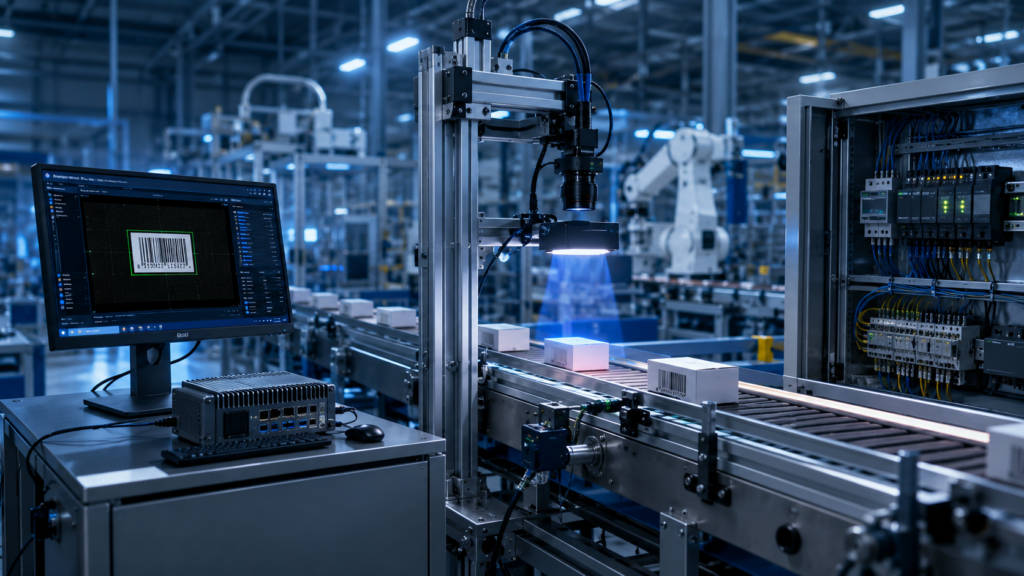
Vision systems read barcodes automatically on moving products and production lines.
Branchenüberblick
Barcode Recognition Is Central to Industrial Traceability
Barcode recognition is widely used in manufacturing, Verpackung, Logistik, Lagerung, and quality inspection.
In production environments, each barcode may represent a product serial number, material batch, work order, process route, test record, or shipment label. When a code is read correctly, the system can link physical goods with digital records.
This supports:
- Produktrückverfolgbarkeit
- Material tracking
- Production routing
- Qualitätskontrolle
- Warehouse management
- Verpackungsüberprüfung
- Shipping confirmation
- Anti-mixing control
- Process error prevention
As factories become more digital, barcode recognition is no longer an isolated scanning task. It is part of a larger industrial data workflow.
Why Vision-Based Barcode Recognition Is Used
Handheld scanners and fixed laser scanners are still used in many applications, but vision-based barcode recognition offers more flexibility.
A barcode vision system can inspect multiple codes in one image, read codes on moving products, verify label position, detect print defects, and capture image evidence for quality records.
It can also recognize different code types, wie zum Beispiel:
- 1D barcodes
- QR-Codes
- Data-Matrix-Codes
- Printed labels
- Direct part marks
- Carton or package labels
- PCB identification codes
For automated production lines, a vision system can reduce manual scanning and improve consistency.
Industrial Computing Is the Processing Foundation
A barcode vision system needs reliable local computing.
The industrial computer receives image data from cameras, runs recognition algorithms, connects to lighting controllers, receives trigger signals, communicates with PLCs, and sends results to MES, WMS, ERP, oder Produktionsdatenbanken.
An embedded computer is often used when space is limited or when the system must be installed inside machines, Schränke, Inspektionsstationen, oder OEM-Ausrüstung.
Im Vergleich zu Büro-PCs, industrial computers provide better suitability for continuous factory operation, industrielle I/O, robuste Installation, stabile Vernetzung, und langfristigen Einsatz.

Beleuchtung, Oberflächenreflexion, motion, and barcode quality affect recognition reliability.
Wichtigste Herausforderungen
Poor Barcode Quality
Barcode quality can vary greatly in real production environments.
Labels may be scratched, faltig, misaligned, faded, partially covered, or printed with low contrast. Direct part marks may be shallow, reflective, or distorted by surface texture.
A barcode vision system must handle these practical conditions without generating too many false reads or missed reads.
Good camera selection, Lichtdesign, Bildverarbeitung, and computing stability are all important.
Beleuchtung und Oberflächenreflexion
Lighting is one of the most important factors in barcode vision.
Reflective surfaces such as metal, plastic film, glossy packaging, or PCB solder mask can create glare. Dark materials may require stronger illumination. Curved or uneven surfaces may create shadows and distortion.
The vision computer must support stable image acquisition and communicate with lighting controllers when needed.
In many industrial projects, lighting design is just as important as the camera or software.
Motion and Production Speed
Production lines may move quickly.
If products pass through the inspection area at high speed, the system must capture sharp images and process them fast enough to keep up with production.
Bewegungsunschärfe, trigger delay, camera exposure, image transfer speed, and processing performance all affect recognition reliability.
The industrial computer must provide enough processing capability for the required line speed and image resolution.
Integration with Factory Systems
Barcode recognition results are usually not useful unless they are connected to production systems.
The vision system may need to communicate with:
- SPS
- MES-Software
- WMS-Plattformen
- ERP-Systeme
- Etikettendrucker
- Mechanismen ablehnen
- Alarmsysteme
- Produktionsdatenbanken
- Industrielle Netzwerke
This requires reliable industrial I/O and stable network communication.
Continuous Operation in Industrial Environments
Barcode vision systems are often installed directly on production lines.
The computing hardware may operate near conveyors, Verpackungsmaschinen, Inspektionsstationen, Roboterzellen, oder Schaltschränke. In diesen Umgebungen kann es zu Vibrationen kommen, Staub, Hitze, begrenzter Luftstrom, elektrisches Rauschen, und lange Betriebsstunden.
A standard commercial PC may work during initial testing, but long-term factory operation requires more stable industrial computing hardware.

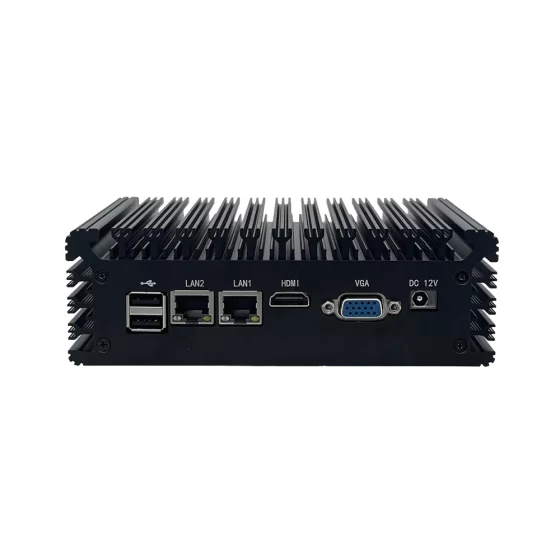
Industrial computers process barcode images and connect recognition results to factory systems.
Barcode Vision System Solution Architecture
Image Capture Layer
The image capture layer includes cameras, Linsen, Beleuchtung, Auslöser, und Montagekonstruktionen.
The camera captures images of barcodes or marked surfaces. The lens determines field of view, Arbeitsabstand, and image clarity. Lighting improves contrast and reduces reflection. Trigger sensors help capture images at the correct time.
This layer must be designed according to the actual object, barcode size, Oberflächenzustand, Liniengeschwindigkeit, and installation space.
A barcode vision system usually depends on consistent image quality before software recognition can perform reliably.
Industrielle Computerschicht
In der Industrial Computing-Schicht führt der Industriecomputer oder eingebettete Computer die lokale Verarbeitung durch.
Auf dieser Ebene, Das System kann:
- Bilddaten von Kameras empfangen
- Führen Sie eine Barcode-Erkennungssoftware aus
- Process 1D and 2D code images
- Control lighting or trigger timing
- Compare barcode data with production rules
- Store image records when required
- Senden Sie Pass- oder Fail-Ergebnisse an SPSen
- Upload data to MES or WMS platforms
- Display status on local HMI screens
This local computing layer allows recognition to happen near the production process, reducing delay and improving system reliability.
Control and Automation Layer
The control layer connects the barcode vision system with production equipment.
A PLC or motion controller may send trigger signals to the industrial computer. After the barcode is recognized, the computer may send results back to the PLC.
Zum Beispiel, if a product barcode is correct, the line may continue. If the barcode is missing, unreadable, or mismatched, Das System kann einen Alarm auslösen, Stoppen Sie die Linie, or activate a reject mechanism.
This closed-loop communication is essential for automated quality control and traceability.
Datenverwaltungsschicht
Barcode recognition data often needs to be stored or transferred.
The system may send barcode values, Zeitstempel, Stations-IDs, image files, operator information, and inspection results to MES, WMS, ERP, oder Qualitätsdatenbanken.
This helps manufacturers build complete traceability records.
For some applications, the industrial computer may also store temporary local data when the network is unavailable and upload records after communication recovers.
Benutzeroberflächenschicht
Operators and engineers often need a local interface.
Der Industriecomputer kann an einen Monitor angeschlossen werden, Touch-Screen, Tastatur, or panel display. Die Schnittstelle kann Livebilder anzeigen, recognition status, error messages, camera settings, Produktion zählt, und Systemprotokolle.
A clear local interface helps maintenance teams adjust the system and respond quickly when barcode recognition problems occur.

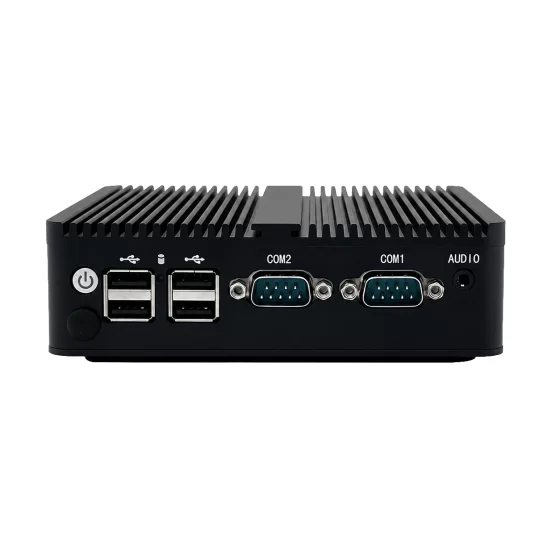
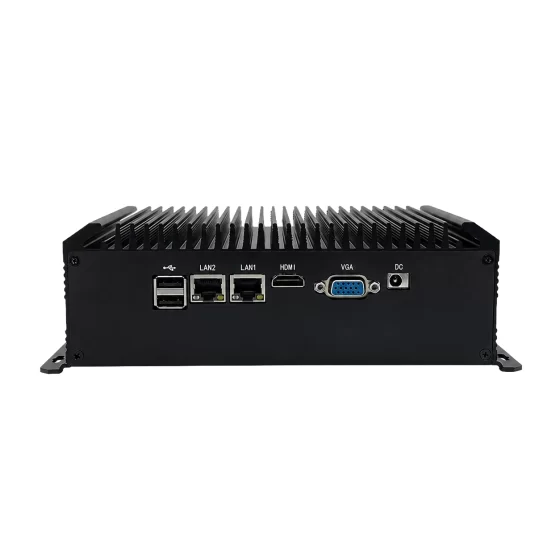
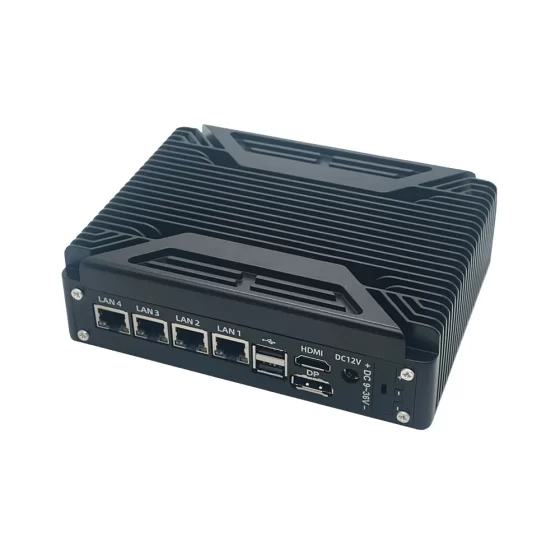
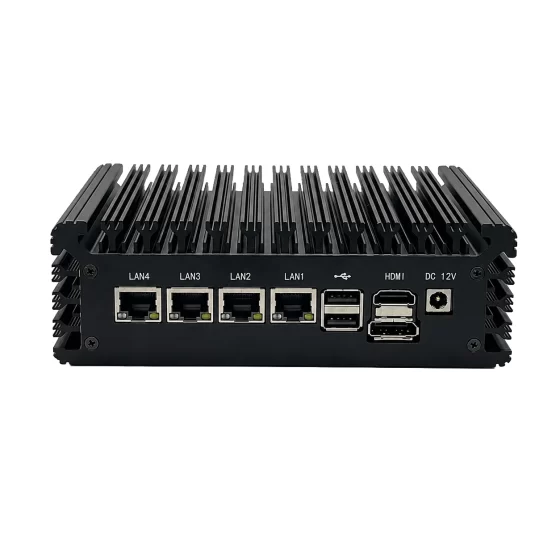
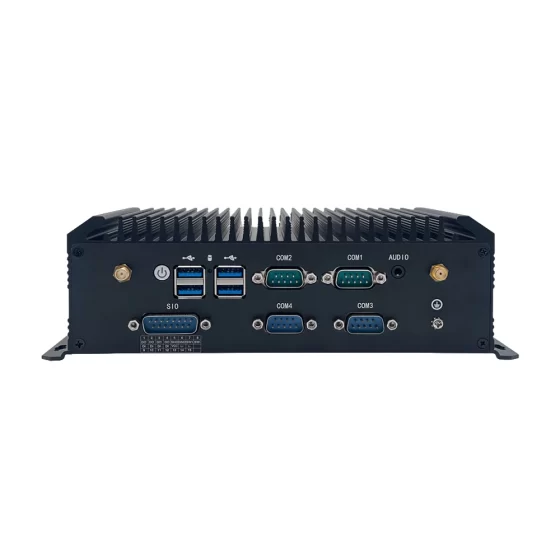
Fanless industrial computers support reliable barcode vision deployment in factory cabinets.
Hauptmerkmale
Stabile Bildverarbeitungsleistung
Barcode vision requires stable image processing.
The computer must process camera images, run recognition algorithms, communicate with factory systems, and display results without interruption.
The required performance depends on:
- Kameraauflösung
- Anzahl der Kameras
- Barcode type
- Line speed
- Komplexität der Bildverarbeitung
- Datenbankkommunikation
- Local image storage requirements
For simple single-camera systems, Ein kompakter eingebetteter Computer kann ausreichen. For multi-camera systems or high-speed recognition, Möglicherweise ist ein leistungsstärkerer Industriecomputer erforderlich.
Industrial Camera and Peripheral Support
The computing platform should support the required camera and peripheral interfaces.
Zu den allgemeinen Schnittstellen können gehören:
- USB 3.0
- Gigabit-Ethernet
- Mehrere LAN-Ports
- Serielle Schnittstellen
- Digitale I/O
- HDMI oder DisplayPort
- M.2-Erweiterung
- Mini-PCIe-Erweiterung
USB and Ethernet cameras are common in industrial vision systems. Multiple LAN ports may be useful when separating camera networks from factory communication networks.
Reliable I/O for Automation Integration
Barcode vision systems often need to exchange signals with automation equipment.
The industrial computer may connect to PLCs, Sensoren, Alarm, Ablehnungsmechanismen, Drucker, or line controllers.
Zu den nützlichen E/A-Optionen können gehören:
- RS232
- RS485
- LAN
- USB
- GPIO
- Digitaler Eingang
- Digitaler Ausgang
The right I/O configuration reduces the need for external converters and improves deployment reliability.
Lüfterloses und robustes Design
Fanless industrial computers are often suitable for barcode recognition systems.
Sie reduzieren die Staubaufnahme und beseitigen eine häufige mechanische Fehlerquelle. This is useful in production environments where systems run continuously and maintenance access may be limited.
A rugged enclosure also helps protect the computing platform from vibration, Kabelbewegung, and installation stress.
Storage for Records and Images
Barcode recognition systems may need local storage.
The computer may store software, Protokolle, Barcode-Datensätze, failed-read images, Produktionsberichte, or inspection evidence.
SSD-Speicher werden häufig bevorzugt, da sie eine schnellere Reaktion und eine bessere Stoßbeständigkeit bieten als mechanische Laufwerke.
For systems that store many images, storage capacity and write endurance should be reviewed carefully.
Software and Operating System Compatibility
Barcode vision software may run on Windows, Linux, or custom industrial environments.
Vor der Bereitstellung, the hardware should be validated with camera drivers, Beleuchtungssteuerungen, recognition software, SPS-Kommunikationstools, database connections, Fernwartungstools, und Cybersicherheitseinstellungen.
This validation helps reduce integration risk during production rollout.
Bereitstellungsszenarien
Production Line Barcode Reading
Production line barcode reading is one of the most common applications.
An industrial computer connects to cameras installed above or beside a conveyor. As products pass through the inspection area, the camera captures images and the computer reads the barcode.
The system can verify product identity, route products correctly, and upload records to MES or production databases.
Packaging and Label Verification
Packaging lines often require barcode and label verification.
A barcode vision system can confirm whether the correct label is applied to the correct package. It can also check barcode readability, Etikettenposition, and printed information quality.
If the barcode is missing or unreadable, the system can send a signal to stop the line or reject the product.
PCB and Electronics Traceability
Electronics manufacturing often uses QR codes or Data Matrix codes on PCBs, Komponenten, Tabletts, and packaging.
An embedded computer can process images from cameras installed near SMT lines, Teststationen, Reparaturbänke, or packaging areas.
The system can link barcode data with production steps, Komponentenchargen, Inspektionsergebnisse, und Prüfprotokolle.
Warehouse and Logistics Automation
Barcode vision systems are useful in warehouse and logistics applications.
Cameras can read package labels, carton codes, pallet IDs, or shipping barcodes as items move through conveyors or sorting systems.
The industrial computer can send barcode results to WMS or logistics software, helping improve sorting accuracy and shipment tracking.
Robotic Picking and Handling
Robotic systems may use barcode recognition to identify parts, bins, Tabletts, or packages.
An industrial computer can process camera images and send recognition results to the robot controller or production system.
This helps robots select the correct item, confirm product identity, and support automated material handling.
Quality Inspection and Anti-Mixing Control
Barcode vision systems can prevent product mix-up.
The system can compare barcode data against the expected work order, production route, or packaging rule. If the code does not match, the system can trigger an alarm or reject action.
This is useful in industries where wrong labeling or mixed products can create quality or compliance risks.
OEM Machine Vision Integration
Machine builders can integrate barcode vision systems into their equipment.
An embedded computer or industrial motherboard can be installed inside the machine to support camera input, Bildverarbeitung, HMI-Anzeige, SPS-Kommunikation, und Produktionsdatenausgabe.
This allows OEM equipment to provide built-in identification and traceability functions.
Geschäftsvorteile
Verbesserte Rückverfolgbarkeit
A barcode vision system helps manufacturers build reliable traceability records.
By reading barcodes automatically at key production points, the system can link products, Materialien, Prozesse, Inspektionsergebnisse, und Versandaufzeichnungen.
This supports quality analysis, Kundenaudits, Garantieuntersuchung, und Prozessverbesserung.
Reduced Manual Scanning
Manual scanning can be slow and inconsistent.
Automated barcode vision reduces operator workload and improves scanning consistency. It is especially useful on fast-moving lines, Verpackungssysteme, or areas where products are difficult to scan by hand.
This helps production teams reduce human error and improve workflow efficiency.
Bessere Qualitätskontrolle
Barcode vision systems can verify whether a code is present, lesbar, and correct.
They can also support label inspection and anti-mixing control. If the wrong product or label appears, the system can trigger alarms or reject mechanisms.
This reduces the risk of incorrect shipment, wrong labeling, and incomplete traceability.
Faster Production Flow
A well-designed barcode vision system can recognize codes without stopping the production line.
This supports faster inspection and smoother material flow.
When recognition results are connected to MES, WMS, or PLC systems, production decisions can happen automatically and quickly.
Better Use of Production Data
Barcode recognition data becomes more valuable when connected to factory systems.
It can support production dashboards, Arbeitsauftragsverfolgung, inventory updates, Qualitätsaufzeichnungen, and logistics visibility.
Industrial computers help make this connection reliable by processing data locally and communicating with higher-level systems.
Scalable Factory Deployment
A standardized industrial computing platform allows barcode vision systems to be deployed across multiple lines, Maschinen, oder Fabriken.
This simplifies software images, Ersatzteile, Kameraintegration, Wartungsschulung, und technischer Support.
Scalable hardware planning is important when barcode recognition becomes part of a larger smart manufacturing strategy.
Warum CoreIPC
CoreIPC bietet industrielle Computerplattformen für die maschinelle Bildverarbeitung, Fabrikautomation, eingebettete Systeme, and industrial data integration. For barcode vision system applications, CoreIPC konzentriert sich auf zuverlässige industrielle Computerhardware, Embedded-Computer-Lösungen, flexible I/O-Konfigurationen, kompaktes Systemdesign, und OEM/ODM-Anpassungsunterstützung. CoreIPC hilft Systemintegratoren, Maschinenbauer, und Fertigungsteams wählen Computerplattformen aus, die den tatsächlichen Bereitstellungsanforderungen entsprechen, einschließlich Kameraschnittstellen, Netzwerkdesign, Automatisierungskommunikation, Montagemethoden, Leistungsaufnahme, thermische Bedingungen, und Lebenszyklusplanung.
Häufig gestellte Fragen
1. What is a barcode vision system?
A barcode vision system uses industrial cameras, Beleuchtung, image processing software, and computing hardware to read barcodes or 2D codes automatically.
It can recognize product labels, QR-Codes, Data-Matrix-Codes, carton labels, PCB marks, and direct part marks. In factories, it is often used for traceability, Verpackungsüberprüfung, production routing, warehouse sorting, und Qualitätskontrolle.
2. Why use an industrial computer for barcode recognition?
An industrial computer provides the processing and connectivity required for reliable barcode recognition on production lines.
Es kann Kamerabilder empfangen, run vision software, Verbindung zu SPSen herstellen, communicate with MES or WMS systems, and store recognition records. Im Vergleich zu Büro-PCs, industrial computers are better suited for vibration, Staub, Hitze, long operation hours, and industrial I/O requirements.
3. How is an embedded computer used in a barcode vision system?
Ein eingebetteter Computer kann in Maschinen eingebaut werden, Schaltschränke, Inspektionsstationen, or compact vision terminals.
It processes image data from cameras, runs barcode recognition software, communicates with PLCs, and sends results to factory systems. Its compact size makes it suitable for OEM equipment and space-limited production environments.
4. What interfaces are important for barcode vision systems?
Wichtige Schnittstellen können USB sein 3.0, Gigabit-Ethernet, mehrere LAN-Ports, RS232, RS485, GPIO, HDMI, DisplayPort, M.2, und Mini PCIe.
Camera interfaces are especially important. USB and Ethernet cameras are commonly used. Serial or GPIO interfaces may be needed for triggers, SPS-Kommunikation, Lichtsteuerung, Alarm, or reject mechanisms.
5. Can barcode vision systems read damaged or low-contrast codes?
A well-designed barcode vision system can improve recognition of difficult codes, but success depends on the full setup.
Kameraauflösung, Objektivauswahl, Lichtdesign, Softwarefähigkeit, object position, Oberflächenreflexion, and processing performance all affect results. Damaged, distorted, or low-contrast codes should be tested under real production conditions before deployment.
6. How does lighting affect barcode recognition?
Lighting strongly affects image quality and recognition accuracy.
Schlechte Beleuchtung kann zu Blendung führen, Schatten, geringer Kontrast, or uneven images. Reflective surfaces such as metal, glossy labels, or plastic film may require special lighting angles or diffused illumination. Good lighting design helps the vision software capture clearer barcode images.
7. Do barcode vision systems need multiple LAN ports?
Multiple LAN ports are useful in many barcode vision deployments.
One LAN port may connect to industrial cameras or machine devices, während ein anderer eine Verbindung zum MES herstellt, WMS, or factory networks. Diese Trennung kann die Netzwerkorganisation verbessern, reduce traffic interference, and support better system integration.
8. Is a fanless industrial computer suitable for barcode vision?
A fanless industrial computer is often suitable for barcode vision systems, especially in dusty production areas or long-running inspection stations.
Fanless design reduces dust intake and removes a common mechanical failure point. Jedoch, the computer must still provide enough processing performance and thermal capacity for the camera resolution, recognition speed, und Software-Auslastung.
9. How does barcode vision support traceability?
Barcode vision supports traceability by automatically reading product IDs, material codes, Chargennummern, and package labels at key process points.
The system can send this data to MES, WMS, ERP, oder Qualitätsdatenbanken. This helps manufacturers link each product with its production history, Inspektionsergebnisse, Verpackungsinformationen, und Versandaufzeichnungen.
10. What should be considered before selecting barcode vision hardware?
Manufacturers should review barcode type, code size, Oberflächenmaterial, Liniengeschwindigkeit, Kameraauflösung, Lichtverhältnisse, Anzahl der Kameras, Software-Auslastung, E/A-Anforderungen, Netzwerkdesign, Montagemethode, Leistungsaufnahme, and operating environment.
It is also important to test the hardware with real products, echte Etiketten, and actual production speeds before full deployment.
Abschluss
A barcode vision system is a practical foundation for industrial identification, Rückverfolgbarkeit der Produktion, automatisierte Inspektion, and logistics control.
By combining cameras, Beleuchtung, recognition software, and reliable industrial computing hardware, manufacturers can read codes more consistently, Reduzieren Sie das manuelle Scannen, Etiketten überprüfen, prevent product mix-up, and connect barcode data with MES, WMS, ERP, und Qualitätssysteme.
Der richtige Industriecomputer oder Embedded Computer sollte entsprechend den tatsächlichen Anwendungsanforderungen ausgewählt werden, inklusive Kameraschnittstelle, Bearbeitungsaufwand, I/O-Konfiguration, Netzwerkarchitektur, Montagemethode, Leistungsaufnahme, thermisches Design, Speicherbedarf, und Lebenszyklusplanung.
CoreIPC supports barcode vision system projects with industrial computing platforms designed for practical factory deployment. Mit der richtigen Hardware-Grundlage, manufacturers can build more reliable identification systems and improve traceability across production, Verpackung, Lagerung, and logistics operations.
Kontaktieren Sie uns
Auf der Suche nach einem Industriecomputer, eingebetteter Computer, or industrial motherboard for a barcode vision system?
Kontaktieren Sie CoreIPC, um Ihre Projektanforderungen zu besprechen, inklusive Kameraschnittstelle, Prozessorplattform, I/O-Konfiguration, Automatisierungskommunikation, Montagemethode, Leistungsaufnahme, Betriebsumgebung, Lebenszyklusanforderungen, und OEM/ODM-Anpassungsoptionen.