Soluciones de informática industrial CoreIPC

Computadora industrial GPU para inferencia de IA
Resumen ejecutivo
A Computadora industrial GPU para inferencia de IA has become a critical enabling technology for modern intelligent automation, visión artificial, robótica, IoT industrial, y aplicaciones de IA de vanguardia. As industries increasingly adopt artificial intelligence to improve operational efficiency, calidad del producto, mantenimiento predictivo, and autonomous decision-making, the demand for high-performance computing platforms capable of executing AI inference workloads in real-time continues to grow.
Unlike traditional cloud-based AI architectures, industrial environments often require low-latency processing, real-time responsiveness, enhanced data privacy, and reliable operation independent of internet connectivity. AI inference performed directly at the edge enables industrial systems to process sensor data, imágenes, secuencias de vídeo, and operational information locally without relying on remote cloud resources.
A GPU industrial computer combines industrial-grade reliability with powerful GPU acceleration, making it ideal for AI-powered applications deployed in factories, sistemas de transporte, ciudades inteligentes, healthcare environments, logistics facilities, and energy infrastructure. These systems provide the computing resources necessary for deep learning inference, machine vision analytics, detección de objetos, mantenimiento predictivo, autonomous navigation, and industrial automation while maintaining reliable operation under demanding environmental conditions.
This article explores the role of GPU industrial computers in AI inference applications, desafíos clave de implementación, solution architecture considerations, características críticas, escenarios de implementación, and the business benefits of implementing edge AI computing platforms.
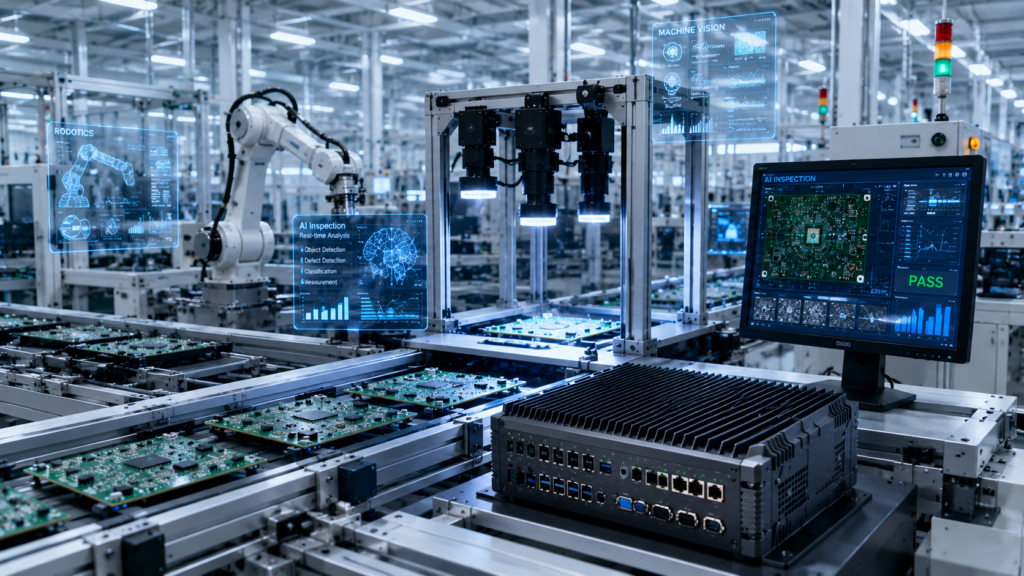
GPU industrial computers enable real-time AI inference for machine vision, robótica, inspección de calidad, and intelligent automation in modern smart factories.
Descripción general de la industria
Artificial Intelligence is transforming industrial operations across virtually every sector. Modern organizations increasingly rely on AI-driven technologies to improve productivity, reducir los costos operativos, enhance quality control, and accelerate decision-making.
Industrial AI applications include:
- Inspección por visión artificial
- Mantenimiento predictivo
- Robots móviles autónomos (RAM)
- Automated guided vehicles (AGV)
- Intelligent surveillance
- Robótica industrial
- Smart transportation
- Industrial IoT analytics
- Detección de defectos
- Optimización de procesos
- Monitoreo de activos
- Safety management
Historically, AI processing was primarily performed in centralized cloud environments. Sin embargo, industrial deployments often face limitations associated with cloud-based architectures, incluido:
- Latencia de red
- Bandwidth constraints
- Data privacy concerns
- Connectivity limitations
- Requisitos de respuesta en tiempo real
Como resultado, edge AI computing has emerged as a preferred deployment model for many industrial applications.
GPU industrial computers provide the processing power required to execute AI models directly at the edge. By combining industrial-grade computing hardware with GPU acceleration technologies, these platforms support real-time AI inference while maintaining reliability in harsh environments.
Industries increasingly deploying GPU-powered edge AI systems include:
- Fabricación
- Transporte
- Logistics
- Cuidado de la salud
- Energía
- Security
- Smart cities
- Agriculture
- Retail automation
As AI adoption continues to accelerate, GPU industrial computers are becoming foundational components of modern intelligent infrastructure.
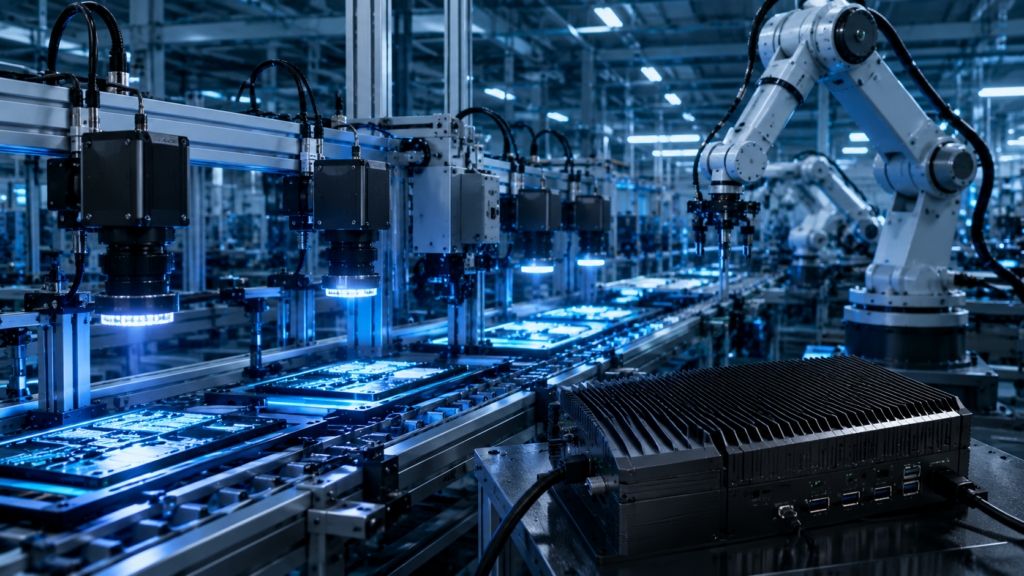
Modern edge AI systems must simultaneously process machine vision data, industrial sensor inputs, and real-time AI inference workloads while maintaining low latency and high reliability.
Desafíos clave
Real-Time Inference Requirements
Industrial applications often require immediate responses to operational events.
Los ejemplos incluyen:
- Defect detection on production lines
- Autonomous robot navigation
- Monitoreo de seguridad
- Gestión del tráfico
- Machine condition analysis
Cloud-based processing may introduce unacceptable delays.
Edge AI systems must deliver inference results in milliseconds.
High Computational Demands
Modern AI models require significant computing resources.
Common workloads include:
- Detección de objetos
- Clasificación de imágenes
- Semantic segmentation
- Facial recognition
- OCR processing
- Análisis predictivo
Running these models efficiently often requires GPU acceleration.
Entornos de implementación hostiles
Industrial environments expose computing platforms to:
- Polvo
- Vibración
- Choque
- Temperaturas extremas
- Humedad
- Interferencia electromagnética
Traditional workstation or server hardware may not withstand these conditions.
Grandes volúmenes de datos
AI applications frequently process:
- High-resolution images
- transmisiones de video
- Datos de sensores
- Operational logs
- Industrial telemetry
Managing and analyzing this information requires robust computing infrastructure.
Power and Space Constraints
Many industrial deployments require compact systems that fit within:
- Armarios de control
- Machine enclosures
- Vehicles
- Edge cabinets
- Mobile platforms
Balancing performance, thermal management, and power consumption presents significant engineering challenges.
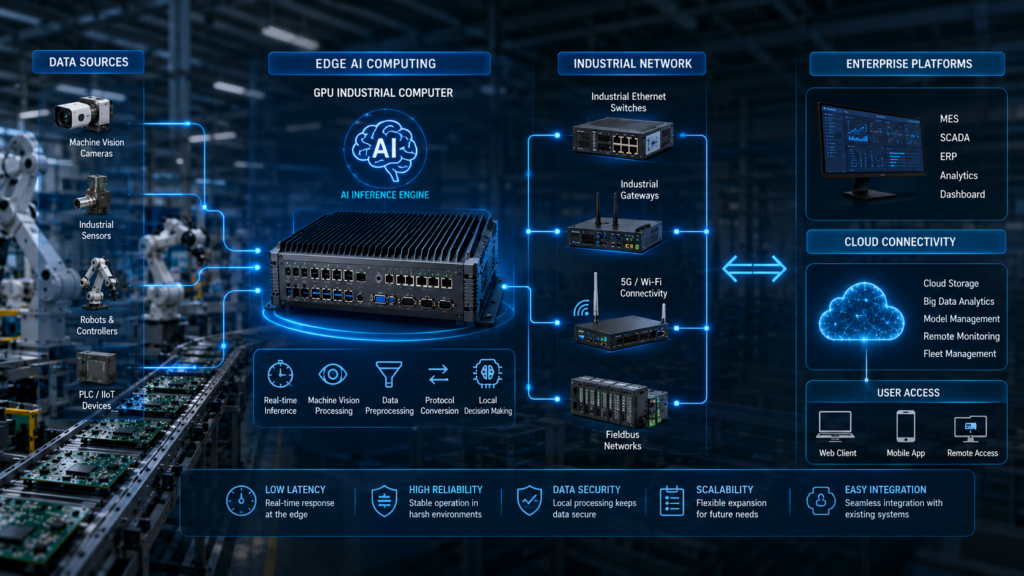
GPU industrial computers serve as the central edge AI platform, connecting machine vision systems, redes industriales, aplicaciones empresariales, and cloud infrastructure for real-time AI inference.
Arquitectura de la solución
A modern AI inference architecture consists of multiple interconnected layers.
Capa 1: Capa de adquisición de datos
La capa de campo incluye:
- Cámaras industriales
- Sensores
- Sistemas LiDAR
- Radar devices
- PLC
- IoT devices
- Sensores de borde
These devices generate the data used for AI analysis.
Capa 2: Edge Connectivity Layer
Industrial networks connect field devices using:
- Ethernet industrial
- GigabitEthernet
- 5GRAMO
- Wifi
- Fieldbus systems
- Pasarelas industriales de IoT
This layer ensures reliable data transmission.
Capa 3: GPU Industrial Computer Layer
The GPU industrial computer serves as the AI inference engine.
Las responsabilidades incluyen:
- AI model execution
- Procesamiento de imágenes
- Análisis de vídeo
- Data preprocessing
- Computación de borde
- Conversión de protocolo
- Toma de decisiones locales
GPU acceleration significantly improves inference performance.
Capa 4: Capa de aplicación
AI applications include:
- Software de visión artificial
- Inspection systems
- Robotics platforms
- Análisis de vídeo
- Predictive maintenance engines
- Industrial monitoring applications
The GPU computer hosts and executes these workloads.
Capa 5: Capa empresarial y de nube
Soportes de integración empresarial:
- plataformas MES
- sistemas ERP
- Análisis de la nube
- Gestión de flotas
- Informes de producción
- Lagos de datos
Only relevant information is transmitted upstream, reducing bandwidth requirements.
Características clave
Aceleración de GPU
The defining feature of a GPU industrial computer is hardware acceleration.
Los beneficios incluyen:
- Faster inference performance
- Parallel processing
- Latencia reducida
- Higher throughput
- Improved AI efficiency
GPU acceleration enables deployment of complex deep learning models at the edge.
Confiabilidad de grado industrial
Industrial environments require dependable operation.
Las computadoras industriales proporcionan:
- Rugged enclosures
- Industrial components
- Soporte de ciclo de vida prolongado
- Continuous operation capability
- Enhanced durability
Estas características mejoran la disponibilidad del sistema..
Fanless or Optimized Thermal Design
Many industrial AI systems utilize:
- Refrigeración sin ventilador
- Heat pipe technology
- Passive thermal management
- Industrial airflow optimization
Reliable thermal design is essential for stable AI performance.
Redes de alta velocidad
AI systems frequently process data from multiple sources.
Soporte de plataformas industriales:
- GigabitEthernet
- 2.5Ethernet
- 10Ethernet
- Conectividad inalámbrica
- Industrial communication protocols
These interfaces support high-bandwidth workloads.
AI Framework Compatibility
GPU industrial computers commonly support:
- TensorFlow
- PyTorch
- ONNX Runtime
- OpenVINO
- TensorRT
- CUDA
This simplifies AI deployment and optimization.
Capacidad de expansión flexible
Industrial AI applications often require:
- Additional storage
- Interfaces de cámara
- Networking modules
- Accelerator cards
Expansion options improve deployment flexibility.
Largo ciclo de vida del producto
Industrial deployments often remain operational for many years.
Las plataformas industriales proporcionan:
- Disponibilidad a largo plazo
- Configuraciones de hardware estables
- Soporte de software consistente
This minimizes redesign costs and lifecycle risks.
Escenarios de implementación
Inspección por visión artificial
GPU industrial computers support:
- Detección de defectos
- Surface inspection
- OCR verification
- Clasificación de productos
- Control de calidad
Real-time AI inference improves manufacturing accuracy and efficiency.
Autonomous Mobile Robots (RAM)
AI-enabled robots rely on GPU computing for:
- Navegación
- Obstacle avoidance
- Mapping
- Localización
- Coordinación de flota
Low-latency inference is critical for safe operation.
Intelligent Video Analytics
GPU systems process video streams for:
- Object tracking
- Detección de intrusiones
- Monitoreo de seguridad
- Análisis de comportamiento
- Occupancy analytics
These applications are widely used in industrial and public environments.
Mantenimiento predictivo
AI models analyze equipment data to identify:
- Abnormal operating conditions
- Performance degradation
- Potential failures
This reduces unplanned downtime and maintenance costs.
Transporte inteligente
Las aplicaciones de transporte incluyen:
- Monitoreo de tráfico
- Detección de vehículos
- Incident analysis
- Tolling systems
- Intersecciones inteligentes
Edge AI processing improves responsiveness and scalability.
Healthcare AI Systems
Medical environments deploy AI for:
- imagen médica
- Diagnostic assistance
- Monitoreo de pacientes
- Intelligent healthcare workflows
Industrial-grade computing platforms support reliable operation.
Beneficios comerciales
Toma de decisiones más rápida
Local AI inference eliminates cloud latency and enables real-time operational responses.
Eficiencia operativa mejorada
Automation powered by AI reduces manual intervention and improves process consistency.
Enhanced Product Quality
Machine vision systems detect defects earlier and more accurately than traditional inspection methods.
Lower Bandwidth Costs
Processing data locally reduces cloud transmission requirements and network traffic.
Increased Data Security
Sensitive operational data remains on-site rather than being transmitted externally.
Scalability for Future AI Applications
GPU industrial computers provide a flexible platform for expanding AI initiatives as requirements evolve.
Por qué CoreIPC
CoreIPC provides industrial computing platforms designed for AI inference, computación de borde, visión artificial, robótica, y aplicaciones de automatización inteligente. Our GPU-enabled industrial computers deliver the processing power required for modern AI workloads while maintaining industrial-grade reliability, Conectividad de E/S flexible, largos ciclos de vida del producto, y capacidades de personalización OEM/ODM. Whether supporting machine vision inspection, autonomous robotics, análisis de vídeo, o mantenimiento predictivo, CoreIPC solutions help organizations deploy scalable and future-ready edge AI infrastructures.
Preguntas frecuentes
What is a GPU industrial computer?
A GPU industrial computer is an industrial-grade computing platform equipped with GPU acceleration capabilities designed to execute AI inference, visión artificial, and edge computing workloads in demanding environments.
Why is GPU acceleration important for AI inference?
GPUs perform parallel processing, enabling significantly faster execution of deep learning models compared to CPUs alone.
Can AI inference be performed without cloud connectivity?
Sí. Edge AI systems execute inference locally, reducing latency and allowing operation even when internet connectivity is unavailable.
What industries use GPU industrial computers?
Fabricación, transporte, logística, cuidado de la salud, energía, seguridad, ciudades inteligentes, and robotics industries commonly deploy GPU-powered industrial computers.
Are GPU industrial computers suitable for machine vision?
Sí. Machine vision is one of the most common applications for GPU industrial computers due to the computational demands of image processing and AI inference.
What AI frameworks are typically supported?
Most systems support TensorFlow, PyTorch, ONNX Runtime, OpenVINO, CUDA, and TensorRT.
Can GPU industrial computers support multiple cameras?
Sí. Many platforms support multiple high-resolution cameras for machine vision and video analytics applications.
Are fanless GPU industrial computers available?
Sí. Many industrial AI platforms utilize advanced passive cooling and optimized thermal designs to achieve reliable operation.
How do GPU industrial computers improve predictive maintenance?
They process sensor and operational data locally, enabling AI models to identify equipment abnormalities before failures occur.
What should be considered when selecting a GPU industrial computer?
Important factors include GPU performance, CPU capability, capacidad de memoria, diseño térmico, especificaciones ambientales, opciones de conectividad, y disponibilidad del ciclo de vida.
Conclusión
A Computadora industrial GPU para inferencia de IA provides the computing foundation necessary for modern edge AI applications. By combining industrial-grade reliability with GPU acceleration, these platforms enable real-time AI processing, machine vision analytics, autonomous robotics, mantenimiento predictivo, and intelligent automation across diverse industrial environments.
As organizations continue to adopt AI-driven technologies, GPU industrial computers will play an increasingly important role in delivering low-latency inference, enhanced operational efficiency, improved quality control, and scalable intelligent infrastructure. Their ability to execute advanced AI workloads at the edge makes them a key component of future Industry 4.0 e iniciativas de fabricación inteligente.
Contáctenos
Looking for a GPU industrial computer for AI inference applications?
CoreIPC proporciona computadoras industriales, computadoras integradas, placas base industriales, and customized edge AI platforms designed for machine vision, robótica, intelligent video analytics, mantenimiento predictivo, y automatización industrial.
Contact our engineering team to discuss your AI deployment requirements and identify the ideal industrial computing solution for your project.