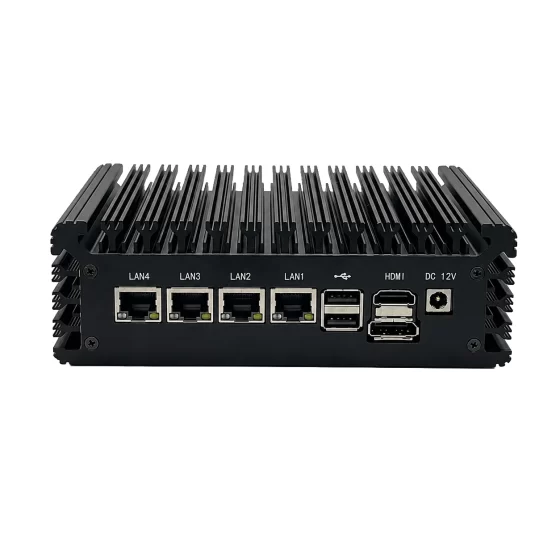
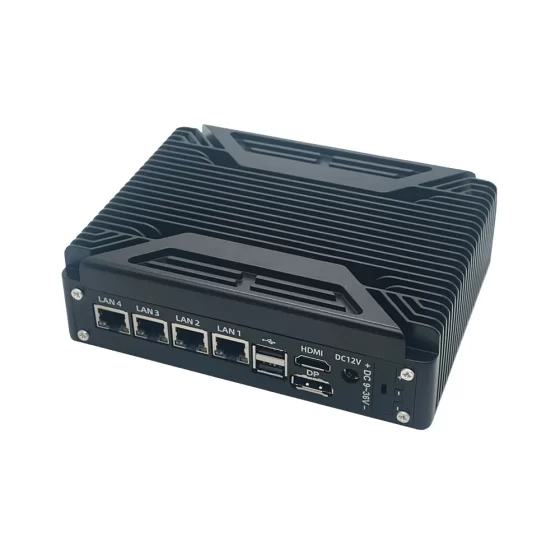
Soluciones de informática industrial CoreIPC

Sistema de procesamiento de IA en tiempo real: Procesamiento de IA en tiempo real para la automatización industrial
Resumen ejecutivo
A real time ai processing system provides the industrial computing foundation for fast AI inference, inspección por visión artificial, guía robótica, monitoreo de procesos, detección de defectos, and automation response in modern manufacturing environments.
Many industrial AI applications require decisions within very short time windows. A vision system may need to reject a defective product before it leaves the inspection station. A robotic cell may need object position data before the next motion cycle. A monitoring system may need to detect abnormal equipment behavior before it causes downtime.
An industrial computer or embedded computer can perform local AI processing close to cameras, sensores, PLC, robots, transportadores, and machines. Esto ayuda a reducir la latencia., lower network dependency, and improve production reliability.
Compared with cloud-only AI processing, real-time edge AI systems allow factories to process data locally and send only useful results, alarmas, resúmenes, or selected records to MES, SCADA, bases de datos de calidad, o plataformas en la nube.
En comparación con las PC comerciales estándar, industrial computers are better suited for factory deployment because they provide rugged mechanical design, E/S flexibles, redes estables, almacenamiento confiable, opciones sin ventilador, y soporte de ciclo de vida prolongado.
This article explains how real time ai processing systems work, ¿Qué desafíos de implementación enfrentan los fabricantes?, cómo está estructurada la arquitectura de la solución, and which hardware features matter when selecting an industrial computer or embedded computer for real-time AI workloads.
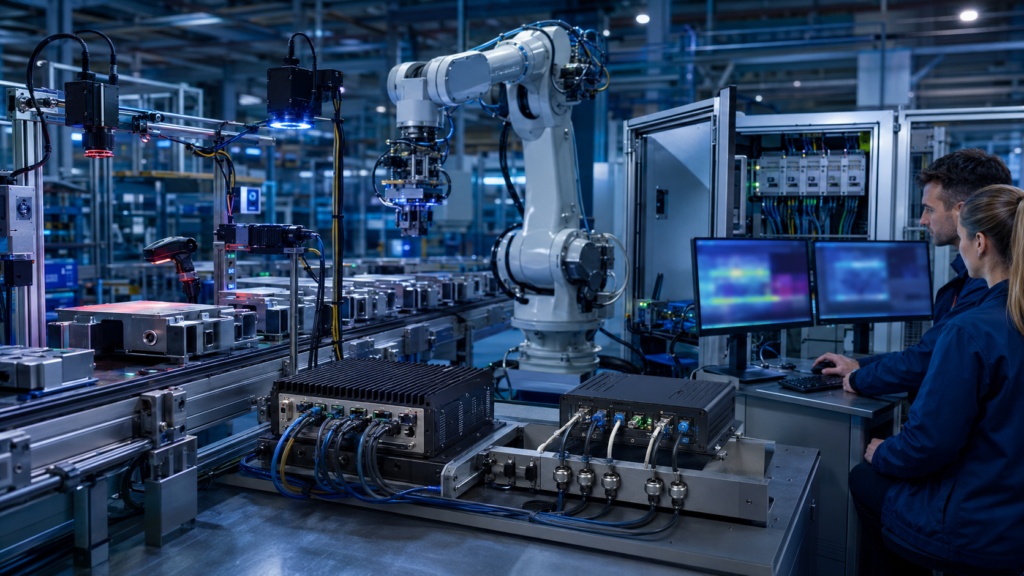
Real-Time AI Factory Deployment
Descripción general de la industria
AI Is Moving from Offline Analysis to Real-Time Production
Early industrial AI projects often focused on offline analysis.
Imágenes, sensor logs, or production records were collected first and analyzed later. This approach is useful for engineering review, model development, and process study.
Sin embargo, modern factories increasingly need AI to support live production.
Real-time AI can help with:
- Rechazo de defectos
- Inspección por visión artificial
- Guiado de robots
- Clasificación del transportador
- Reconocimiento de códigos de barras y OCR
- Predictive maintenance alerts
- Safety zone awareness
- Monitoreo de equipos
- Detección de anomalías en el proceso
- Verificación de embalaje
- Logistics routing
These applications require local computing hardware that can process data quickly and communicate with automation systems reliably.
Why Real-Time Processing Matters
In industrial automation, delay can directly affect production results.
If AI inference is too slow, a defective product may pass the reject point. If robot guidance data arrives late, the robot may miss the correct picking window. If an equipment alarm is delayed, maintenance teams may respond too late.
Real-time AI processing helps convert data into action within the production cycle.
The system must handle image capture, preprocesamiento, model inference, result calculation, almacenamiento de datos, and PLC communication fast enough for the application.
La informática industrial es la base del hardware
A real-time AI system depends on more than a model.
It needs stable industrial computing hardware that can run AI workloads continuously, connect to industrial devices, gestionar datos, and operate in real factory environments.
Los ordenadores industriales y los ordenadores integrados proporcionan esta base..
Pueden admitir interfaces de cámara., múltiples puertos LAN, Conectividad USB, puertos serie, GPIO, E/S digitales, Almacenamiento SSD o NVMe, salida de pantalla, y módulos de expansión.
Esto los hace adecuados para la inspección por IA en el lado de la máquina, células robóticas, automated sorting systems, seguimiento de la producción, and OEM smart equipment.

Real-Time AI Deployment Challenges
Desafíos clave
Low-Latency AI Inference
Real-time AI systems must process data quickly.
The required response time depends on the application. A high-speed inspection line may need results within milliseconds or a short production cycle. A predictive maintenance system may allow longer analysis windows but still needs timely alerts.
Latency may come from several stages:
- Image capture
- Sensor sampling
- Data transfer
- Preprocessing
- AI model inference
- Post-processing
- comunicación PLC
- Almacenamiento de resultados
- Carga de red
The industrial computer must be selected according to the full processing pipeline, not only the AI model itself.
Multi-Source Data Processing
Real-time AI systems often collect data from many sources.
Una sola implementación puede incluir cámaras., sensores, PLC, robots, lectores de códigos de barras, controladores de movimiento, y bases de datos de producción.
Las fuentes de datos comunes incluyen:
- Cámaras industriales
- 3cámaras D
- Cámaras de alta velocidad
- Sensores de vibración
- Sensores de temperatura
- Señales PLC
- Controladores de robots
- Conveyor encoders
- Lectores de códigos de barras
- Medidores de energía
- Controladores de máquinas
The computer must collect and process this data without unstable timing or communication bottlenecks.
Camera Bandwidth and Frame Stability
Machine vision is one of the most common real-time AI applications.
Camera bandwidth must be planned carefully. A system using multiple high-resolution cameras may generate large data streams that require stable LAN, USB, PCIe, or frame grabber support.
Los factores importantes incluyen:
- Recuento de cámaras
- Resolución
- Velocidad de fotogramas
- Profundidad de bits de la imagen
- Interface type
- Sincronización del disparador
- Separación de red
- Velocidad de almacenamiento
- AI inference workload
A powerful processor cannot solve the problem if images are not acquired reliably.
Industrial Control Integration
Real-time AI results must connect with production action.
The system may need to send pass, fallar, alarma, posición, clasificación, or routing results to PLCs, robots, transportadores, mecanismos de rechazo, or SCADA systems.
This requires reliable industrial communication.
Las interfaces útiles pueden incluir:
- LAN
- RS232
- RS485
- GPIO
- Entrada digital
- Salida digital
- USB
- hdmi
- DisplayPort
- M.2
- PCIe
The right I/O configuration reduces external converters and improves system reliability.
Long-Term Stability Under Continuous Workload
Real-time AI systems often run across multiple shifts.
The computer may operate inside a cabinet, cerca de una línea de producción, inside an inspection machine, or beside a robotic cell.
Estos entornos pueden incluir vibraciones., polvo, calor, ruido electrico, flujo de aire limitado, y tensión del cable.
Industrial-grade hardware helps maintain stable operation under continuous AI workload and factory conditions.

Real-Time AI Processing Architecture
Real Time AI Processing System Solution Architecture
Capa de adquisición de datos
La capa de adquisición de datos captura imágenes., valores de los sensores, estado de la máquina, and production signals.
Esta capa puede incluir:
- Cámaras
- Sensores
- PLC
- Robots
- Codificadores
- Controladores de iluminación
- Lectores de códigos de barras
- Controladores de movimiento
- Pasarelas industriales
- Equipo de producción
The quality and timing of this data directly affect real-time AI performance.
If data acquisition is unstable, AI results may become delayed, incompleto, or unreliable.
Capa de computación de borde industrial
The industrial edge computing layer is where the industrial computer or embedded computer performs local processing.
en esta capa, el sistema puede:
- Receive camera images
- Recopilar datos de sensores
- Run AI inference
- Procesar algoritmos de visión artificial.
- Detectar defectos o anomalías
- Calculate robot coordinates
- Enviar resultados a PLC
- Almacenar registros locales
- Display dashboards
- Upload selected data
This layer reduces dependence on remote servers and allows AI decisions to happen close to the equipment.
AI Inference Layer
The AI inference layer contains the models and runtime environment.
Dependiendo de la aplicación, puede incluir:
- Modelos de detección de objetos
- Modelos de detección de defectos
- Modelos OCR
- Segmentation models
- Modelos de detección de anomalías
- Modelos de mantenimiento predictivo
- Video analytics models
- Lógica de fusión de sensores
The computing platform must support the required operating system, conductores, Marco de IA, SDK de cámara, GPU or accelerator modules, y software de comunicación industrial.
Automation Response Layer
The automation response layer connects AI output with real production action.
Por ejemplo:
- A defect result triggers a reject mechanism.
- A robot receives object coordinates.
- A conveyor sorter receives lane information.
- A monitoring system sends an alarm.
- A PLC receives a pass or fail signal.
- A dashboard displays production status.
This layer turns AI processing into practical automation value.
Capa de integración de datos de fábrica
Real-time AI systems also need to connect with higher-level software.
The industrial computer may send selected records to:
- MES
- SCADA
- ERP
- Bases de datos de calidad
- WMS
- Plataformas en la nube
- Paneles de control de IoT industriales
- Plataformas de mantenimiento
- Sistemas de historiadores locales.
En lugar de cargar todos los datos sin procesar, the system can upload results, exceptions, alarmas, imágenes, resúmenes, y registros de trazabilidad.
Características clave
Real-Time AI Performance
The most important feature is stable real-time performance.
The system must process data within the required cycle time.
La selección debe considerar:
- rendimiento de la CPU
- Compatibilidad con GPU o acelerador de IA
- Capacidad de memoria
- Ancho de banda de la cámara
- Velocidad de almacenamiento
- Latencia de red
- Complejidad del modelo de IA
- Soporte del sistema operativo
- Diseño térmico
- Estabilidad a largo plazo
Para cargas de trabajo ligeras, una computadora integrada puede ser suficiente. For multi-camera or deep learning systems, an edge AI computer or industrial PC with stronger acceleration may be required.
Multiple Camera and Sensor Interfaces
Real-time AI platforms must support reliable device connectivity.
Las opciones de hardware útiles pueden incluir:
- USB 3.0
- Múltiples puertos LAN
- 2.5Opciones GbE o 10GbE
- RS232
- RS485
- GPIO
- Entrada digital
- Salida digital
- expansión PCIe
- Expansión M.2
- HDMI o DisplayPort
Estas interfaces admiten cámaras., sensores, controladores de iluminación, PLC, lectores de códigos de barras, robots, y exhibiciones locales.
Almacenamiento local y almacenamiento en búfer de datos
Real-time AI systems may generate many records.
La computadora puede almacenar:
- Imágenes de defectos
- Registros de inferencia
- Videoclips
- Historial de sensores
- Bases de datos locales
- Archivos de modelo de IA
- Registros de alarma
- Informes de producción
- Amortiguadores temporales
Generalmente se prefiere el almacenamiento SSD o NVMe porque proporciona un acceso rápido y una mejor resistencia a los golpes que las unidades mecánicas..
Para aplicaciones con muchos datos, capacidad de almacenamiento, velocidad de escritura sostenida, escribe resistencia, y la estrategia de respaldo debe revisarse cuidadosamente.
Network Separation
Real-time systems often need multiple networks.
Una red puede conectar cámaras.. Another may connect PLCs. Another may connect MES or cloud systems.
Múltiples puertos LAN pueden admitir:
- Separación del tráfico de cámaras
- Comunicación de red de máquinas.
- Conexión TI de fábrica
- Mantenimiento remoto
- Subir a la nube
- Segmentación de seguridad
- Implementación multilínea
Good network architecture reduces traffic conflict and improves system stability.
Diseño robusto y sin ventilador
Fanless industrial computers are useful in many real-time AI deployments.
Reducen la entrada de polvo y eliminan un punto común de falla mecánica..
Sin embargo, Las cargas de trabajo de IA pueden generar calor. For high-performance AI systems, thermal planning is important.
Designers should review:
- Carga de trabajo del procesador
- Uso de GPU o acelerador
- Temperatura ambiente
- Flujo de aire del gabinete
- Diseño de gabinete
- Método de montaje
- Power input
- Enrutamiento de cables
Stable thermal design helps keep AI performance consistent.
Largo ciclo de vida y mantenibilidad
Real-time AI systems often become part of production infrastructure.
Frequent hardware changes can create validation issues with AI software, camera drivers, Controladores de GPU, sistemas operativos, and automation interfaces.
Industrial computing platforms with lifecycle planning help manufacturers and machine builders maintain consistent systems across multiple machines, pauta, y sitios de fábrica.

Real-Time AI Production Operations
Escenarios de implementación
Real-Time Vision Inspection
Real-time AI processing is widely used for machine vision inspection.
The system captures images, ejecuta inferencia de IA, detecta defectos, and sends pass or fail results to a PLC.
Applications include electronics inspection, inspección de embalaje, inspección de alimentos, inspección farmacéutica, inspección de batería, and semiconductor AOI.
Robotic Guidance
Robots can use real-time AI processing for object recognition, localización de piezas, recogida de contenedores, and inspection.
The industrial computer processes camera or 3D sensor data and sends coordinates to the robot controller.
This supports flexible automation and faster robotic decision-making.
Conveyor Sorting
Sorting systems need fast decisions.
An AI computer can recognize products, paquetes, etiquetas, códigos de barras, or object categories and send routing information to PLCs or diverters.
This is useful in logistics, embalaje, e-commerce fulfillment, and production material handling.
Predictive Maintenance Alerts
Real-time AI can analyze machine data from vibration, temperatura, actual, presión, or PLC status.
The system can detect abnormal patterns and generate alerts locally.
This helps maintenance teams respond earlier to equipment problems.
Análisis de vídeo
Industrial video analytics can monitor production flow, equipment areas, zonas de seguridad, logistics movement, o instalaciones remotas.
The industrial computer processes video streams locally and sends only event records or alerts to monitoring systems.
Esto reduce la carga de la red y mejora el tiempo de respuesta..
Packaging Verification
Packaging lines often require fast checks for labels, códigos de barras, códigos de fecha, gorras, sellos, cajas de cartón, and final package quality.
A real-time AI processing system can inspect each package and trigger reject actions through PLC communication.
Esto ayuda a reducir los errores de envío y mejorar la trazabilidad..
Industrial IoT Edge Processing
Industrial IoT deployments can use real-time AI to analyze sensor data near machines.
An embedded computer can collect data, detectar anomalías, registros de buffer, and upload selected results to dashboards or cloud platforms.
This supports smarter machine monitoring and factory visibility.
OEM Intelligent Equipment
Machine builders can integrate real-time AI computers into inspection machines, sistemas robóticos, puertas de enlace inteligentes, equipo de clasificación, y equipos de producción automatizados.
La plataforma informática puede proporcionar inferencia de IA, procesamiento de imágenes, comunicación PLC, almacenamiento local, pantalla HMI, y salida de datos de fábrica.
Beneficios comerciales
Decisiones de producción más rápidas
Real-time AI processing allows decisions to happen near the production equipment.
This reduces delay and helps the system respond within the required cycle time.
Fast local processing is valuable for inspection, clasificación, guía del robot, escucha, y alarmas.
Reducción de la dependencia de la nube
Factories do not need to send every image, secuencia de vídeo, o registro del sensor a la nube.
The industrial computer can process data locally and upload only selected results.
This reduces bandwidth usage and improves production resilience.
Control de calidad mejorado
Real-time AI helps detect defects earlier and more consistently.
The system can inspect products during production and trigger immediate actions when defects appear.
This reduces downstream quality risk and supports stronger production control.
Better Automation Integration
Industrial computers can connect AI results with PLCs, robots, transportadores, sensores, y software de fábrica.
This turns AI models into practical automation systems.
The result can be faster reject control, better robot guidance, automated sorting, and improved monitoring.
Mayor trazabilidad
Los resultados de la IA se pueden vincular con los ID de los productos, marcas de tiempo, categorías de defectos, imágenes, ID de estación, versiones del modelo, y registros de producción.
This creates useful traceability for audits, engineering review, análisis de calidad, y mejora de procesos.
Implementación escalable de fábrica inteligente
A standardized real-time AI processing platform makes it easier to deploy AI across multiple lines, maquinas, y fábricas.
El hardware consistente simplifica las imágenes de software, validación del conductor, planificación de repuestos, entrenamiento de mantenimiento, y soporte del ciclo de vida.
This helps manufacturers move from pilot AI projects to scalable production deployment.
Por qué CoreIPC
CoreIPC proporciona plataformas informáticas industriales para IA de vanguardia, visión artificial, automatización industrial, robótica, e integración de sistemas integrados. For real time ai processing applications, CoreIPC se centra en hardware informático industrial confiable, soluciones informáticas integradas, Configuraciones de E/S flexibles, diseño de sistema compacto, capacidad de almacenamiento local, y soporte de personalización OEM/ODM. CoreIPC ayuda a los integradores de sistemas, constructores de maquinaria, y los fabricantes seleccionan plataformas informáticas que coincidan con los requisitos de implementación reales, incluida la carga de trabajo de IA, interfaces de cámara, diseño de red, comunicación PLC, necesidades de almacenamiento, métodos de montaje, entrada de energía, condiciones termicas, y planificación del ciclo de vida.
Preguntas frecuentes
1. What is a real-time AI processing system?
A real-time AI processing system uses local computing hardware to run AI inference and generate results within a required production time window.
It may process camera images, valores de los sensores, PLC data, secuencias de vídeo, or robot vision data. The system then sends results to automation equipment, tableros, or factory software.
2. Why use an industrial computer for real-time AI processing?
An industrial computer is designed for continuous operation in factory environments.
Soporta instalación robusta, E/S industriales, conectividad de la cámara, redes confiables, almacenamiento local, y una implementación de ciclo de vida prolongado. These features make it suitable for real-time AI systems installed near machines, transportadores, robots, y estaciones de inspección.
3. How is an embedded computer used in real-time AI systems?
Se puede instalar una computadora integrada dentro de las máquinas, sistemas de inspección, gabinetes de control, or compact automation equipment.
Puede recopilar datos, ejecutar inferencia de IA, comunicarse con PLC, mostrar resultados locales, and upload selected records. Its compact size is useful for machine builders and distributed edge deployments.
4. What applications need real-time AI processing?
Applications include machine vision inspection, guía robótica, conveyor sorting, verificación de embalaje, análisis de vídeo, mantenimiento predictivo, reconocimiento de código de barras, monitoreo de seguridad, and industrial IoT edge processing.
Any application that needs fast AI decisions near production equipment can benefit from real-time AI processing.
5. Does real-time AI processing require a GPU?
No siempre. Some lightweight AI models can run on CPU-based industrial computers.
A GPU or AI accelerator may be needed for high-resolution images, múltiples cámaras, análisis de vídeo, modelos de aprendizaje profundo, or strict cycle-time requirements. El hardware debe seleccionarse basándose en pruebas de modelos reales..
6. What interfaces are important for real-time AI computers?
Las interfaces importantes pueden incluir múltiples puertos LAN, USB 3.0, 2.5Llevar, 10Llevar, RS232, RS485, GPIO, entrada digital, salida digital, hdmi, DisplayPort, M.2, PCIe, sata, y soporte de almacenamiento NVMe.
Estas interfaces ayudan a conectar cámaras., sensores, PLC, robots, controladores de iluminación, alarmas, y redes de fábricas.
7. Can fanless industrial computers support real-time AI?
Fanless industrial computers can support many moderate real-time AI workloads.
Sin embargo, inferencia de IA de alto rendimiento, procesamiento multicámara, o las cargas de trabajo basadas en GPU pueden generar un calor significativo. carga de trabajo de la CPU, uso de acelerador, flujo de aire del gabinete, temperatura ambiente, y el método de montaje deben revisarse antes de la implementación..
8. How does real-time AI connect with PLCs?
The AI computer can communicate with PLCs through Ethernet, comunicación en serie, E/S digitales, or supported industrial software interfaces.
The PLC may trigger image capture or send machine status. Después del procesamiento, la computadora AI puede devolver el pase, fallar, alarma, posición, o resultados de clasificación.
9. Can real-time AI systems connect with MES or SCADA?
Sí. Las computadoras industriales pueden enviar resultados de IA, alarmas, registros de inspección, datos de producción, and system status to MES, SCADA, bases de datos de calidad, tableros, o plataformas en la nube.
This connects machine-side AI decisions with higher-level manufacturing workflows.
10. Qué se debe probar antes de la implementación?
Antes del despliegue, El sistema debe probarse con cámaras reales., sensores, Modelos de IA, comunicación PLC, tiempos del ciclo de producción, carga de trabajo de almacenamiento, arquitectura de red, y operación de larga duración.
Estabilidad térmica, inference latency, frame acquisition, I/O response, almacenamiento en búfer local, and data upload should also be validated.
Conclusión
A real time ai processing system is a practical foundation for industrial AI applications that require low latency, local inference, automation response, and reliable edge deployment.
Colocando una computadora industrial o una computadora integrada cerca de las cámaras, sensores, PLC, robots, transportadores, y sistemas de producción, Los fabricantes pueden procesar datos localmente., reducir la dependencia de la nube, mejorar el tiempo de respuesta, and connect AI results with real production action.
Se debe seleccionar la plataforma adecuada de acuerdo con los requisitos de implementación reales., incluida la carga de trabajo de IA, interfaz de la cámara, sensor input, configuración de E/S, arquitectura de red, necesidades de almacenamiento, requisitos de expansión, método de montaje, entrada de energía, condiciones termicas, soporte del sistema operativo, y planificación del ciclo de vida.
CoreIPC supports real-time AI processing projects with industrial computing platforms designed for practical factory and equipment deployment. Con la base de hardware adecuada, Los fabricantes y fabricantes de maquinaria pueden construir sistemas fiables., escalable, and production-ready AI systems for smart manufacturing.
Contáctenos
Busco ordenador industrial, computadora integrada, or edge AI platform for real-time AI processing?
Póngase en contacto con CoreIPC para analizar los requisitos de su proyecto., incluida la carga de trabajo de IA, interfaz de la cámara, sensor input, comunicación PLC, diseño de red, necesidades de almacenamiento, método de montaje, entrada de energía, entorno operativo, necesidades del ciclo de vida, y opciones de personalización OEM/ODM.