販売に関するお問い合わせ
|
見積もりを取得する


Battery Inspection AI Computer for Quality Control | コアIPC

AI Inspection for Battery Manufacturing: Battery Inspection AI Computer for Reliable Quality Control

AI Inspection for Battery Manufacturing: Battery Inspection AI Computer for Reliable Quality Control

エグゼクティブサマリー

Battery inspection AI systems are becoming an important part of modern battery manufacturing, where quality, consistency, safety, and traceability are critical across every production stage.

In battery production, defects may appear in electrode materials, cell assembly, tab welding, sealing, labeling, module assembly, pack integration, and final inspection. Some defects are visible, while others are subtle and difficult to identify through manual inspection or simple rule-based vision systems.

An AI inspection platform uses industrial cameras, lighting, センサー, machine vision software, AI inference models, and industrial computing hardware to detect defects, classify abnormalities, verify assembly quality, and connect inspection results with production records.

An industrial computer or embedded computer acts as the local AI processing platform. It receives image or sensor data, runs AI inference workloads, communicates with PLCs and automation systems, stores inspection records, and uploads data to MES, quality management systems, or factory databases.

Compared with standard commercial PCs, industrial computers provide stronger reliability, 柔軟な I/O, rugged mechanical design, 安定した熱性能, ファンレスオプション, 長いライフサイクルのサポート. These features are important when AI inspection systems are deployed near battery production lines, inspection stations, welding equipment, コンベア, or automated assembly cells.

This article explains how battery inspection AI platforms work, what challenges manufacturers face, ソリューション アーキテクチャがどのように構成されているか, and which hardware features matter most when selecting an industrial computer for battery manufacturing inspection.

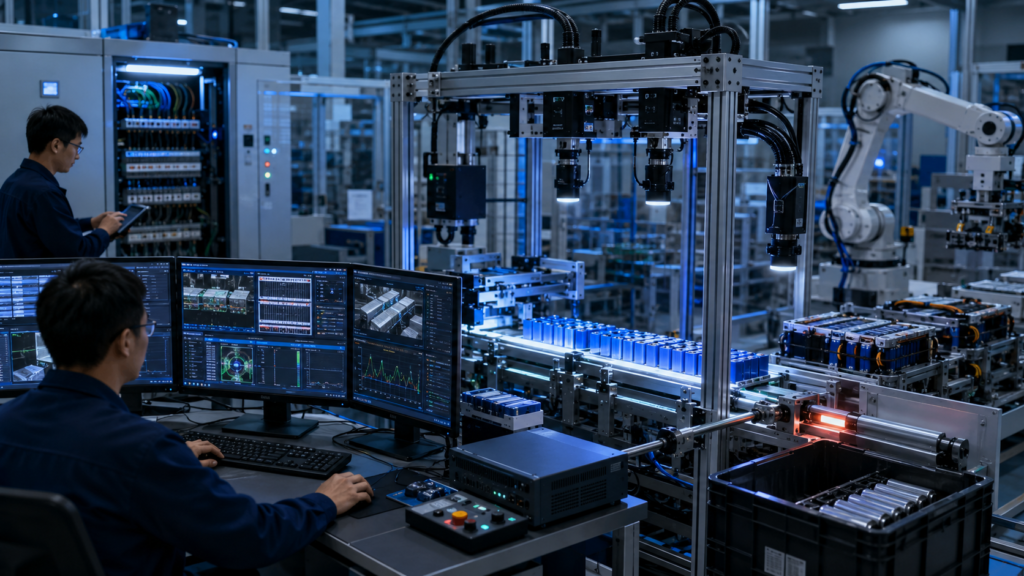
Industrial computers processing battery inspection AI data on a production line with cameras, lighting, battery cells, modules, and PLC cabinet

Industrial computers process camera images for AI-based battery defect detection and production quality control.

業界の概要

Battery Manufacturing Requires Strict Quality Control

Battery manufacturing involves multiple process steps where small defects can affect product reliability, safety, and performance.

Inspection may be required during electrode production, cell assembly, welding, sealing, formation, module assembly, pack integration, labeling, and final testing.

Common inspection targets may include:

  • Electrode surface defects
  • Coating irregularities
  • Tab position and welding quality
  • Cell alignment
  • Seal quality
  • Surface scratches or dents
  • Label and barcode accuracy
  • Module assembly verification
  • Pack wiring and connector inspection
  • Final appearance inspection

Because battery products often move through automated production lines, inspection systems must operate quickly, consistently, and reliably.

Why AI Is Used in Battery Inspection

Traditional vision systems are useful for clear and repeatable defects.

しかし, battery manufacturing defects may vary in shape, size, texture, position, lighting response, and surface appearance. Some abnormalities are difficult to define using fixed thresholds or simple image rules.

AI inspection can help identify complex defect patterns and classify different abnormal conditions.

Battery inspection AI systems can support:

  • Surface defect detection
  • Weld defect recognition
  • Assembly error detection
  • Foreign object detection
  • Label verification
  • Cell and module alignment checking
  • Packaging inspection
  • Quality grading
  • Defect classification
  • Production traceability

AI does not replace good camera, lighting, and mechanical design. Instead, it depends on stable image acquisition and reliable industrial computing hardware.

Industrial Computing Is the Local AI Foundation

Battery inspection systems often need to make decisions close to the production line.

Sending every image to a remote server may increase latency, network load, and dependency on centralized infrastructure. Local industrial computers allow image processing and AI inference to happen near the inspection point.

An AI quality control computer can connect cameras, lighting controllers, センサー, PLC, コンベア, ロボット, barcode scanners, and factory networks.

An embedded computer may be used when the inspection system must fit inside a machine, control cabinet, compact workstation, or OEM equipment platform.

Battery inspection AI challenges with reflective cells, weld areas, seal edges, barcode labels, scratches, dents, contamination marks, and industrial cameras

Surface reflection, weld areas, cell alignment, labels, defect variation, and lighting affect battery inspection reliability.

主要な課題

Defect Variability in Battery Production

Battery defects are not always simple or consistent.

A scratch, dent, contamination mark, welding abnormality, coating issue, or alignment error may appear differently depending on product type, surface material, lighting, camera angle, and production condition.

Common inspection challenges include:

  • Low-contrast surface defects
  • Reflective metal surfaces
  • Fine scratches
  • Deformation or swelling
  • Tab welding irregularities
  • Seal defects
  • Cell misalignment
  • Label placement errors
  • Foreign particles
  • Connector or cable assembly mistakes

The AI platform must process real production images reliably and avoid unstable detection results.

High Image Processing Workload

Battery inspection may involve high-resolution cameras, multiple inspection angles, and fast-moving production lines.

The AI computer must process images quickly enough to match the production cycle. If processing is delayed, the system may slow down inspection, miss production timing, or fail to trigger reject actions on time.

ハードウェアの選択は次の点を考慮する必要があります:

  • Camera resolution
  • Number of cameras
  • Frame rate
  • AI model size
  • Inspection cycle time
  • Local image storage
  • PLC communication timing
  • MES or database upload requirements

Stable sustained performance is more important than short peak performance.

Lighting and Surface Reflection

Battery components can include reflective metal tabs, aluminum surfaces, plastic films, labels, connectors, and dark or glossy materials.

These surfaces may create glare, shadows, low contrast, or inconsistent image quality. Poor image quality can reduce AI inspection accuracy.

A reliable system requires coordination between camera selection, lens design, lighting method, mounting position, trigger timing, software model, and computing platform.

The industrial computer must support stable camera acquisition and lighting control where required.

Integration with Automation Equipment

Battery production lines are often highly automated.

The AI inspection computer may need to communicate with PLCs, motion systems, welding equipment, コンベア, ロボット, alarms, reject mechanisms, MESシステム, and quality databases.

This requires reliable industrial I/O and network connectivity.

A practical AI inspection platform may need:

  • LAN
  • USB
  • RS232
  • RS485
  • GPIO
  • デジタル入力
  • デジタル出力
  • Display output
  • Expansion interfaces

Without the right interface configuration, system integration becomes more complex.

Continuous Operation and Traceability

Battery manufacturing inspection systems may operate across long shifts and high production volumes.

If the inspection computer fails, inspection may stop, quality data may be lost, or production records may become incomplete.

Traceability is also important. Inspection results should be linked with product IDs, batch numbers, station IDs, timestamps, defect categories, images, and production records.

Industrial-grade computing hardware helps support stable operation and reliable data handling.

Industrial computer connected to cameras, lighting, PLC, conveyor, robot handling cell, MES, quality database, and dashboard for battery inspection AI

Industrial computers connect AI inspection cameras, automation equipment, MES, and battery quality systems.

Battery Inspection AI Solution Architecture

Image and Sensor Acquisition Layer

The acquisition layer captures the raw data needed for AI inspection.

This layer may include industrial cameras, lenses, lighting modules, trigger sensors, バーコードリーダー, measurement devices, and production sensors.

Depending on the inspection point, the system may collect:

  • Electrode surface images
  • Cell appearance images
  • Welding area images
  • Seal inspection images
  • Module assembly images
  • Pack wiring images
  • Label and barcode images
  • Measurement values
  • Position data
  • Process signals

Consistent input data is essential. AI inspection accuracy depends heavily on stable image and sensor quality.

Industrial AI Computing Layer

The industrial AI computing layer is where the battery inspection AI computer performs local processing.

この層では, 産業用コンピュータまたは組み込みコンピュータは、:

  • Receive image data from cameras
  • Run AI inference models
  • Detect defects and abnormalities
  • Classify inspection results
  • Compare results with production rules
  • Store images and logs
  • Send pass or fail signals
  • Communicate with PLCs
  • Upload data to MES or quality systems
  • Display results on local monitors

This edge computing layer allows inspection decisions to happen close to the battery production process.

Automation Control Layer

The automation control layer connects AI inspection results with production equipment.

A PLC, motion controller, conveyor system, welding system, or robot controller may trigger inspection. After AI processing, the industrial computer can send the result back to the control system.

例えば, if a cell surface defect is detected, the system may trigger an alarm, mark the product for review, activate a reject mechanism, or send the data to MES.

This closed-loop communication turns AI inspection into practical production control.

Data Management Layer

Inspection data must be connected with manufacturing records.

The industrial computer may send data to MES, quality management systems, factory databases, or analytics platforms.

Inspection records may include:

  • Product ID
  • Batch number
  • Inspection result
  • Defect category
  • Image evidence
  • Confidence score
  • Station ID
  • Timestamp
  • Equipment ID
  • Operator action
  • Repair or recheck status

This information supports traceability, 品質分析, そしてプロセスの改善.

User Interface and Engineering Layer

Operators and engineers need a practical local interface.

The AI inspection computer may connect to a monitor, touchscreen, keyboard, or HMI panel. The interface can show live images, defect locations, inspection results, alarms, production counts, model status, and system logs.

A clear interface helps engineers adjust inspection parameters, review defect images, and troubleshoot production issues more efficiently.

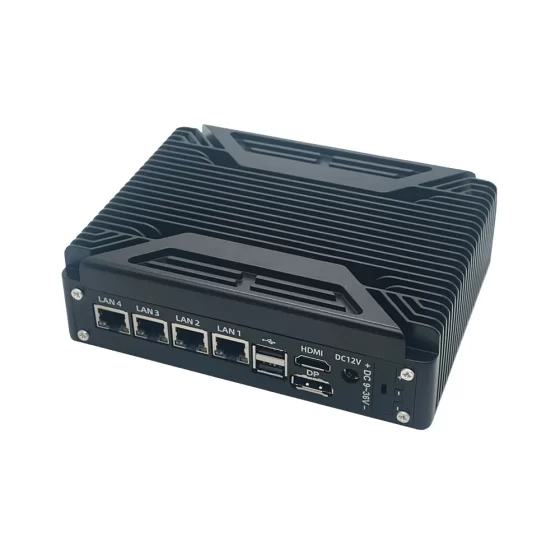
Fanless industrial computer installed in a cabinet for battery inspection AI with camera cables, USB, COM, GPIO, SSD, power supply, and switch

Fanless industrial computers support reliable AI inspection deployment in battery manufacturing cabinets.

主な特長

AI Inference Performance

Battery inspection AI systems require stable AI inference performance.

Different inspection tasks may require different computing levels. A simple label verification system may use a compact embedded computer. A multi-camera weld inspection or surface defect detection system may require a more powerful industrial computer or edge AI platform.

選択は考慮すべきです:

  • AI model complexity
  • Camera resolution
  • Number of cameras
  • Required frame rate
  • Inspection cycle time
  • Storage workload
  • Software framework
  • CPU, GPU, or AI accelerator needs

The hardware should be selected based on real inspection workload, not only general specifications.

Camera and Vision Interface Support

AI inspection depends on reliable image acquisition.

The computing platform should support the camera interfaces required by the project. USB and Gigabit Ethernet cameras are common in many machine vision systems.

Useful interface features may include:

  • USB 3.0
  • Multiple LAN ports
  • PCIe expansion
  • M.2 expansion
  • HDMI or DisplayPort
  • High-speed storage
  • Stable power design

For multi-camera systems, bandwidth planning is especially important. Camera traffic may need to be separated from factory network traffic.

Industrial I/O for Production Integration

The AI inspection computer must connect with real production equipment.

重要な I/O オプションには次のものがあります。:

  • LAN
  • USB
  • RS232
  • RS485
  • GPIO
  • デジタル入力
  • デジタル出力
  • Display output

These interfaces can support cameras, センサー, PLC, lighting controllers, scanners, alarms, reject mechanisms, コンベア, and robotic equipment.

Flexible I/O reduces the need for external converters and improves system reliability.

Fanless and Rugged Design

Fanless industrial computers are useful in many battery inspection applications.

粉塵の侵入を減らし、一般的な機械的故障点を 1 つ除去します。. This is valuable in production environments where systems run continuously and maintenance access may be limited.

A rugged enclosure also helps protect the computer from vibration, ケーブルストレス, and cabinet installation conditions.

For high-performance AI workloads, thermal design should be reviewed carefully to ensure stable long-term operation.

Storage for Images and Inspection Records

Battery inspection AI systems may generate large amounts of data.

The computer may store defect images, production images, inspection logs, model files, reports, and local databases.

SSD storage is commonly preferred because it provides faster response and better shock resistance than mechanical drives.

For image-heavy inspection applications, ストレージ容量, 書き込み耐久性, and data retention policy should be reviewed during system design.

長いライフサイクルと保守性

Battery manufacturing equipment may remain in operation for many years.

Frequent changes in computer models, ドライバー, interfaces, or expansion options can increase validation workload and maintenance cost.

Industrial computing platforms with lifecycle planning help manufacturers and OEM equipment builders maintain consistent inspection systems across multiple production lines and equipment generations.

導入シナリオ

Electrode Surface Inspection

Battery electrode production requires consistent coating and surface quality.

AI inspection can help detect scratches, stains, coating irregularities, particles, edge defects, and other surface abnormalities.

An industrial computer processes camera images locally and sends inspection results to production or quality systems.

Cell Appearance Inspection

Cell appearance inspection may check surfaces, edges, dents, deformation, contamination, and label placement.

An AI quality control computer can detect visual abnormalities and classify inspection results before the cell moves to the next process.

This helps reduce downstream quality risk.

Tab Welding Inspection

Tab welding quality is important in battery cell and module production.

AI inspection systems can analyze weld area images to identify visible abnormalities, position issues, surface marks, or inconsistent welding appearance.

The industrial computer can send pass, fail, or review results to the production control system.

Seal and Edge Inspection

Battery sealing and edge quality may require detailed visual inspection.

AI systems can inspect seal position, surface defects, edge damage, contamination, and visible irregularities.

An embedded computer can be installed near the sealing or inspection station to process images and upload records.

Module Assembly Verification

Battery module assembly involves multiple cells, busbars, connectors, brackets, and structural components.

AI inspection can verify whether parts are present, correctly positioned, and assembled according to production rules.

The system can support assembly confirmation and reduce manual inspection workload.

Battery Pack Wiring and Connector Inspection

Battery pack production includes wiring, connectors, fasteners, labels, and safety-related assembly steps.

AI inspection can check cable routing, connector placement, missing parts, label position, and assembly consistency.

An industrial computer can process images and connect results with MES or quality systems.

Barcode, Label, and Traceability Inspection

Battery production requires strong traceability.

AI vision systems can verify barcodes, QR codes, labels, product IDs, and printed information. The inspection computer can link recognition results with batch data, work orders, and inspection records.

This helps maintain complete production history.

Final Quality Inspection

Before shipment, battery cells, modules, or packs may require final visual inspection.

AI inspection systems can check appearance, labels, connectors, packaging, and visible defects. The industrial computer stores results and uploads data to factory systems for final quality records.

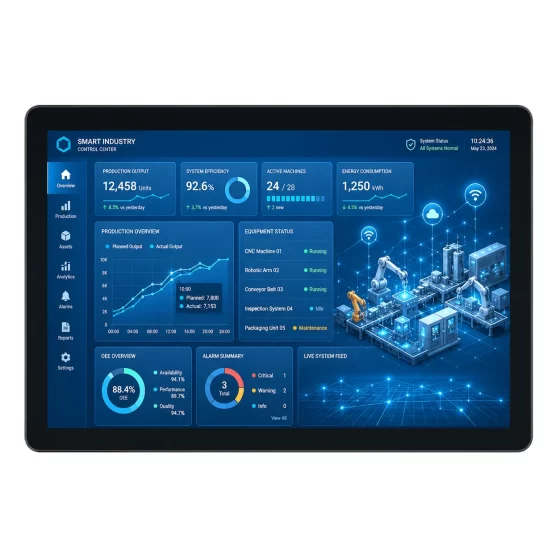
Battery AI defect detection dashboard with traceability workstation, module inspection station, industrial computer terminals, and engineers reviewing results

Battery inspection AI platforms improve defect review, traceability, quality monitoring, and production inspection performance.

ビジネス上のメリット

Improved Defect Detection

Battery inspection AI systems help identify defects that may be difficult to detect manually or with simple rule-based vision.

When combined with proper cameras, lighting, and industrial computing hardware, AI inspection can improve consistency and reduce missed defects.

This supports stronger quality control across battery manufacturing processes.

Reduced Manual Inspection Workload

Manual inspection can be repetitive and inconsistent.

AI inspection platforms automate many visual inspection tasks, allowing operators and engineers to focus on exception handling, maintenance, そしてプロセスの改善.

This improves inspection efficiency and reduces dependence on manual judgment.

Faster Quality Decisions

Local AI processing allows inspection decisions to happen near the production line.

The industrial computer can process images, classify defects, and send results to PLCs or MES systems quickly.

This enables faster reject action, repair routing, or process correction.

Stronger Production Traceability

AI inspection data can be linked with product IDs, batch numbers, defect categories, images, timestamps, station information, and work orders.

This creates stronger traceability records for quality control, customer audits, warranty analysis, and root cause investigation.

Better Process Improvement

AI inspection platforms generate useful data for process analysis.

Manufacturers can review recurring defect patterns, station performance, process drift, equipment issues, and inspection trends.

Reliable industrial computing hardware helps ensure that this data is collected consistently and connected to factory systems.

Scalable Battery Manufacturing Deployment

A standardized industrial computing platform makes it easier to deploy AI inspection across multiple lines, processes, and factories.

一貫したハードウェアによりソフトウェア イメージが簡素化されます, driver management, スペアパーツの計画, メンテナンストレーニング, and technical support.

This helps manufacturers expand AI inspection from pilot projects to full production deployment.

CoreIPC を選ぶ理由

CoreIPC provides industrial computing platforms for machine vision, エッジAI, ファクトリーオートメーション, および組み込みシステムの統合. For battery inspection AI applications, CoreIPC は信頼性の高い産業用コンピューター ハードウェアに重点を置いています, 組み込みコンピュータソリューション, flexible I/O configurations, コンパクトなシステム設計, OEM/ODMカスタマイズサポート. CoreIPC はシステム インテグレーターを支援します, equipment builders, and battery manufacturers select computing platforms that match real deployment requirements, including camera interfaces, AI ワークロード, automation communication, 取り付け方法, 電源入力, thermal design, ストレージのニーズ, およびライフサイクル計画.

よくある質問

1. What is battery inspection AI?

Battery inspection AI is an automated inspection approach that uses cameras, センサー, AI models, and industrial computing hardware to detect defects in battery manufacturing.

It can inspect electrode surfaces, cell appearance, weld areas, seals, labels, modules, connectors, and final products. The goal is to improve defect detection, reduce manual inspection workload, and connect inspection results with traceability systems.

2. Why use an industrial computer for battery inspection AI?

An industrial computer provides the local processing and connectivity required for AI inspection on production lines.

It can receive images from cameras, run AI inference models, communicate with PLCs, connect to sensors and lighting controllers, store inspection records, and upload data to MES or quality systems. It is designed for industrial environments where reliability and continuous operation are important.

3. How is an embedded computer used in battery inspection?

An embedded computer can be installed inside inspection machines, production cabinets, compact vision stations, or OEM battery manufacturing equipment.

It can process camera images, run inspection software, connect to automation devices, and send results to factory systems. Its compact size makes it suitable for space-limited machine-side deployment.

4. What defects can AI inspection detect in battery manufacturing?

AI inspection can support detection of surface scratches, dents, contamination, coating irregularities, weld appearance issues, seal defects, label errors, cell misalignment, missing components, connector placement issues, and packaging defects.

The exact detection capability depends on camera quality, lighting design, model training, product variation, and real production testing.

5. What interfaces are important for battery inspection AI computers?

Important interfaces may include USB 3.0, multiple LAN ports, RS232, RS485, GPIO, digital input, digital output, HDMI, ディスプレイポート, M.2, and PCIe expansion.

Camera interfaces are critical for image acquisition. Industrial I/O is also important for PLC communication, trigger signals, lighting control, alarms, コンベア, and reject mechanisms.

6. Is a fanless industrial computer suitable for battery inspection?

A fanless industrial computer can be suitable for many battery inspection applications because it reduces dust intake and removes a common mechanical failure point.

しかし, AI workloads may generate significant heat. Processor selection, AI accelerator use, cabinet airflow, 周囲温度, and mounting method should be reviewed before final hardware selection.

7. How does AI inspection support battery traceability?

AI inspection supports traceability by connecting inspection results with product IDs, batch numbers, defect categories, images, timestamps, station IDs, and work orders.

This data can be uploaded to MES or quality systems. Complete records help manufacturers analyze defects, support audits, investigate quality issues, and improve production processes.

8. Can AI inspection replace manual quality inspection completely?

AI inspection can automate many repetitive visual inspection tasks, but it should be introduced carefully.

Some defects or unusual cases may still require human review, especially during early deployment or process validation. In many factories, AI inspection works best as a consistent automated layer that reduces manual workload and improves inspection reliability.

9. What should be tested before deploying battery inspection AI?

導入前, the system should be tested with real products, real defects, production lighting, camera resolution, line speed, AI models, PLC通信, ストレージのワークロード, and network conditions.

Long-running stability and thermal performance should also be tested. This helps confirm that the platform can operate reliably in production.

10. Can battery inspection AI connect with MES systems?

はい. Industrial computers can send AI inspection results to MES, quality databases, or production dashboards.

The uploaded data may include product IDs, inspection results, defect categories, image records, timestamps, station information, and work order references. This helps connect quality inspection with production traceability and process improvement.

結論

Battery inspection AI is a practical foundation for improving visual inspection, 欠陥検出, traceability, and quality control in battery manufacturing.

By placing industrial computing hardware close to cameras, センサー, lighting controllers, PLC, コンベア, and assembly equipment, manufacturers can process inspection data locally and respond faster to quality issues.

The right industrial computer or embedded computer should be selected according to real deployment requirements, including AI workload, camera interface, image resolution, I/O configuration, network design, ストレージのニーズ, 取付方法, 電源入力, 熱条件, オペレーティング システムのサポート, およびライフサイクル計画.

CoreIPC supports battery inspection AI projects with industrial computing platforms designed for practical factory deployment. 適切なハードウェア基盤があれば, battery manufacturers and equipment builders can build more reliable, スケーラブルな, and data-driven quality control systems.

お問い合わせ

産業用コンピュータを探しています, 組み込みコンピュータ, or industrial motherboard for battery inspection AI?

プロジェクトの要件については、CoreIPC にお問い合わせください。, including camera interface, AI workload, I/O configuration, automation communication, 取付方法, 電源入力, 動作環境, ライフサイクルのニーズ, および OEM/ODM カスタマイズ オプション.
伝言を残す


    セキュリティチェック: