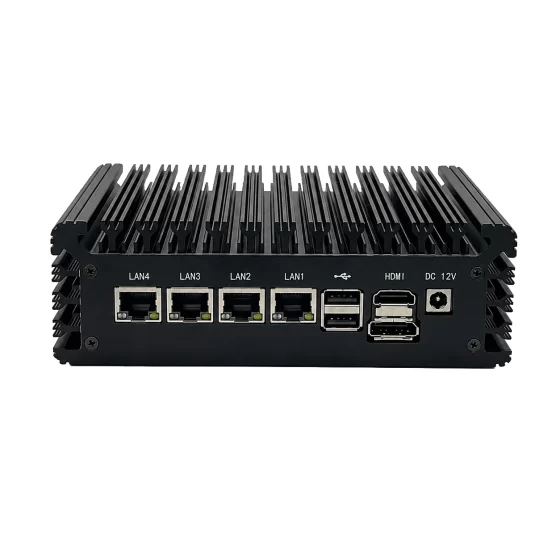
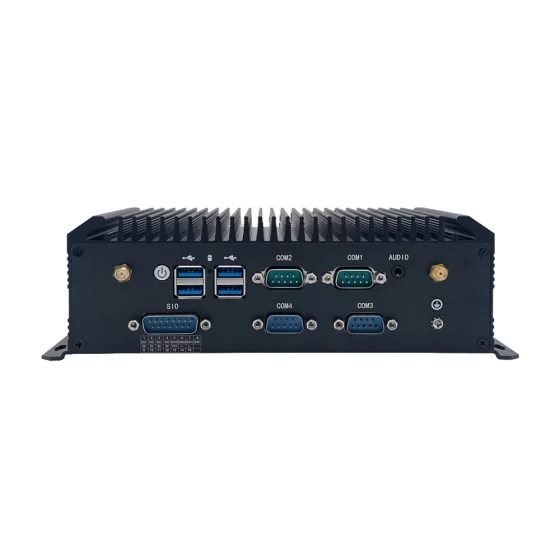
CoreIPC 産業用コンピューティング ソリューション

モバイルロボット 産業用PC: AGV および AMR エッジ コンピューティング用のモバイル ロボット IPC
エグゼクティブサマリー
A mobile robot ipc provides the industrial computing foundation for AGV and AMR navigation, センサーフュージョン, ロボット制御サポート, エッジ AI 認識, フリート通信, 安全監視, データロギング, モバイルオートメーションシステムにおけるリアルタイムの意思決定.
最新の移動ロボットは倉庫で広く使用されています, 工場, 物流センター, 病院, 研究室, スマートな小売施設, および産業サービス環境. AGV と AMR は資材の移動を支援します, 商品を届ける, 生産ラインをサポート, 社内物流を自動化する, 手作業での搬送作業を軽減.
これらのロボットには信頼性の高いオンボード コンピューティングが必要です.
産業用コンピュータまたは組み込みコンピュータ上に構築されたモバイル ロボット産業用 PC は、LiDAR からのデータを処理できます, カメラ, エンコーダ, IMU, 深度センサー, 超音波センサー, モーターコントローラー, バッテリーシステム, および無線通信モジュール. ナビゲーションソフトウェアをサポートできます, SLAMアルゴリズム, エッジAI推論, ロボットタスクの実行, リモート診断, およびフリート管理コミュニケーション.
Compared with standard consumer computers or office PCs, industrial computers are better suited for mobile robot deployment because they support rugged design, コンパクトな設置, low-power operation, 耐振動性, ファンレスオプション, wide power input, 柔軟な I/O, 信頼できるストレージ, 長いライフサイクルの可用性.
This article explains how mobile robot IPC platforms support AGV and AMR applications, what deployment challenges appear in real robot systems, ソリューション アーキテクチャの仕組み, and which hardware features matter when selecting an industrial computer or embedded computer for mobile robot applications.
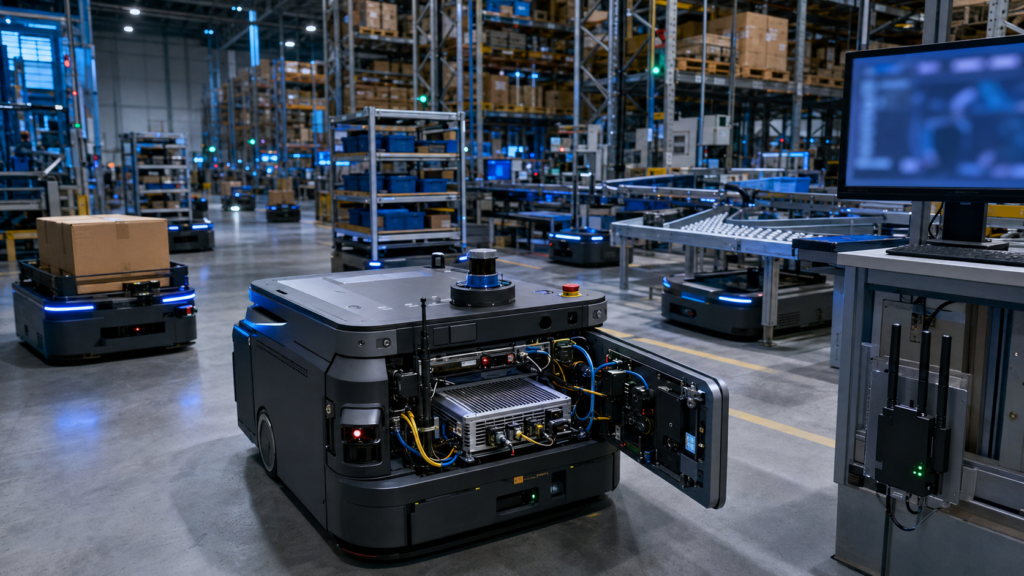
Mobile Robot Onboard Edge Computing
業界の概要
Mobile Robots Are Expanding Across Industries
Mobile robots are becoming a major part of automation.
倉庫内, AMRs support picking, 補充, 輸送, 並べ替え, and inventory operations. In factories, AGVs and AMRs move materials between production lines, 倉庫, assembly cells, および検査ステーション. In hospitals and laboratories, mobile robots can transport supplies, サンプル, medicine, と設備.
Common mobile robot applications include:
- AGV material transport
- AMR warehouse logistics
- Autonomous cart systems
- 移動式検査ロボット
- Hospital delivery robots
- Laboratory transport robots
- Factory line feeding
- Smart retail service robots
- Mobile security robots
- Autonomous cleaning robots
- Robot fleet management
- Smart transportation support systems
These applications require stable onboard computing and reliable communication with robot sensors, コントローラー, and fleet platforms.
Mobile Robots Need Local Edge Computing
Mobile robots cannot depend entirely on remote servers.
They need to make local decisions while moving through dynamic environments. A robot may need to avoid obstacles, update its route, detect people, identify objects, dock at a charging station, or stop safely when a risk appears.
A mobile robot ipc can process these tasks onboard.
サポートしてくれるかもしれない:
- スラムナビゲーション
- センサーフュージョン
- 経路計画
- 障害物検出
- Camera processing
- LiDAR data handling
- Motor control communication
- Battery status monitoring
- ワイヤレス接続
- Fleet management communication
- Local event logging
- リモート診断
This local computing capability improves robot autonomy and operational reliability.
Industrial Computers Provide the Robot Hardware Foundation
Mobile robots operate in real environments.
They may move across warehouse floors, factory aisles, loading areas, hospital corridors, cleanroom zones, 物流センター, or outdoor-adjacent spaces.
これらの環境には振動が含まれる可能性があります, ショック, ほこり, 温度変化, 不安定な電力, 限られたスペース, electromagnetic noise, and continuous motion.
Industrial computers and embedded computers provide the rugged hardware foundation required for mobile robot deployment.
They support compact form factors, 信頼できるストレージ, ファンレス設計オプション, 柔軟な I/O, マルチネットワーク通信, 長期的な可用性.

Mobile Robot IPC Deployment Challenges
主要な課題
Processing Multiple Sensors Onboard
Mobile robots rely on many sensors.
A typical robot may include LiDAR, カメラ, 深度センサー, IMU modules, wheel encoders, 超音波センサー, bumper sensors, safety scanners, battery controllers, and motor drivers.
The mobile robot IPC must collect and process these signals reliably.
Sensor workload may include:
- LiDAR point cloud data
- Camera image streams
- Depth information
- Position feedback
- Motor status
- バッテリーの状態
- Safety signals
- Wireless communication data
- Environmental sensor records
- Robot health information
The platform must provide enough performance and I/O flexibility for the full sensor system.
Supporting Navigation and SLAM
Autonomous mobile robots often rely on SLAM and localization algorithms.
These functions help the robot understand its position, build or update maps, avoid obstacles, and follow routes.
Navigation workloads may require:
- Real-time sensor fusion
- Map processing
- 障害物検出
- ルート計画
- Localization updates
- Docking support
- Dynamic path adjustment
- Fleet task communication
Hardware must be selected according to the actual navigation software, robot speed, map size, sensor count, and response requirements.
Managing Power and Thermal Constraints
Mobile robots have limited onboard power.
The IPC must provide enough computing performance while keeping power consumption under control.
Battery-powered systems need careful balance between performance, 熱, ランタイム, and reliability.
設計に関する重要な質問には次のものがあります。:
- How much power can the IPC consume?
- Does the robot have enough battery capacity?
- Is the enclosure ventilated?
- Is fanless operation required?
- Will the robot run continuously?
- Is GPU or AI acceleration needed?
- What is the ambient temperature range?
- How will heat be removed from the enclosure?
Power and thermal planning are critical for mobile robot IPC deployment.
Handling Vibration and Motion
Mobile robots are constantly moving.
They may travel over uneven floors, ramps, joints, しきい値, and warehouse surfaces. The onboard computer must withstand vibration, ショック, and cable movement.
Reliable hardware design should consider:
- 頑丈な筐体
- 確実な取り付け
- Lockable connectors
- ケーブルの張力緩和
- SSDまたはNVMeストレージ
- ファンレス設計
- 安定した電源入力
- Electrical noise protection
A standard PC is usually not suitable for this environment.
Integrating Robot Control and Fleet Systems
A mobile robot does not work alone.
ロボットコントローラーと通信する必要があります, motor drivers, バッテリーシステム, センサー, wireless networks, fleet management platforms, 倉庫ソフトウェア, 工場システム, およびリモートメンテナンスツール.
The onboard IPC may exchange:
- Task commands
- Route updates
- ロボットの位置
- Battery data
- Error codes
- Sensor status
- Safety events
- Charging status
- メンテナンスログ
- Fleet coordination messages
Stable communication is essential for reliable robot operation.
Supporting Long-Term Robot Product Deployment
Mobile robot products may be manufactured and deployed over many years.
Frequent computer hardware changes can create problems with operating systems, ドライバー, robot software, sensor SDKs, AI ランタイム, 無線モジュール, and certification workflows.
Industrial computing platforms with lifecycle planning help robot manufacturers maintain consistent robot designs across product generations and customer sites.

Mobile Robot IPC Architecture
Mobile Robot IPC Solution Architecture
Robot Sensor Layer
The robot sensor layer includes all devices that help the robot perceive and measure its environment.
この層には以下が含まれる場合があります:
- LiDARセンサー
- 産業用カメラ
- デプスカメラ
- IMU modules
- Wheel encoders
- 超音波センサー
- セーフティスキャナ
- Bumper sensors
- 温度センサー
- Battery monitoring devices
- Motor feedback systems
These sensors provide raw data for navigation, 安全性, perception, and robot health monitoring.
Mobile Robot IPC Edge Layer
The mobile robot IPC edge layer is the onboard computing layer.
この層では, 産業用コンピュータまたは組み込みコンピュータは、:
- センサーデータを収集する
- Run navigation software
- Process camera streams
- Handle LiDAR data
- Perform sensor fusion
- Execute edge AI models
- ログを保存する
- Communicate with motor controllers
- Send status to fleet systems
- リモート診断のサポート
This layer provides the robot with local intelligence and stable computing performance.
ロボット制御統合層
The robot control integration layer connects the IPC with motion and control systems.
と通信する可能性があります:
- モーターコントローラー
- Drive systems
- Battery management systems
- ロボットコントローラー
- 安全装置
- Charging station interfaces
- PLC
- Conveyor or dock systems
- Local HMI panels
The IPC may send commands, receive status data, monitor faults, and coordinate robot behavior with external equipment.
Communication and Fleet Layer
Mobile robots usually connect to a larger fleet or operation platform.
The communication layer may include:
- Wi-Fi modules
- 4G or 5G modules
- Ethernet service ports
- フリート管理システム
- 倉庫管理システム
- 倉庫管理システム
- 工場のダッシュボード
- クラウド監視プラットフォーム
- リモートメンテナンスツール
This layer allows operators to assign tasks, monitor robot location, アラームを確認する, and manage multiple robots.
Data and Security Layer
Mobile robot systems need local records and controlled access.
The IPC may store:
- Robot logs
- センサー記録
- Navigation events
- Error messages
- Battery history
- Charging records
- Task records
- リモートアクセスログ
- Software configuration files
- 診断データ
Security features may include network segmentation, アクセス制御, secure remote service, 暗号化通信, and configuration backup.
主な特長
Compact and Rugged Design
Mobile robot IPC systems must fit inside limited robot enclosures.
A compact embedded computer can be installed inside the robot body, control compartment, battery area, or service module.
The enclosure should support reliable mounting and protection from vibration.
Compact hardware helps robot manufacturers reduce mechanical complexity while maintaining enough computing performance for navigation and communication.
Low-Power Edge Computing
Power efficiency is important for mobile robots.
The IPC must support onboard computing without reducing robot runtime too much.
ハードウェアの選択は次の点を考慮する必要があります:
- Processor power consumption
- AI accelerator requirements
- Sensor workload
- Battery capacity
- Thermal dissipation
- Operating temperature
- Continuous runtime
- Standby behavior
A well-selected embedded computer helps balance autonomy and computing performance.
Sensor and Device Connectivity
Mobile robots require many device interfaces.
便利な I/O オプションには次のものがあります。:
- LAN
- USB
- RS232
- RS485
- CAN or expansion interface
- GPIO
- デジタル入力
- デジタル出力
- HDMI
- ディスプレイポート
- M.2
- PCIe
- SATA または NVMe ストレージ
The final configuration should match the robot sensor suite, motor system, battery system, および通信モジュール.
カメラとビジョンのサポート
Many mobile robots use cameras for perception, ナビゲーション, ドッキング, 物体検出, バーコード読み取り, or remote monitoring.
The IPC may connect cameras through USB, ギゲ・ラン, または拡張インターフェイス.
Camera planning should consider:
- カメラ数
- 解決
- フレームレート
- Field of view
- Lighting conditions
- ストレージのニーズ
- AI model requirements
- Data bandwidth
- Processing latency
For AI-based perception, the platform may need GPU or AI accelerator support.
LiDAR and Sensor Fusion Support
LiDAR is commonly used for AMR navigation and safety-aware movement.
The IPC may process LiDAR data together with camera, IMU, encoder, and safety sensor information.
Sensor fusion helps improve localization and obstacle detection.
The computing platform should be validated with the actual robot navigation stack and sensor configuration.
信頼性の高いローカルストレージ
Local storage supports robot software, maps, ログ, 診断, AIモデル, route data, and event records.
SSD または NVMe ストレージは、機械式ドライブよりも高速アクセスと優れた耐衝撃性を備えているため、一般的に好まれます。.
ストレージ計画で考慮すべきこと:
- Map file size
- ログの保存
- 診断記録
- AIモデルストレージ
- タスク履歴
- 書き込み耐久性
- リカバリワークフロー
- Software update process
Reliable storage improves maintainability and field support.
ワイヤレスおよび拡張オプション
Mobile robots often require wireless communication.
M.2 and PCIe expansion can support Wi-Fi, ブルートゥース, 4G, 5G, 追加LAN, AIの加速, またはカスタムモジュール.
Expansion support helps robot manufacturers adapt the same computing platform to different robot models and customer environments.
This flexibility is valuable for OEM and ODM robot development.
Fanless Operation and Thermal Stability
Fanless computers are preferred in many robot systems because they reduce dust intake and remove one mechanical failure point.
しかし, fanless operation requires good thermal planning.
The design should consider:
- Processor heat output
- AI ワークロード
- Robot enclosure material
- Heat conduction path
- 周囲温度
- 連続運転
- Battery area temperature
- Mounting surface
Thermal validation should be performed under real robot workloads.
長いライフサイクルの可用性
Mobile robot products need stable supply.
Long lifecycle industrial computers help robot manufacturers maintain consistent hardware designs, ソフトウェアイメージ, ドライバー, sensor support, およびスペアパーツ.
This reduces redesign work and supports multi-year robot product deployment.

AGV and AMR Fleet Operations
導入シナリオ
AMR Navigation Computer
An embedded computer can serve as the navigation computer for autonomous mobile robots.
It can process LiDAR, カメラ, IMU, encoder, and map data.
It can support localization, 障害物検知, パスの計画, フリート通信, and remote diagnostics.
AGV Control Support Platform
AGVs may follow fixed paths, magnetic strips, QRコード, markers, or guided routes.
A mobile robot IPC can support onboard communication, task logging, センサーの統合, バッテリー監視, and connection with control systems.
This improves AGV visibility and maintainability.
Mobile Robot Vision Processing
Some robots use vision for object detection, ドッキング, バーコード読み取り, shelf recognition, or navigation assistance.
An industrial computer can process camera data locally and send results to the robot control system.
For AI vision, edge AI computing performance may be required.
Warehouse AMR Fleet System
Warehouses may deploy many AMRs for picking, 輸送, 補充, and sorting support.
The onboard IPC communicates with fleet management systems and warehouse software.
It can report robot status, task completion, battery state, route events, and diagnostic information.
Factory Material Handling Robot
Factories use mobile robots to move parts, ツール, carts, and materials between production lines.
An embedded computer can connect the robot with PLCs, コンベア, docking stations, and factory monitoring systems.
This supports more integrated production logistics.
Hospital and Service Robot
Service robots may operate in hospitals, オフィス, 研究室, or public facilities.
The IPC can support navigation, 障害物検知, task communication, カメラ処理, and remote monitoring.
The final system should be selected according to application-specific safety and compliance requirements.
Outdoor-Adjacent Inspection Robot
Some mobile robots inspect facilities, 機器室, utility areas, or semi-outdoor environments.
Industrial computers support rugged operation, ローカルデータ処理, センサーの統合, そして遠隔コミュニケーション.
Environmental and power design should be reviewed carefully for these deployments.
OEM Mobile Robot Computing Platform
Robot manufacturers can integrate industrial computers or custom embedded boards into mobile robot products.
The platform can support navigation, perception, コミュニケーション, データストレージ, リモート診断, 無線モジュール, および顧客固有の I/O.
This helps create scalable mobile robot product lines.
ビジネス上のメリット
Improved Robot Autonomy
A mobile robot IPC gives robots local computing power for navigation, perception, センサーフュージョン, そして意思決定.
This reduces dependence on remote systems and improves robot responsiveness.
Better onboard computing supports more capable AGV and AMR systems.
運用上の可視性の向上
The IPC can collect and store robot status, location records, task data, battery information, エラーログ, and sensor events.
This information can be sent to fleet platforms, 倉庫システム, factory dashboards, or maintenance tools.
Better visibility helps operators manage robot fleets more effectively.
More Reliable Field Operation
Industrial computers provide rugged hardware for moving systems.
ファンレス設計オプション, 信頼できるストレージ, 確実な取り付け, 安定した電力入力, and vibration-resistant design help reduce downtime risk.
This is important for mobile robots operating long hours.
Easier Robot System Integration
A mobile robot IPC can connect sensors, motor systems, battery modules, カメラ, 無線モジュール, and fleet software.
This helps robot manufacturers and system integrators build complete mobile robot systems with fewer integration gaps.
Flexible I/O supports different robot designs.
Scalable Robot Product Development
A standardized industrial computing platform makes it easier to develop multiple robot models.
一貫したハードウェアによりソフトウェア イメージが簡素化されます, ドライバー, navigation stack validation, スペアパーツの計画, およびライフサイクル管理.
This supports OEM mobile robot product development.
Stronger Maintenance and Diagnostics
ローカルログ, リモートアクセス, health monitoring, and diagnostic records help engineers troubleshoot issues faster.
This reduces service cost and improves customer support.
Reliable storage and remote diagnostics are especially valuable for deployed robot fleets.
CoreIPC を選ぶ理由
CoreIPC はロボット工学向けの産業用コンピューティング プラットフォームを提供します, エッジAI, マシンビジョン, 産業用IoT, スマートな交通手段, および組み込みシステムの統合. For mobile robot IPC applications, CoreIPC は信頼性の高い産業用コンピューター ハードウェアに重点を置いています, 組み込みコンピュータソリューション, コンパクトな組み込み設計, 柔軟な I/O, マルチLAN構成, camera and sensor connectivity, ファンレス導入オプション, ローカルストレージ機能, OEM/ODMカスタマイズサポート. CoreIPC helps robot manufacturers, システムインテグレーター, and automation providers select computing platforms that match real deployment requirements, センサー数を含む, navigation workload, AI推論のニーズ, 電源入力, 取付方法, 熱条件, ワイヤレス拡張, およびライフサイクル計画.
よくある質問
1. What is a mobile robot IPC?
A mobile robot IPC is an industrial computing platform installed onboard an AGV, AMR, or service robot.
It can process sensor data, support navigation, communicate with motor controllers, connect cameras and LiDAR, ログを保存する, manage wireless communication, and exchange data with fleet management or warehouse software systems.
2. Why use an industrial computer for mobile robots?
An industrial computer provides rugged hardware for moving robot platforms.
コンパクトな設置に対応可能, vibration-resistant storage, ファンレス動作, 柔軟な I/O, multiple LAN and USB ports, 安定した電力入力, 長いライフサイクルの可用性. These features make it suitable for mobile robots operating in warehouses, 工場, 病院, and service environments.
3. How is an embedded computer used in AGV and AMR systems?
An embedded computer can act as the onboard computing node.
It may run navigation software, process LiDAR and camera data, communicate with motor controllers, monitor battery status, connect wireless modules, store maps, and report robot status to fleet management platforms.
4. What sensors can a mobile robot IPC connect?
A mobile robot IPC may connect LiDAR, カメラ, 深度センサー, IMU, エンコーダ, 超音波センサー, safety scanners, bumper sensors, バッテリーシステム, モーターコントローラー, 無線モジュール, and local service interfaces.
The exact support depends on hardware interfaces, ソフトウェアドライバー, and robot system design.
5. Does mobile robot IPC hardware need AI acceleration?
常にではありません.
Basic AGV control and simple data logging may not need AI acceleration. Advanced AMR perception, 物体検出, vision-based navigation, ドッキング, and obstacle classification may benefit from GPU or AI accelerator support.
The final choice should be based on the actual AI workload.
6. Why is low power consumption important for mobile robot IPC systems?
Mobile robots run on batteries.
A high-power computer may reduce runtime, increase heat, and require larger batteries or more complex thermal design.
The IPC should provide enough computing performance while staying within the robot power budget.
7. Why are fanless computers useful for mobile robots?
Fanless computers reduce dust intake and remove one mechanical failure point.
They are useful in warehouses, 工場, and service environments where robots may operate for long hours. しかし, fanless thermal design must be validated under real navigation, センサー, and AI workloads.
8. What hardware features matter for mobile robot IPC platforms?
重要な機能にはコンパクトなサイズが含まれます, low power consumption, 十分なCPU性能, optional AI acceleration, 複数のLANポート, USB, RS232, RS485, GPIO, 拡張インターフェース, SSDまたはNVMeストレージ, 頑丈な筐体, ファンレス設計, 安定した電力入力, and wireless module support.
The final configuration should match robot workload and mechanical design.
9. Can mobile robot IPC platforms support fleet management?
はい. A mobile robot IPC can exchange robot status, task information, location data, バッテリー残量, アラーム, and diagnostic records with fleet management systems.
It can also support remote monitoring and software updates depending on system design.
10. 導入前にテストすべきこと?
導入前, the platform should be tested with real robot sensors, モーターコントローラー, バッテリーシステム, navigation software, wireless networks, robot workloads, 保管動作, 長時間にわたる運用.
熱安定性, vibration performance, power behavior, 通信遅延, リモート診断, 回復手順も検証する必要があります.
結論
A mobile robot ipc is a practical foundation for AGV and AMR navigation, onboard edge computing, センサーフュージョン, robot perception, 無線通信, fleet integration, ローカルデータストレージ, and remote diagnostics.
By placing an industrial computer or embedded computer inside the robot platform, robot manufacturers and system integrators can connect LiDAR, カメラ, IMU, エンコーダ, モーターコントローラー, バッテリーシステム, safety sensors, 無線モジュール, フリートプラットフォーム, 倉庫システム, and monitoring dashboards through reliable onboard computing.
The right mobile robot industrial PC should be selected according to real deployment requirements, センサー数を含む, navigation workload, AI推論のニーズ, 電力バジェット, battery runtime, I/O要件, ワイヤレス拡張, ストレージ構成, 取付方法, 振動条件, 熱設計, オペレーティング システムのサポート, およびライフサイクル計画.
CoreIPC supports mobile robot IPC projects with industrial computing platforms designed for practical AGV, AMR, service robot, warehouse robot, およびOEM展開. 適切なハードウェア基盤があれば, robot manufacturers and automation providers can build reliable, スケーラブルな, and intelligent mobile robot systems.
お問い合わせ
産業用コンピュータを探しています, 組み込みコンピュータ, or compact IPC platform for mobile robot deployment?
プロジェクトの要件については、CoreIPC にお問い合わせください。, センサーインターフェースを含む, navigation workload, AI performance, 電源入力, ワイヤレス拡張, I/O のニーズ, ストレージデザイン, 取付方法, 振動環境, 熱条件, ライフサイクルのニーズ, および OEM/ODM カスタマイズ オプション.