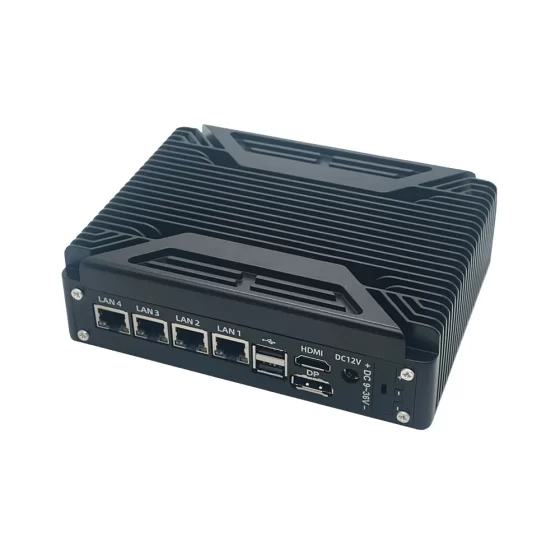
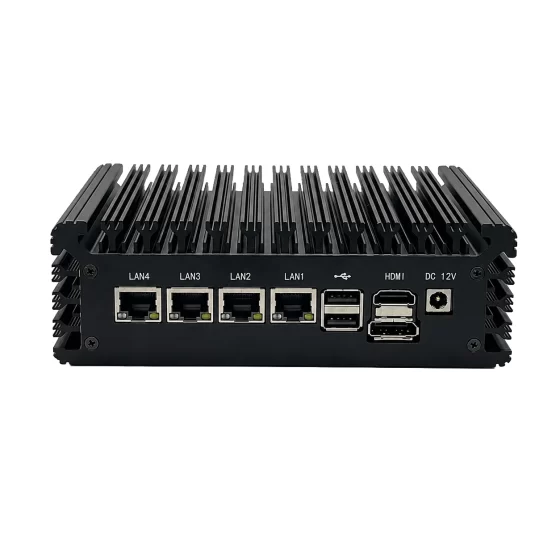
CoreIPC Industrial Computing-Lösungen

AI Vision Computing-Plattform: AI Vision-Plattform für industrielle Inspektion und Automatisierung
Zusammenfassung
An AI vision platform provides the industrial computing foundation for machine vision inspection, Fehlererkennung, Objekterkennung, Roboterführung, Verpackungsüberprüfung, and production quality control.
Modern factories are using more cameras, Sensoren, KI-Modelle, and automation systems to improve inspection accuracy and production visibility. Instead of relying only on manual inspection or simple rule-based vision systems, manufacturers can use AI vision to detect complex defects, classify products, recognize labels, guide robots, and connect inspection results with factory software.
An industrial computer or embedded computer acts as the local AI vision computing platform. Es empfängt Bilddaten von Kameras, runs AI inference models, communicates with PLCs and robots, speichert Inspektionsaufzeichnungen, and uploads selected results to MES, Qualitätsdatenbanken, SCADA-Systeme, oder Cloud-Plattformen.
Im Vergleich zu handelsüblichen PCs, industrial computers are better suited for factory deployment because they provide rugged design, flexible I/O, stabile Vernetzung, lüfterlose Optionen, zuverlässige Lagerung, und langen Lebenszyklus-Support.
An AI vision computing platform can be deployed in electronics manufacturing, Halbleiterinspektion, battery production, Verpackungslinien, Lebensmittelverarbeitung, Pharmazeutische Inspektion, logistics sorting, Roboterzellen, and general industrial automation.
This article explains how AI vision platforms work, vor welchen Bereitstellungsherausforderungen Hersteller stehen, wie die Lösungsarchitektur aufgebaut ist, and which hardware features are important when selecting an industrial computer or embedded computer for AI vision applications.
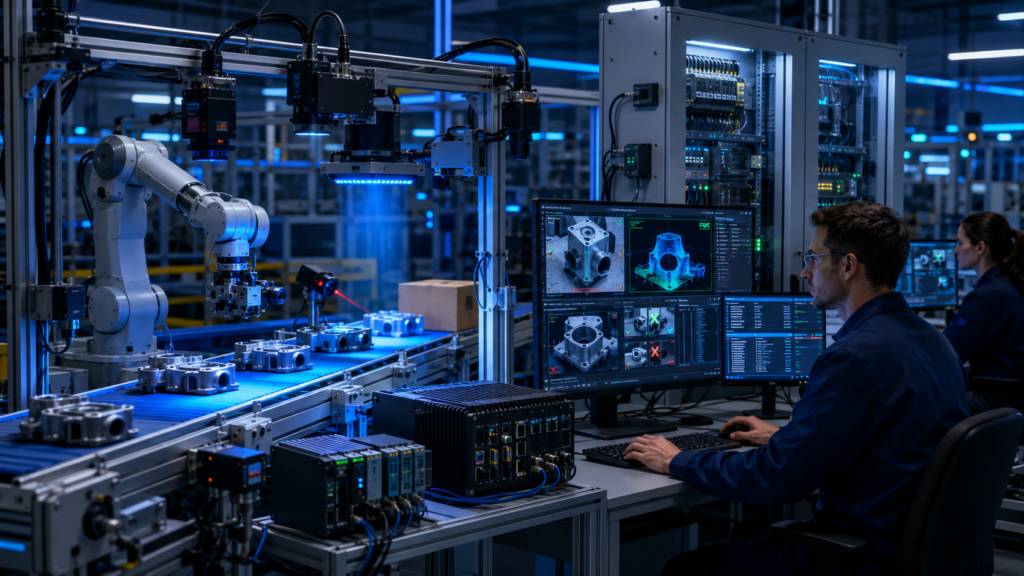
AI vision platforms process camera images for inspection, Erkennung, Roboterführung, Verpackungsüberprüfung, and automation.
Branchenüberblick
Machine Vision Is Becoming More Intelligent
Traditional machine vision has been used for many years in industrial inspection.
It can check product presence, measure simple dimensions, read barcodes, Etiketten überprüfen, and detect clear defects. These applications usually rely on fixed rules, thresholds, Kantenerkennung, pattern matching, or predefined inspection logic.
Jedoch, many real production defects are not simple.
Kratzer, Dellen, Risse, Flecken, fehlende Teile, solder issues, Verpackungsschäden, Oberflächenverschmutzung, and assembly errors may appear in different shapes, Größen, Farben, und Lichtverhältnisse.
AI vision helps address these challenges by using trained models to identify patterns that are difficult to define through fixed rules alone.
AI Vision Is Moving to the Edge
AI vision systems often need local processing close to production equipment.
Sending all images to a remote server or cloud platform can create latency, network pressure, storage cost, and dependency on external connections.
A local AI vision platform can process images at the machine side and return results quickly.
This is important for:
- Fehlerablehnung
- Roboterführung
- Barcode-Überprüfung
- Verpackungsinspektion
- Sorting decisions
- Production alarms
- Qualitätsrückverfolgbarkeit
- Echtzeitüberwachung
Industrial edge computing allows AI vision systems to become practical production tools instead of only offline analysis systems.
Industrial Computing ist die Hardware-Grundlage
AI vision systems require more than cameras and models.
They need stable industrial computing hardware that can connect cameras, Bilder verarbeiten, Kommunikation mit Automatisierungsgeräten, Aufzeichnungen speichern, and operate continuously in factory environments.
Industriecomputer und eingebettete Computer bilden diese Grundlage.
They support camera interfaces, mehrere LAN-Ports, USB-Konnektivität, serielle Kommunikation, GPIO, SSD-Speicher, Ausgabe anzeigen, Erweiterungsmodule, und robuste Montage.
Dadurch eignen sie sich für die maschinenseitige KI-Inspektion, OEM vision systems, Roboterzellen, and smart manufacturing platforms.

Multi-Kamera-Daten, Beleuchtung, Oberflächenreflexion, Fehlervariation, Bandbreitendruck, and automation integration affect AI vision reliability.
Wichtigste Herausforderungen
Hoher Arbeitsaufwand bei der Bildverarbeitung
AI vision platforms often process high-resolution images, multiple camera streams, oder komplexe Deep-Learning-Modelle.
The computing workload depends on:
- Kameraauflösung
- Anzahl der Kameras
- Bildrate
- Komplexität des KI-Modells
- Inspektionszykluszeit
- Bildvorverarbeitung
- Fehlerklassifizierung
- Lokale Bildspeicherung
- Factory data upload
Wenn der Computer zu wenig Strom hat, Es kann zu Verzögerungen bei der Verarbeitung durch das System kommen, ausgelassene Frames, Instabile Inspektionsgeschwindigkeit, or missed production timing.
Eine stabile, nachhaltige Leistung ist wichtiger als eine kurze Benchmark-Spitzenleistung.
Camera Interface and Bandwidth Planning
AI vision systems may use USB cameras, GigE-Kameras, 2.5GbE-Kameras, 10GbE-Kameras, 3D-Kameras, or specialized industrial vision interfaces.
Each camera configuration has different bandwidth requirements.
A single low-resolution camera may be easy to support. A multi-camera inspection platform may require careful network separation, Erweiterungsfähigkeit, and high-speed storage.
Poor interface planning can limit the whole system.
Even a powerful processor cannot solve a camera data bottleneck if the industrial computer does not provide the correct camera interface or bandwidth.
Image Quality and Lighting Stability
AI vision accuracy depends heavily on image quality.
Schlechte Beleuchtung kann Schatten erzeugen, Blendung, reflections, geringer Kontrast, Bewegungsunschärfe, or color inconsistency. These problems can reduce model accuracy and increase false rejection.
A reliable AI vision system requires coordination between:
- Kameraauswahl
- Linsendesign
- Beleuchtungsmethode
- Produktpositionierung
- Trigger-Timing
- Mechanische Montage
- KI-Modelltraining
- Computerhardware
The industrial computer must support stable image acquisition and reliable connection with cameras, Beleuchtungssteuerungen, und Triggersensoren.
Integration mit Automatisierungsgeräten
AI vision results must connect with real production action.
Das System muss möglicherweise mit SPS kommunizieren, Förderer, Roboter, Ablehnungsmechanismen, Sensoren, Barcode-Lesegeräte, Alarm, MES-Systeme, und hochwertige Datenbanken.
A practical AI vision platform may need:
- LAN
- USB
- RS232
- RS485
- GPIO
- Digitaler Eingang
- Digitaler Ausgang
- HDMI
- DisplayPort
- M.2
- PCIe
Without suitable industrial I/O, Die Systemintegration wird komplexer und weniger zuverlässig.
Langfristige Fabrikzuverlässigkeit
AI vision systems often operate across multiple shifts.
They may be installed near production lines, Inneninspektionsmaschinen, in control cabinets, neben Förderbändern, or inside robotic cells.
In diesen Umgebungen kann es zu Vibrationen kommen, Staub, Hitze, elektrisches Rauschen, Kabelbewegung, und begrenzter Luftstrom.
Industrial-grade hardware helps reduce downtime risk by supporting rugged mechanical design, stabile thermische leistung, zuverlässige Lagerung, sichere Montage, und Lebenszykluskontinuität.

Industrial computers connect AI vision cameras, Automatisierungsgeräte, Roboter, Fabriksoftware, und Qualitätssysteme.
AI Vision Platform Solution Architecture
Bilderfassungsebene
The image acquisition layer captures visual data from products, Teile, Pakete, Etiketten, or production processes.
Diese Schicht kann umfassen:
- Industriekameras
- 3D-Kameras
- Hochgeschwindigkeitskameras
- Lenses
- Lighting modules
- Triggersensoren
- Barcode-Lesegeräte
- Position sensors
- Bewegungssysteme
Abhängig von der Anwendung, the system may capture surface images, assembly images, label images, barcode images, Paketbilder, Defektbilder, or 3D depth data.
Stable and repeatable image quality is the foundation of reliable AI vision performance.
Industrielle KI-Computing-Schicht
The industrial AI computing layer is where the AI vision platform performs local processing.
Auf dieser Ebene, B. der Industriecomputer oder der eingebettete Computer:
- Bilddaten von Kameras empfangen
- Führen Sie KI-Inferenzmodelle aus
- Verarbeiten Sie Bildverarbeitungsalgorithmen
- Erkennen Sie Mängel oder Anomalien
- Classify products or defect types
- Speichern Sie Inspektionsbilder und Protokolle
- Inspektionsstatus anzeigen
- Senden Sie Pass- oder Fail-Signale
- Communicate with PLCs or robots
- Laden Sie ausgewählte Daten in Fabriksysteme hoch
This layer allows inspection and recognition decisions to happen close to production equipment.
Ebene der Automatisierungssteuerung
The automation control layer connects AI vision results with physical equipment action.
Eine SPS, Robotersteuerung, Förderbandsteuerung, motion system, or reject mechanism may trigger image capture and receive results from the AI vision computer.
Zum Beispiel, after detecting a defective package, the industrial computer can send a fail signal to a PLC. The PLC can activate a reject mechanism.
In robotic applications, the AI vision platform may identify object position and send coordinate data to the robot controller.
Datenverwaltungsschicht
AI vision results become more valuable when connected with production records.
Der Industriecomputer kann Daten an das MES senden, SCADA, Qualitätsdatenbanken, WMS, ERP, oder Cloud-Plattformen.
Inspektionsdaten können Folgendes umfassen::
- Produkt-ID
- Arbeitsauftrag
- Chargennummer
- Inspektionsergebnis
- Fehlerkategorie
- Bildbeweis
- Vertrauenswert
- Stations-ID
- Zeitstempel
- Bedieneraktion
- Rework status
Dies unterstützt die Rückverfolgbarkeit, Qualitätsanalyse, Prozessverbesserung, und Produktionsverantwortung.
User Interface and Maintenance Layer
Betreiber und Ingenieure benötigen eine praktische lokale Schnittstelle.
The AI vision computer may connect to a monitor, Touch-Screen, HMI-Panel, or engineering workstation.
Die Schnittstelle kann angezeigt werden:
- Live camera images
- AI detection results
- Defect locations
- Die Produktion zählt
- Reject statistics
- Camera status
- KI-Statusmodell
- Netzwerkstatus
- Alarmmeldungen
- Systemprotokolle
A clear local interface helps engineers adjust parameters, review inspection results, and troubleshoot system issues quickly.
Hauptmerkmale
KI-Inferenzleistung
AI vision platforms require stable inference performance.
The right hardware depends on model complexity, Kameraauflösung, Anzahl der Kameras, Produktionsgeschwindigkeit, und Reaktionszeitanforderungen.
Die Auswahl sollte berücksichtigt werden:
- CPU-Leistung
- GPU- oder KI-Beschleunigerunterstützung
- Speicherkapazität
- Speichergeschwindigkeit
- Kamerabandbreite
- Software-Framework
- Betriebssystemunterstützung
- Thermisches Design
- Langzeitstabilität
A compact embedded computer may support moderate AI workloads. A multi-camera AI inspection platform may require an edge AI computer or higher-performance industrial PC.
Unterstützung für Kamera- und Vision-Schnittstellen
Die Kamerakonnektivität ist eine der wichtigsten Hardwareanforderungen.
Useful interface options may include:
- USB 3.0
- Mehrere LAN-Ports
- 2.5GbE- oder 10GbE-Optionen
- PCIe-Erweiterung
- M.2-Erweiterung
- HDMI
- DisplayPort
- High-speed SSD or NVMe storage
Für Mehrkamerasysteme, camera traffic should be planned carefully.
In vielen Einsätzen, one network may connect cameras while another connects the factory system. This helps reduce traffic conflict and improves system stability.
Flexible industrielle I/O
AI vision computers must connect with real factory equipment.
Zu den wichtigen E/A-Optionen können gehören:
- LAN
- USB
- RS232
- RS485
- GPIO
- Digitaler Eingang
- Digitaler Ausgang
- Ausgabe anzeigen
- Expansion slots
Diese Schnittstellen können Kameras unterstützen, Beleuchtungssteuerungen, Sensoren, Barcode-Lesegeräte, SPS, Förderer, Roboter, Alarm, und Ablehnungsmechanismen.
Flexible I/O reduziert den Bedarf an externen Adaptern und verbessert die Bereitstellungszuverlässigkeit.
Robustes und lüfterloses Design
Fanless industrial computers are useful in many AI vision applications.
Sie reduzieren die Staubaufnahme und beseitigen eine häufige mechanische Fehlerquelle. This supports lower maintenance in production environments where systems run continuously.
Ein robustes Gehäuse schützt den Computer vor Vibrationen, Kabelspannung, und Schrankeinbaubedingungen.
Jedoch, KI-Workloads können Hitze erzeugen.
For high-performance AI vision systems, Das thermische Design sollte sorgfältig geprüft werden. Prozessorauslastung, GPU- oder Beschleunigernutzung, Luftzirkulation im Schrank, Umgebungstemperatur, and mounting method all affect long-term stability.
Reliable Storage for Vision Data
AI vision systems may generate many images and records.
Der Computer kann speichern:
- Defektbilder
- Accepted image samples
- Inspektionsprotokolle
- KI-Modelldateien
- Lokale Datenbanken
- Produktionsberichte
- Videoclips
- Temporäre Puffer
SSD- oder NVMe-Speicher werden häufig bevorzugt, da sie einen schnelleren Zugriff und eine bessere Stoßfestigkeit als mechanische Laufwerke bieten.
For image-heavy systems, Speicherkapazität, anhaltende Schreibgeschwindigkeit, schreibe Ausdauer, Sicherungsmethode, und Aufbewahrungsrichtlinien sollten während des Entwurfs überprüft werden.
Lange Lebensdauer und Wartbarkeit
AI vision systems may remain in production for many years.
Häufige Hardwareänderungen können zu Problemen bei der Softwarevalidierung führen, Probleme mit der Treiberkompatibilität, Ersatzteil-Herausforderungen, and maintenance cost.
Industrial computing platforms with lifecycle planning help manufacturers and machine builders maintain consistent deployments across multiple production lines, Maschinen, und Fabrikgelände.
This is especially important for scalable AI vision deployment.
Bereitstellungsszenarien
AI Visual Defect Detection
AI vision platforms are widely used for defect detection.
The system can inspect surfaces, Komponenten, assemblies, Pakete, Etiketten, and finished products.
It can detect scratches, Dellen, Risse, Flecken, fehlende Teile, incorrect assembly, Kontamination, beschädigte Verpackung, and visual abnormalities.
The industrial computer processes images locally and sends results to PLCs or quality systems.
Electronics and SMT Inspection
Electronics manufacturing can use AI vision for PCB inspection, Komponentenüberprüfung, solder review, Barcode-Erkennung, Steckerprüfung, and repair data collection.
Ein eingebetteter Computer kann in der Nähe von SMT-Linien installiert werden, AOI-Ausrüstung, Teststationen, oder Reparaturbänke.
Prüfergebnisse können mit Leiterplatten-Seriennummern verknüpft werden, Arbeitsaufträge, und MES-Datensätze.
Halbleiterinspektion
Semiconductor inspection may require high-resolution imaging for wafers, stirbt, Substrate, Pakete, and laser marks.
An AI vision platform can support defect classification, Markierungsüberprüfung, Paketinspektion, and quality traceability.
The industrial computer processes image data and connects results with MES, SPC, oder Qualitätsdatenbanken.
Battery Manufacturing Inspection
Battery production can use AI vision for electrode surface inspection, cell appearance checking, tab welding inspection, module assembly verification, wiring inspection, Etikettenprüfung, and pack inspection.
The AI vision computer processes images locally and sends results to production systems.
This supports quality control and traceability in battery manufacturing.
Verpackungsinspektion
AI vision platforms can inspect labels, Barcodes, Datumscodes, Siegel, Kappen, Kartons, Beutel, Flaschen, und Endpakete.
The industrial computer can detect packaging defects and trigger reject mechanisms through PLC communication.
This helps reduce shipment errors and improve packaging quality.
Lebensmittel- und Pharmainspektion
In der Lebensmittel- und Arzneimittelproduktion ist häufig eine visuelle Inspektion der Produkte erforderlich, Pakete, Etiketten, Codes, Siegel, und Endverpackung.
AI vision platforms can support appearance inspection, fill-level checking, Etikettenüberprüfung, Barcode-Erkennung, und Fehlererkennung.
Industrial computing hardware helps connect inspection results with batch and quality records.
Logistics Sorting and Barcode Recognition
Logistics systems can use AI vision for parcel identification, Barcode-Erkennung, Etikettenüberprüfung, Sortierkontrolle, and exception handling.
In Scantunneln kann ein eingebetteter Computer installiert werden, Förderanlagen, or sorting equipment.
The system can send sorting results to WMS platforms and PLC-controlled diverters.
Robotic Vision Guidance
Robots often need vision data to identify objects, locate parts, and adjust motion.
An AI vision platform can process 2D or 3D camera data and send position information to robot controllers.
This supports bin picking, Montage, Sortierung, Inspektion, and flexible automation.
Geschäftsvorteile
Verbesserte Inspektionskonsistenz
AI vision platforms help manufacturers inspect products more consistently across production shifts.
The system processes images according to trained models and inspection logic. Dies verringert die Abhängigkeit von manueller Beurteilung und trägt zur Aufrechterhaltung einer stabilen Qualitätskontrolle bei.
Reliable industrial computing hardware supports consistent image acquisition and AI inference.
Schnellere Produktionsentscheidungen
Local AI processing enables faster response.
The industrial computer can detect defects, Ergebnisse einordnen, and send pass or fail signals to PLCs or robots near the production line.
This helps support faster reject actions, Nacharbeitsrouting, Sortierentscheidungen, and automation response.
Reduzierter manueller Inspektionsaufwand
Die manuelle Inspektion kann repetitiv sein, langsam, und inkonsistent.
AI vision automates many visual inspection tasks and allows operators to focus on exceptions, Wartung, setup, und Prozessverbesserung.
This improves efficiency and reduces missed defects caused by fatigue.
Stärkere Rückverfolgbarkeit der Qualität
AI vision data can be linked with product IDs, Arbeitsaufträge, Fehlerkategorien, Bilder, Zeitstempel, Informationen zum Sender, und Bedieneraktionen.
This creates stronger quality records for customer audits, Garantieuntersuchung, Prozessüberprüfung, und Ursachenanalyse.
Traceability becomes more valuable when inspection data is collected consistently and connected with factory systems.
Bessere Prozessverbesserung
AI vision platforms generate useful production data.
Hersteller können wiederkehrende Mängel analysieren, Prozessdrift, machine-related quality issues, reject trends, and product variation.
Zuverlässige Industriecomputer tragen dazu bei, dass diese Daten gespeichert werden, übertragen, und einheitlich angezeigt.
Skalierbare Smart-Manufacturing-Bereitstellung
A standardized AI vision platform makes it easier to deploy inspection and recognition systems across multiple machines, Linien, und Fabriken.
Konsistente Hardware vereinfacht Software-Images, camera driver management, Ersatzteilplanung, Wartungsschulung, und Lebenszyklusunterstützung.
This helps manufacturers move from pilot AI vision projects to scalable production deployment.
Warum CoreIPC
CoreIPC bietet industrielle Computerplattformen für die maschinelle Bildverarbeitung, Kanten-KI, Fabrikautomation, Robotik, und eingebettete Systemintegration. For AI vision platform applications, CoreIPC konzentriert sich auf zuverlässige industrielle Computerhardware, Embedded-Computer-Lösungen, flexible I/O-Konfigurationen, kompaktes Systemdesign, und OEM/ODM-Anpassungsunterstützung. CoreIPC hilft Systemintegratoren, Maschinenbauer, und Fertigungsteams wählen Computerplattformen aus, die den tatsächlichen Bereitstellungsanforderungen entsprechen, einschließlich Kameraschnittstellen, KI-Workloads, Automatisierungskommunikation, Netzwerkdesign, Speicherbedarf, Montagemethoden, Leistungsaufnahme, thermische Bedingungen, und Lebenszyklusplanung.
Häufig gestellte Fragen
1. What is an AI vision platform?
An AI vision platform is an industrial computing system used to process camera images and run AI-based inspection or recognition software.
It can detect defects, classify products, Etiketten lesen, verify barcodes, guide robots, und Ergebnisse mit Fabriksystemen verknüpfen. Es umfasst normalerweise Kameras, Beleuchtung, KI-Modelle, Bildverarbeitungssoftware, and an industrial computer or embedded computer.
2. Why use an industrial computer for AI vision?
An industrial computer is designed for factory environments.
It supports continuous operation, robuste Montage, industrielle I/O, Kamera-Konnektivität, stabile Lagerung, mehrere Netzwerkanschlüsse, und Bereitstellung über einen langen Lebenszyklus. These features make it more suitable than a standard office PC for AI vision systems installed near machines, Förderer, Roboter, und Prüfstationen.
3. How is an embedded computer used in AI vision systems?
In Inspektionsmaschinen kann ein eingebetteter Computer installiert werden, Roboterzellen, Verpackungssysteme, Tunnel scannen, oder Schaltschränke.
It can receive camera data, KI-Inferenz ausführen, mit SPS kommunizieren, lokale Ergebnisse anzeigen, und Prüfprotokolle hochladen. Its compact design makes it useful for OEM equipment and space-limited machine-side deployment.
4. What applications can an AI vision computing platform support?
AI vision platforms can support visual defect detection, assembly verification, Barcode-Erkennung, Verpackungsinspektion, Lebensmittelkontrolle, Pharmazeutische Inspektion, Batterieinspektion, Halbleiterinspektion, SMT-Inspektion, logistics sorting, and robotic guidance.
The exact application depends on camera setup, AI model design, Produktionsgeschwindigkeit, I/O-Anforderungen, und Systemintegrationsanforderungen.
5. Does an AI vision platform need a GPU?
Some AI vision applications need GPU or AI accelerator support, insbesondere für hochauflösende Bilder, mehrere Kameras, Videoanalyse, 3D-Vision, oder komplexe Deep-Learning-Modelle.
Other applications may run on CPU-based industrial computers if the model is lightweight and the cycle time is moderate. Die Hardware sollte auf der Grundlage realer Modelltests ausgewählt werden.
6. What interfaces are important for AI vision computers?
Wichtige Schnittstellen können USB sein 3.0, mehrere LAN-Ports, 2.5Tragen, 10Tragen, RS232, RS485, GPIO, digitaler Eingang, digitaler Ausgang, HDMI, DisplayPort, M.2, und PCIe-Erweiterung.
Camera interfaces are critical. Auch für die SPS-Kommunikation sind industrielle I/O wichtig, Lichtsteuerung, Sensoren, Auslöser, Roboter, Förderer, und Ablehnungsmechanismen.
7. Can fanless industrial computers support AI vision?
Fanless industrial computers can support many AI vision applications, especially moderate single-camera or low-maintenance deployments.
Jedoch, Hochleistungs-KI-Inferenz, Multikamera-Inspektion, oder GPU-basierte Arbeitslasten können erhebliche Wärme erzeugen. Prozessorauslastung, Beschleunigereinsatz, Luftzirkulation im Schrank, Umgebungstemperatur, and mounting position should be reviewed before deployment.
8. How does AI vision support traceability?
AI vision supports traceability by linking inspection results with product IDs, Arbeitsaufträge, Fehlerkategorien, Bildaufzeichnungen, Zeitstempel, Stations-IDs, und Bedieneraktionen.
Diese Daten können in MES hochgeladen werden, Qualitätsdatenbanken, WMS, SCADA, oder Cloud-Plattformen. Vollständige Aufzeichnungen helfen Herstellern bei der Fehleranalyse, unterstützen Audits, und Produktionsprozesse verbessern.
9. Can an AI vision platform connect with PLCs and robots?
Ja. An AI vision computer can communicate with PLCs, Robotersteuerungen, Förderer, Ablehnungsmechanismen, Sensoren, and other automation devices.
The system can receive triggers, Bilder verarbeiten, and send pass, scheitern, Position, Einstufung, or alarm results back to the equipment. This makes AI vision useful for real production control.
10. Was sollte vor der Bereitstellung getestet werden??
Vor der Bereitstellung, Das System sollte mit echten Kameras getestet werden, real products, Produktionsbeleuchtung, actual line speed, KI-Modelle, SPS-Kommunikation, Roboterintegration, Speicherauslastung, und Netzwerkbedingungen.
Langzeitstabilität, thermische Leistung, Zuverlässigkeit der Bilderfassung, and data upload behavior should also be validated to reduce production risk.
Abschluss
An AI vision platform is a practical foundation for machine vision inspection, AI defect detection, Roboterführung, Barcode-Erkennung, Verpackungsüberprüfung, logistics sorting, und Rückverfolgbarkeit der Produktion.
Indem Sie einen Industriecomputer oder einen eingebetteten Computer in der Nähe von Kameras platzieren, Sensoren, SPS, Förderer, Roboter, und Inspektionsausrüstung, manufacturers can process visual data locally, Latenz reduzieren, improve inspection consistency, und Ergebnisse mit Fabriksystemen verknüpfen.
The right AI vision computing platform should be selected according to real deployment requirements, inklusive Kameraschnittstelle, KI-Arbeitsbelastung, Bildauflösung, I/O-Konfiguration, Netzwerkarchitektur, Speicherbedarf, Erweiterungsbedarf, Montagemethode, Leistungsaufnahme, thermische Bedingungen, Betriebssystemunterstützung, und Lebenszyklusplanung.
CoreIPC supports AI vision platform projects with industrial computing platforms designed for practical factory and equipment deployment. Mit der richtigen Hardware-Grundlage, Hersteller und Maschinenbauer können zuverlässig bauen, skalierbar, and data-driven AI vision systems for smart manufacturing.
Kontaktieren Sie uns
Auf der Suche nach einem Industriecomputer, eingebetteter Computer, or edge AI platform for an AI vision computing project?
Kontaktieren Sie CoreIPC, um Ihre Projektanforderungen zu besprechen, inklusive Kameraschnittstelle, KI-Arbeitsbelastung, I/O-Konfiguration, robot or PLC communication, Netzwerkdesign, Speicherbedarf, Montagemethode, Leistungsaufnahme, Betriebsumgebung, Lebenszyklusanforderungen, und OEM/ODM-Anpassungsoptionen.