CoreIPC Industrial Computing-Lösungen

GPU-IPC für Deep Learning: Deep Learning IPC für industrielle KI und maschinelles Sehen
Zusammenfassung
A deep learning IPC provides the industrial computing foundation for AI inference, maschinelles Sehen, Fehlererkennung, Videoanalyse, Roboterführung, and data-driven automation in modern manufacturing environments.
As factories adopt deeper AI models and more camera-based inspection systems, computing requirements are increasing. Traditional industrial computers can support many automation and data collection tasks, but deep learning workloads often require stronger parallel processing, higher memory bandwidth, faster storage, and stable GPU acceleration.
A GPU IPC combines industrial computer reliability with graphics processing capability. It can process high-resolution images, multiple camera streams, Deep-Learning-Modelle, and real-time AI inference near production equipment.
An embedded computer may also be used when the system needs compact deployment, machine-side installation, or OEM integration. For more demanding AI vision applications, an industrial computer with GPU expansion or edge AI acceleration can provide the performance required for real production workloads.
Im Vergleich zu handelsüblichen PCs, industrial GPU IPC platforms are designed for industrial environments. Sie unterstützen eine robuste Installation, stabiles thermisches Design, flexible I/O, Kamera-Konnektivität, Hochgeschwindigkeitsspeicher, Industrielle Vernetzung, und Bereitstellung über einen langen Lebenszyklus.
This article explains how GPU IPC systems support deep learning applications, welchen Herausforderungen Hersteller bei der Bereitstellung gegenüberstehen, wie die Lösungsarchitektur funktioniert, and which hardware features are important when selecting an industrial computer or embedded computer for deep learning workloads.
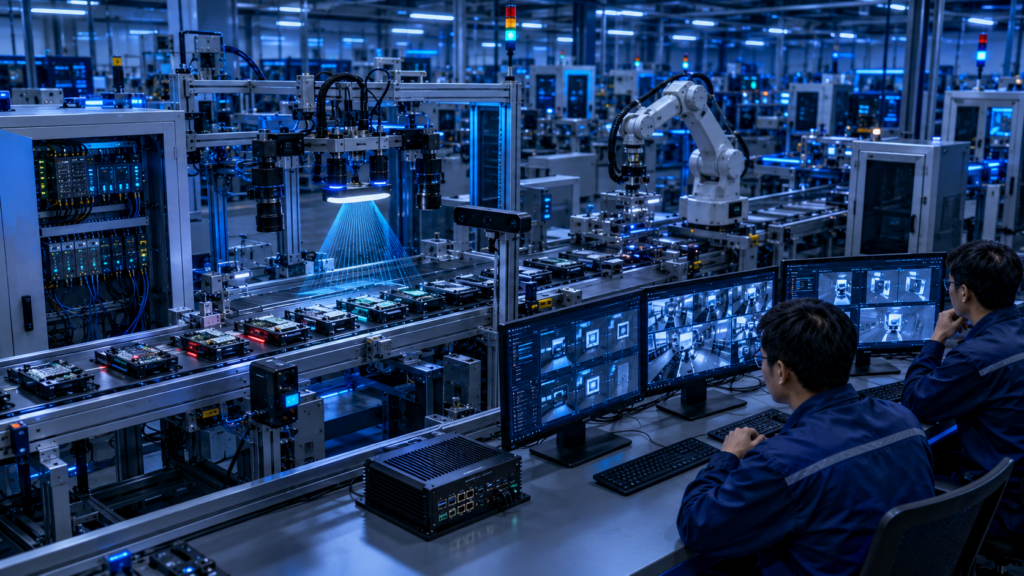
GPU IPC platforms process AI vision and deep learning inference workloads near production equipment.
Branchenüberblick
Deep Learning Is Becoming Practical in Industrial Automation
Deep learning is increasingly used in factory automation and smart manufacturing.
It helps manufacturers analyze images, Mängel erkennen, Objekte klassifizieren, recognize patterns, Geräte überwachen, and process complex industrial data.
Typical deep learning applications include:
- Visual defect detection
- Oberflächeninspektion
- Semiconductor AOI
- Electronics inspection
- Battery inspection
- Verpackungsinspektion
- Barcode- und OCR-Erkennung
- Objekterkennung
- Robotic guidance
- Videoanalyse
- Vorausschauende Wartung
- Anomalieerkennung
These applications require reliable local computing hardware.
A deep learning IPC helps bring AI processing from cloud or laboratory environments into real production systems.
Why GPU Acceleration Matters
Deep learning models often require many parallel calculations.
GPUs are well suited for this type of workload because they can process large amounts of image and matrix data efficiently.
In industriellen Anwendungen, GPU acceleration can help with:
- Faster AI inference
- Multikamera-Verarbeitung
- High-resolution image analysis
- Video stream analytics
- Complex defect segmentation
- Objekterkennung
- Model validation
- Edge AI deployment
- Real-time visual inspection
Not every application needs a large GPU. Some lightweight models can run on CPU-based industrial computers or embedded AI modules.
Jedoch, when image resolution, Anzahl der Kameras, Modellkomplexität, or response-time requirements increase, a GPU IPC becomes more important.
Industrial Computing Is Different from Office AI Hardware
A deep learning IPC is not just a desktop PC with a GPU.
Factory environments require stable operation near machines, Förderer, Kameras, Roboter, SPS, und Schaltschränke.
In diesen Umgebungen kann es zu Vibrationen kommen, Staub, Hitze, begrenzter Luftstrom, elektrisches Rauschen, und lange Betriebsstunden.
Industrial computers and embedded computers are designed for these conditions.
They provide stronger mechanical design, industrielle I/O, reliable power input, controlled thermal performance, Unterstützung für einen langen Lebenszyklus, and flexible mounting for real factory deployment.

Multi-Kamera-Daten, GPU thermal design, Speicherauslastung, SPS-Kommunikation, and cabinet installation affect deep learning IPC reliability.
Wichtigste Herausforderungen
High AI Processing Workload
Deep learning workloads can be demanding.
The required performance depends on camera resolution, Anzahl der Kameras, Bildrate, Größe des KI-Modells, inference speed, Vorverarbeitung, post-processing, and local storage needs.
A system may need to process:
- Hochauflösende Bilder
- Multiple camera streams
- Videoclips
- Defect segmentation models
- Objekterkennungsmodelle
- OCR-Modelle
- Classification models
- Sensor fusion data
- Produktionsaufzeichnungen
If the IPC is underpowered, the system may experience delayed inference, ausgelassene Frames, missed inspection timing, or unstable production performance.
GPU Thermal Management
GPU acceleration improves AI processing, but it also increases power and heat.
Industrial systems often operate inside cabinets or near production lines where airflow may be limited.
Thermal planning is critical.
Wichtige Faktoren sind unter anderem:
- GPU power consumption
- CPU-Auslastung
- Gehäusedesign
- Luftzirkulation im Schrank
- Umgebungstemperatur
- Mounting position
- Dust conditions
- Long-running workload
- Expansion card layout
A GPU IPC must be selected and installed according to real operating conditions, not only peak performance specifications.
Camera Bandwidth and Data Flow
Many deep learning applications are camera-based.
A system may use USB cameras, GigE-Kameras, 2.5GbE-Kameras, 10GbE-Kameras, Zeilenkameras, 3D-Kameras, oder spezielle Framegrabber-Schnittstellen.
Each camera creates data bandwidth requirements.
A multi-camera AI inspection platform must consider:
- Camera interface type
- Anzahl der Kameras
- Bildrate
- Bildauflösung
- Netzwerktrennung
- PCIe-Erweiterung
- Speichergeschwindigkeit
- Speicherbandbreite
- Processing pipeline
A powerful GPU cannot solve a camera bottleneck if the system cannot acquire images reliably.
Industrial Device Integration
A deep learning IPC must communicate with factory equipment.
It may need to connect with PLCs, Roboter, Motion-Controller, Förderer, Sensoren, Beleuchtungssteuerungen, Barcode-Lesegeräte, Alarm, MES-Systeme, and SCADA platforms.
Useful industrial interfaces may include:
- LAN
- USB
- RS232
- RS485
- GPIO
- Digitaler Eingang
- Digitaler Ausgang
- HDMI
- DisplayPort
- M.2
- PCIe
Without the right I/O design, AI deployment becomes harder to integrate and maintain.
Long-Term Reliability and Lifecycle
Industrial AI systems often remain in production for many years.
A change in GPU model, driver, Betriebssystem, camera SDK, or industrial computer platform can create validation problems.
Manufacturers and machine builders need hardware that can support consistent deployment, Ersatzteilplanung, software image stability, und langfristige Wartung.
This is why lifecycle planning is important for deep learning IPC projects.

GPU IPC systems connect AI vision cameras, acceleration hardware, Automatisierungsgeräte, und Fabriksoftwaresysteme.
Deep Learning IPC Solution Architecture
Datenerfassungsschicht
Die Datenerfassungsschicht erfasst Bilder, Videostreams, Sensorwerte, and machine data.
Diese Schicht kann umfassen:
- Industriekameras
- 3D-Kameras
- Hochgeschwindigkeitskameras
- Zeilenkameras
- Frame grabbers
- Beleuchtungssteuerungen
- Triggersensoren
- SPS
- Vibrationssensoren
- Barcode-Lesegeräte
- Robotersteuerungen
- Produktionsausrüstung
The quality of this input directly affects deep learning performance.
Stable camera acquisition, accurate triggering, and clean sensor data are required before AI models can produce reliable results.
GPU Industrial Computing Layer
The GPU industrial computing layer is the core of the system.
Auf dieser Ebene, the industrial computer or embedded computer processes data locally.
It may:
- Acquire images from cameras
- Run deep learning inference
- Perform image preprocessing
- Execute defect detection models
- Run segmentation algorithms
- Process video analytics
- Bewahren Sie Inspektionsprotokolle auf
- Zeigen Sie lokale Dashboards an
- Senden Sie Ergebnisse an SPSen
- Laden Sie ausgewählte Daten in Fabriksysteme hoch
This local computing layer reduces latency and allows AI decisions to happen close to production equipment.
AI Software Layer
The AI software layer includes the models, runtimes, Fahrer, and application software.
Je nach Projekt, es kann beinhalten:
- Deep learning inference runtime
- Bildverarbeitungssoftware
- Kamera-SDKs
- GPU-Treiber
- AI model management tools
- Image preprocessing pipeline
- Fehlerklassifizierungslogik
- Videoanalysesoftware
- Local database software
- Industrial communication software
Hardware selection should consider software compatibility from the beginning.
A GPU IPC must support the operating system, GPU-Treiber, Kameraschnittstellen, and AI frameworks required by the application.
Ebene der Automatisierungssteuerung
The automation control layer connects AI results with physical production action.
Eine SPS, Robotersteuerung, Fördersystem, Motion-Controller, or reject mechanism may receive output from the deep learning IPC.
Zum Beispiel, after detecting a surface defect, the IPC can send a fail signal to a PLC. The PLC can then activate a reject mechanism.
In robot guidance applications, the IPC may process camera data and send object coordinates to a robot controller.
Factory Data Integration Layer
AI results become more valuable when connected with production records.
The deep learning IPC may send selected data to:
- MES
- SCADA
- Qualitätsdatenbanken
- WMS
- ERP
- Cloud-Plattformen
- Lokalhistorische Systeme
- Produktions-Dashboards
Data may include product IDs, Fehlerkategorien, Bilder, Zeitstempel, Stations-IDs, confidence scores, Modellversionen, und Inspektionsergebnisse.
Dies unterstützt die Rückverfolgbarkeit, Qualitätsanalyse, und Prozessverbesserung.
Hauptmerkmale
GPU Acceleration for AI Inference
GPU acceleration is one of the most important features of a deep learning IPC.
The right GPU configuration depends on the actual model and production workload.
Die Auswahl sollte berücksichtigt werden:
- Größe des KI-Modells
- Required inference speed
- Anzahl der Kameras
- Bildauflösung
- Anzahl der Videostreams
- Batch processing needs
- GPU memory
- Stromverbrauch
- Driver support
- Thermisches Design
Für industrielle Anwendungen, stable long-running inference is more important than short benchmark results.
High-Speed Camera Connectivity
Deep learning vision systems need reliable camera input.
Zu den nützlichen Hardwareoptionen können gehören:
- USB 3.0 Häfen
- Mehrere LAN-Ports
- 2.5GbE- oder 10GbE-Optionen
- PCIe-Erweiterung
- Framegrabber-Unterstützung
- M.2-Erweiterung
- High-speed SSD or NVMe storage
- Ausgänge anzeigen
For multi-camera inspection, network traffic and camera bandwidth should be planned carefully.
Camera networks may need to be separated from factory IT networks to improve stability.
Flexible industrielle I/O
A GPU IPC must connect with automation equipment.
Zu den wichtigen E/A-Optionen können gehören:
- LAN
- USB
- RS232
- RS485
- GPIO
- Digitaler Eingang
- Digitaler Ausgang
- HDMI
- DisplayPort
- M.2
- PCIe
- SATA oder NVMe
Diese Schnittstellen unterstützen Kameras, Sensoren, Beleuchtungssteuerungen, SPS, Roboter, Förderer, Barcode-Lesegeräte, Alarm, und lokale Displays.
Flexible I/O reduzieren den Einsatz externer Konverter und verbessern die Bereitstellungszuverlässigkeit.
Reliable Storage for AI Data
Deep learning systems may generate large amounts of data.
The IPC may need to store:
- Defektbilder
- Accepted samples
- Videoclips
- KI-Modelldateien
- Training samples
- Inferenzprotokolle
- Inspection records
- Lokale Datenbanken
- Temporäre Puffer
SSD or NVMe storage is commonly preferred because it supports faster access and better shock resistance than mechanical drives.
For data-heavy AI systems, Speicherkapazität, anhaltende Schreibgeschwindigkeit, schreibe Ausdauer, backup strategy, und Aufbewahrungsrichtlinien sollten während des Entwurfs überprüft werden.
Rugged Mechanical and Thermal Design
A deep learning IPC must support industrial installation.
Das robuste Design schützt vor Vibrationen, Kabelspannung, zunehmender Aufprall, und Dauerbetrieb.
Thermal design is especially important when using GPU acceleration.
System designers should review:
- CPU and GPU heat output
- Fanless or active cooling requirements
- Luftzirkulation im Schrank
- Umgebungstemperatur
- GPU card clearance
- Dust control
- Power supply capacity
- Kabelführung
Reliable thermal planning helps maintain stable AI performance over long operating periods.
Lange Lebensdauer und Wartbarkeit
Deep learning systems often require careful software validation.
Kameratreiber, GPU-Treiber, KI-Frameworks, Betriebssysteme, and application software must work together.
Frequent hardware changes can increase maintenance cost.
Industrial computing platforms with lifecycle support help machine builders and manufacturers maintain consistent AI systems across multiple machines, Linien, und Fabrikgelände.
Bereitstellungsszenarien
AI Visual Defect Detection
Visual defect detection is one of the most common deep learning IPC applications.
The system can inspect products for scratches, Dellen, Risse, Flecken, Kontamination, fehlende Teile, and surface abnormalities.
The GPU IPC processes camera images locally and sends inspection results to PLCs or quality systems.
Semiconductor AOI
Semiconductor AOI often requires high-resolution imaging and advanced defect classification.
A deep learning IPC can process wafer images, die Bilder, Paketbilder, and mark verification data.
It can also connect results with MES, SPC, und hochwertige Datenbanken.
Electronics and SMT Inspection
Electronics manufacturing can use GPU IPC systems for component verification, solder inspection, PCB defect detection, Barcode-Erkennung, and connector inspection.
The system can process images from AOI equipment or production-line cameras and link results with PCB serial numbers.
Battery Manufacturing Inspection
Battery production can use deep learning IPC platforms for electrode surface inspection, tab welding inspection, cell appearance checking, module assembly verification, and pack inspection.
The GPU IPC helps process complex defect patterns and connect results with production traceability systems.
Verpackungsinspektion
Packaging inspection can involve labels, Siegel, Barcodes, Datumscodes, Kappen, Kartons, Beutel, Flaschen, and final package verification.
A deep learning IPC can support AI defect detection and send reject decisions to PLC-controlled equipment.
Robotics and 3D Vision
Robotic applications may need deep learning for object detection, Teilelokalisierung, Bin-Picking, and quality inspection.
A GPU IPC can process 2D or 3D camera data and send coordinates or classification results to robot controllers.
Videoanalyse
Industrial video analytics can support safety monitoring, process observation, Geräteüberwachung, and logistics tracking.
A GPU IPC can process multiple video streams locally and upload only selected events or alerts.
Dies reduziert die Netzwerklast und verbessert die Reaktionszeit.
Integration von OEM-KI-Geräten
Machine builders can integrate GPU IPC systems into AI inspection machines, Robotersysteme, Sortierausrüstung, Intelligente Gateways, or automation platforms.
Die Computerplattform kann KI-Inferenz liefern, camera processing, lokaler Speicher, HMI-Anzeige, SPS-Kommunikation, und Werksdatenausgabe.
This helps OEMs deliver industrial AI equipment ready for production deployment.
Geschäftsvorteile
Faster AI Inference
A GPU IPC provides stronger local processing for deep learning workloads.
This helps reduce inference time and supports faster production decisions.
Fast local AI is useful for defect rejection, Roboterführung, Sortierung, Überwachung, and high-speed inspection.
Improved Inspection Capability
Deep learning can help detect complex visual defects that are difficult to define with fixed rules.
A deep learning IPC provides the computing power needed to run these models near production equipment.
This helps manufacturers improve inspection consistency and reduce manual review workload.
Reduzierte Cloud-Abhängigkeit
Local GPU processing reduces the need to send all images or video streams to cloud platforms.
The IPC can process data at the edge and upload only selected results, Bilder, Warnungen, or summaries.
This reduces bandwidth pressure and improves operational resilience.
Stärkere Rückverfolgbarkeit der Produktion
KI-Ergebnisse können mit Produkt-IDs verknüpft werden, Arbeitsaufträge, Fehlerkategorien, Bilder, Zeitstempel, Stations-IDs, Modellversionen, und Bedieneraktionen.
This creates stronger quality records.
Reliable industrial storage and data integration help support audits, Prozessüberprüfung, Garantieuntersuchung, und Ursachenanalyse.
Better Integration with Automation
A GPU IPC can connect deep learning results with PLCs, Roboter, Förderer, und Fabriksysteme.
This turns AI analysis into practical production action.
The system can trigger reject mechanisms, guide robots, send alarms, or update quality databases automatically.
Scalable Industrial AI Deployment
A standardized deep learning IPC platform makes it easier to deploy AI across multiple production lines and factories.
Konsistente Hardware vereinfacht Software-Images, GPU driver validation, camera SDK management, Ersatzteilplanung, and maintenance training.
This helps manufacturers move from AI pilot projects to scalable production deployment.
Warum CoreIPC
CoreIPC bietet industrielle Computerplattformen für Edge-KI, maschinelles Sehen, Fabrikautomation, Robotik, und eingebettete Systemintegration. For deep learning IPC applications, CoreIPC konzentriert sich auf zuverlässige industrielle Computerhardware, Embedded-Computer-Lösungen, flexible I/O-Konfigurationen, kompaktes Systemdesign, GPU-ready platform planning, und OEM/ODM-Anpassungsunterstützung. CoreIPC hilft Systemintegratoren, Maschinenbauer, und Fertigungsteams wählen Computerplattformen aus, die den tatsächlichen Bereitstellungsanforderungen entsprechen, including GPU workload, Kameraschnittstellen, Automatisierungskommunikation, Speicherbedarf, Montagemethoden, Leistungsaufnahme, thermisches Design, Softwarekompatibilität, und Lebenszyklusplanung.
Häufig gestellte Fragen
1. What is a deep learning IPC?
A deep learning IPC is an industrial computer designed to run deep learning workloads in industrial environments.
It may include GPU acceleration, Hochgeschwindigkeitskamera-Konnektivität, industrielle I/O, Robustes mechanisches Design, zuverlässige Lagerung, and factory network support. It is commonly used for AI inspection, Videoanalyse, Roboter-Vision, and industrial edge computing.
2. Why use a GPU IPC for deep learning?
Deep learning models often require parallel processing.
A GPU IPC can accelerate AI inference, Bildverarbeitung, Objekterkennung, Segmentierung, and video analytics. This helps the system process more data locally and respond faster in production environments.
3. How is an embedded computer used for deep learning?
An embedded computer can be used for compact AI deployment near machines, Kameras, Roboter, oder Schaltschränke.
For lighter workloads, it may run CPU-based AI or embedded AI acceleration. For heavier workloads, a larger industrial computer with GPU support may be required. The selection depends on model complexity, Anzahl der Kameras, und Reaktionszeitanforderungen.
4. What applications need a deep learning IPC?
Applications include visual defect detection, Halbleiter-AOI, Elektronikinspektion, Batterieinspektion, Verpackungsinspektion, Roboterführung, Videoanalyse, logistics sorting, vorausschauende Wartung, and smart factory monitoring.
Any application that uses deep learning models near production equipment may benefit from a properly selected industrial GPU IPC.
5. Does every AI vision system need a GPU?
NEIN. Some AI vision systems can run on CPU-based industrial computers or compact embedded computers.
A GPU is usually more important when the system uses high-resolution images, mehrere Kameras, complex deep learning models, Videoanalyse, 3D-Vision, or short cycle-time requirements. Real model testing should guide hardware selection.
6. What interfaces are important for GPU IPC systems?
Wichtige Schnittstellen können USB sein 3.0, mehrere LAN-Ports, 2.5Tragen, 10Tragen, PCIe, M.2, RS232, RS485, GPIO, digitaler Eingang, digitaler Ausgang, HDMI, DisplayPort, SATA, und NVMe-Speicherunterstützung.
Camera interfaces and PCIe expansion are especially important for many deep learning vision applications.
7. Can fanless industrial computers support deep learning?
Fanless industrial computers can support some deep learning workloads, especially lightweight inference and moderate AI applications.
Jedoch, GPU-based deep learning workloads may generate significant heat. CPU-Leistung, GPU power, Gehäusedesign, Luftzirkulation im Schrank, Umgebungstemperatur, und Montagemethode sollten vor der Bereitstellung überprüft werden.
8. How does a deep learning IPC connect with PLCs and robots?
A deep learning IPC can communicate with PLCs and robots through Ethernet, serielle Kommunikation, digitale I/O, or supported automation software interfaces.
It can receive triggers, Bilder verarbeiten, and send pass, scheitern, Alarm, Position, or classification results back to the automation system.
9. Can deep learning IPC systems connect with MES or quality databases?
Ja. Industrial computers can upload AI inspection results to MES, Qualitätsdatenbanken, SCADA, WMS, ERP, oder Cloud-Plattformen.
Hochgeladene Daten können Produkt-IDs enthalten, Fehlerkategorien, Bildaufzeichnungen, Zeitstempel, Modellversionen, Stations-IDs, und Inspektionsergebnisse. This supports traceability and quality analysis.
10. What should be tested before deploying a GPU IPC?
Vor der Bereitstellung, Das System sollte mit echten Kameras getestet werden, real AI models, actual production images, GPU-Treiber, Kamera-SDKs, SPS-Kommunikation, Speicherauslastung, Netzwerkarchitektur, und langlebigen Betrieb.
Thermische Stabilität, inference speed, Zuverlässigkeit der Bilderfassung, and data upload behavior should also be validated.
Abschluss
A deep learning IPC is a practical foundation for industrial AI systems that require GPU acceleration, maschinelles Sehen, Videoanalyse, Roboterführung, Fehlererkennung, and local edge intelligence.
By placing a GPU-ready industrial computer or embedded computer close to cameras, Sensoren, SPS, Roboter, Förderer, und Produktionssysteme, manufacturers can process AI workloads locally, Latenz reduzieren, lower cloud dependency, and connect deep learning results with real automation actions.
Die richtige Plattform sollte entsprechend den tatsächlichen Bereitstellungsanforderungen ausgewählt werden, including AI model complexity, GPU workload, Kameraschnittstelle, Bildauflösung, I/O-Konfiguration, Netzwerkarchitektur, Speicherbedarf, Erweiterungsbedarf, Montagemethode, Leistungsaufnahme, thermische Bedingungen, Betriebssystemunterstützung, und Lebenszyklusplanung.
CoreIPC supports deep learning IPC projects with industrial computing platforms designed for practical factory and equipment deployment. Mit der richtigen Hardware-Grundlage, Hersteller und Maschinenbauer können zuverlässig bauen, skalierbar, and production-ready industrial AI systems.
Kontaktieren Sie uns
Auf der Suche nach einem Industriecomputer, eingebetteter Computer, or GPU IPC for deep learning?
Kontaktieren Sie CoreIPC, um Ihre Projektanforderungen zu besprechen, einschließlich KI-Arbeitsaufwand, GPU requirements, Kameraschnittstelle, I/O-Konfiguration, robot or PLC communication, Speicherdesign, Montagemethode, Leistungsaufnahme, Betriebsumgebung, Lebenszyklusanforderungen, und OEM/ODM-Anpassungsoptionen.