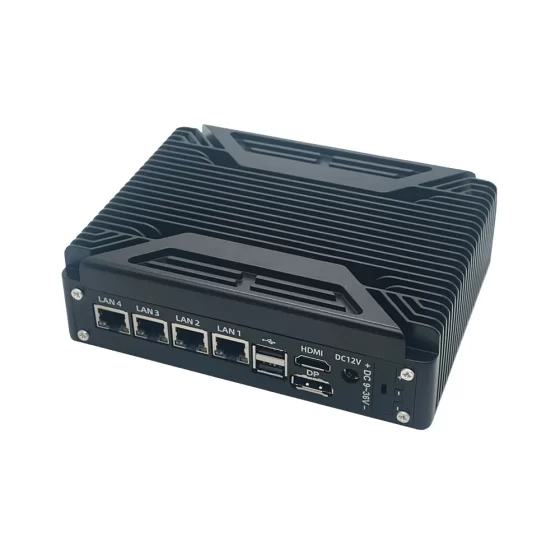
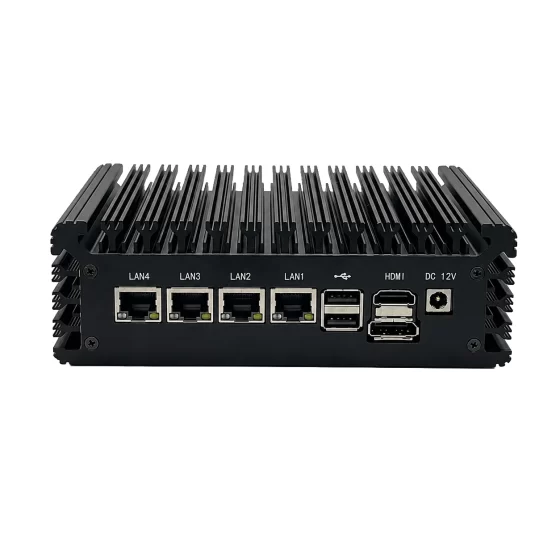
CoreIPC Industrial Computing-Lösungen

Edge-KI-Computer für die Überwachung: Edge-KI-Überwachung für industrielle Überwachung und Sicherheit
Zusammenfassung
Edge AI surveillance is becoming an important technology foundation for industrial monitoring, facility security, safety awareness, equipment visibility, and real-time video analytics in modern industrial environments.
Fabriken, Lagerhäuser, Energieanlagen, Verkehrsknotenpunkte, logistics centers, and smart infrastructure sites often operate with many cameras and continuous video streams. Sending all raw video to a remote cloud or central server can create high bandwidth usage, latency, Speicherdruck, und Netzwerkabhängigkeit.
An edge AI computer for surveillance processes video data locally. It can connect to IP cameras, Industriekameras, Sensoren, access control systems, Alarm, SPS, network switches, und Überwachungs-Dashboards. It can run AI models near the camera network to detect events, classify abnormal conditions, trigger alerts, and send selected results to security platforms or industrial systems.
Ein Industriecomputer oder eingebetteter Computer stellt die lokale Computerplattform für diese Arbeitslasten bereit. Im Vergleich zu handelsüblichen PCs, industrial computers are better suited for continuous operation in factory and infrastructure environments because they support rugged installation, flexible I/O, multiple network interfaces, zuverlässige Lagerung, lüfterlose Optionen, und Bereitstellung über einen langen Lebenszyklus.
This article explains how edge AI surveillance systems work, Welche Herausforderungen treten im realen Einsatz auf?, wie die Lösungsarchitektur aufgebaut ist, and which hardware features are important when selecting an industrial computer or embedded computer for AI-based surveillance and monitoring.
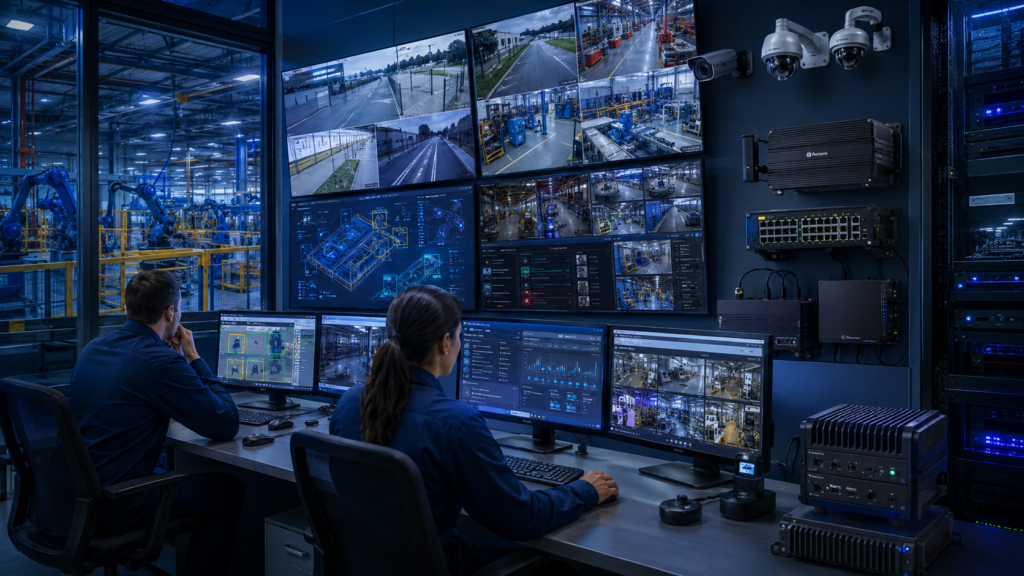
Edge AI computers process camera streams locally for industrial monitoring, facility visibility, and event alerts.
Branchenüberblick
Surveillance Is Moving from Recording to Intelligence
Traditional surveillance systems mainly record video for later review.
This approach is useful, but it has limitations. Operators cannot manually watch every camera all the time, and important events may only be discovered after a problem has already occurred.
Edge AI surveillance adds local intelligence to camera systems.
Instead of only recording video, the system can analyze camera streams in real time and generate event-based alerts.
Industrial surveillance may support:
- Facility perimeter monitoring
- Restricted area detection
- Equipment area monitoring
- Production line visibility
- Warehouse and logistics monitoring
- Safety event awareness
- Vehicle and material flow monitoring
- Abnormal behavior or abnormal scene detection
- Fire, smoke, or spill detection support
- Remote site monitoring
The goal is to improve visibility and response without sending every video stream to the cloud.
Why Edge AI Matters for Surveillance
Surveillance video creates large amounts of data.
A site with many cameras can quickly generate heavy network traffic and storage requirements. If all video is processed centrally, the system may require high bandwidth and powerful centralized servers.
Edge AI computing helps reduce this pressure.
The edge AI computer can process video near the camera network and upload only selected information, such as alarms, event clips, metadata, or summary records.
This supports faster response and more efficient system design.
Industrial Computing Is Needed for Real Deployment
Industrial surveillance systems are often installed in practical field conditions.
The computing hardware may operate in control rooms, Schränke, factory floors, Lagerhäuser, Transportstandorte, Umspannwerke, outdoor enclosures, oder abgelegene Einrichtungen.
Diese Umgebungen können Staub enthalten, Vibration, Temperaturschwankungen, instabile Macht, limited maintenance access, und kontinuierliche Betriebspläne.
Industrial computers and embedded computers are designed for these conditions.
Sie sorgen für einen stabilen Betrieb, robuste Gehäuse, mehrere LAN-Ports, Speichermöglichkeiten, I/O-Konnektivität, und lange Verfügbarkeit über den gesamten Lebenszyklus.

Kamerabandbreite, Netzwerksegmentierung, Speicheraufbewahrung, alarm wiring, Zugangskontrolle, and cabinet deployment affect surveillance reliability.
Wichtigste Herausforderungen
Multiple Video Streams
Edge AI surveillance often involves multiple cameras.
Each camera stream adds processing, network, and storage load. The system may need to process several IP camera streams, industrial camera feeds, or high-resolution video channels at the same time.
Zu den wichtigsten Arbeitsbelastungsfaktoren gehören::
- Anzahl der Kameras
- Video resolution
- Bildrate
- Compression format
- Komplexität des KI-Modells
- Event detection requirements
- Storage duration
- Local display needs
- Network upload frequency
The edge AI computer must be selected according to the actual number of cameras and analysis tasks.
Real-Time Event Detection
Surveillance systems are most valuable when they detect important events quickly.
If AI processing is delayed, the system may miss the correct response window.
Echtzeitanforderungen können in auftreten:
- Perimeter intrusion alerts
- Restricted zone monitoring
- Equipment abnormality detection
- Conveyor blockage detection
- Vehicle movement monitoring
- Warehouse aisle monitoring
- Fire or smoke event support
- Safety area awareness
- Remote site alarms
The computing platform must provide stable sustained performance during continuous video analysis.
Network Bandwidth and Segmentation
Video surveillance networks can create heavy traffic.
If camera streams share the same network as production systems, SPS, MES, or office IT traffic, network congestion may occur.
A practical edge AI surveillance computer may need multiple LAN ports for network separation.
Zum Beispiel:
- One LAN port for IP cameras
- One LAN port for local monitoring systems
- One LAN port for factory IT connection
- One LAN port for remote access or cloud upload
Good network architecture improves stability and supports better cybersecurity planning.
Storage and Retention
Surveillance systems may need to store video clips, event images, AI metadata, Protokolle, und lokale Datenbanken.
The storage requirement depends on camera count, recording method, event retention policy, Bildauflösung, and upload strategy.
Some systems store only event clips. Others need continuous local recording for a defined retention period.
Die Lagerungsplanung sollte berücksichtigt werden:
- Capacity
- Schreibgeschwindigkeit
- Schreiben Sie Ausdauer
- Sicherungsmethode
- Arbeitslast der lokalen Datenbank
- Video retention period
- Event clip storage
- Verhalten bei Netzwerkunterbrechungen
Reliable storage helps protect important surveillance records.
Privacy and Operational Policy
AI surveillance must be deployed carefully.
Industrial monitoring should focus on safety, Sicherheit, equipment visibility, and operational awareness. It should follow site policy, local regulations, Zugangskontrollregeln, und Anforderungen an die Datenaufbewahrung.
System design should consider:
- What events are monitored
- Who can access video data
- How long records are stored
- How alerts are reviewed
- Which areas are monitored
- How data is protected
- How remote access is controlled
The computing platform should support secure deployment and controlled data handling.

Edge AI computers connect cameras, Alarm, access control systems, VMS platforms, cloud monitoring, and security dashboards.
Edge AI Surveillance Solution Architecture
Camera and Sensor Layer
The camera and sensor layer captures raw visual and event data.
Diese Schicht kann umfassen:
- IP-Kameras
- Industriekameras
- Wärmebildkameras
- Low-light cameras
- PTZ-Kameras
- Door sensors
- Access control signals
- Bewegungssensoren
- Alarm inputs
- Umweltsensoren
- Network video devices
These devices generate the video and event data required for AI analysis.
Stable camera connections and proper network design are essential for reliable edge AI surveillance.
Edge AI Computing-Schicht
The edge AI computing layer is where the industrial computer or embedded computer processes video data locally.
Auf dieser Ebene, Der Computer kann:
- Receive camera streams
- Decode video
- Führen Sie KI-Inferenzmodelle aus
- Detect defined events
- Classify abnormal scenes
- Store event clips
- Generieren Sie Benachrichtigungen
- Zeigen Sie lokale Dashboards an
- Send metadata to platforms
- Buffer records during network issues
This layer reduces latency and limits the need to upload all raw video.
AI Video Analytics Layer
The AI video analytics layer contains the software logic used to analyze surveillance streams.
Abhängig von der Anwendung, es kann beinhalten:
- Objekterkennung
- Area monitoring
- Vehicle detection
- Person detection for safety zones
- Abnormal scene detection
- Smoke or fire event support
- Equipment status recognition
- Überwachung des Produktionsflusses
- Video event classification
- Regelbasierte Alarmlogik
Der Industrierechner muss das erforderliche Betriebssystem unterstützen, Fahrer, KI-Laufzeit, video management software, and camera protocols.
Alert and Control Layer
The alert and control layer connects AI results with action.
When the system detects an event, it may trigger a local alarm, send a notification, mark a video clip, display an alert on a dashboard, or send data to a security platform.
In industriellen Umgebungen, it may also connect with:
- Alarm devices
- Access control systems
- SPS
- SCADA-Systeme
- Safety monitoring systems
- Facility management systems
- Fernüberwachungsplattformen
This helps turn video analysis into operational response.
Plattformintegrationsschicht
Edge AI surveillance systems often connect with higher-level systems.
The edge AI computer may send selected data to:
- Videomanagementsysteme
- Security operation platforms
- SCADA-Systeme
- Industrielle IoT-Dashboards
- Cloud-Überwachungsplattformen
- Lokale Datenbanken
- Facility management systems
- Wartungsplattformen
Instead of sending every frame, the system can send events, metadata, Warnungen, snapshots, and selected clips.
This makes surveillance deployment more efficient and easier to manage.
Hauptmerkmale
AI Video Processing Performance
Edge AI surveillance requires stable video analytics performance.
The right hardware depends on camera count, Auflösung, Bildrate, Komplexität des KI-Modells, and event detection requirements.
Die Auswahl sollte berücksichtigt werden:
- CPU-Leistung
- GPU- oder KI-Beschleunigerunterstützung
- Speicherkapazität
- Video decoding workload
- Netzwerkbandbreite
- Speichergeschwindigkeit
- Betriebssystemunterstützung
- Kompatibilität mit KI-Frameworks
- Thermisches Design
A compact embedded computer may support a small camera group. A larger multi-camera surveillance system may require an edge AI computer or industrial PC with stronger acceleration.
Multiple LAN Ports
Multiple LAN ports are valuable in surveillance systems.
They allow separation between camera networks, Managementnetzwerke, Fabriknetzwerke, and remote access networks.
This can improve:
- Camera traffic stability
- Netzwerksegmentierung
- Security planning
- Fernwartung
- Multi-site deployment
- Local recording reliability
- Factory network organization
For sites with many IP cameras, network design should be planned before hardware selection.
Flexible industrielle I/O
Surveillance systems may need to connect with more than cameras.
Zu den wichtigen E/A-Optionen können gehören:
- LAN
- USB
- RS232
- RS485
- GPIO
- Digitaler Eingang
- Digitaler Ausgang
- HDMI
- DisplayPort
- M.2
- PCIe
- SATA- oder NVMe-Speicher
Diese Schnittstellen können Kameras unterstützen, Alarm, Sensoren, Zugangskontrollgeräte, display screens, network switches, Speichergeräte, and industrial systems.
Flexible I/O reduzieren den Bedarf an externen Konvertern und verbessern die Bereitstellungszuverlässigkeit.
Zuverlässiger lokaler Speicher
Local storage is important for edge AI surveillance.
The computer may store video clips, event snapshots, metadata, Alarmprotokolle, KI-Modelldateien, Systemprotokolle, und lokale Datenbanken.
SSD- oder NVMe-Speicher werden häufig bevorzugt, da sie einen schnellen Zugriff und eine bessere Stoßfestigkeit als mechanische Laufwerke bieten.
For video-heavy deployments, Speicherkapazität, schreibe Ausdauer, Aufbewahrungsrichtlinie, Sicherungsmethode, and upload strategy should be reviewed carefully.
Robustes und lüfterloses Design
Edge AI surveillance computers may run continuously in challenging environments.
Fanless designs can reduce dust intake and remove one common mechanical failure point. Robuste Gehäuse schützen das System vor Vibrationen, Kabelspannung, und Schrankeinbaubedingungen.
Jedoch, video analytics and AI inference may generate heat.
Thermal design should be reviewed based on CPU workload, Beschleunigereinsatz, Gehäusedesign, Umgebungstemperatur, Luftstrom, und Montageort.
Lange Lebensdauer und Wartbarkeit
Surveillance infrastructure often stays in service for many years.
Frequent hardware changes can create issues with video software, camera compatibility, KI-Modelle, Betriebssysteme, and driver validation.
Industrial computing platforms with lifecycle planning help system integrators and facility operators maintain consistent deployments across multiple sites and equipment generations.
This improves long-term support and reduces maintenance complexity.

Edge AI surveillance platforms improve event detection, Fernüberwachung, facility visibility, data control, and operational response.
Bereitstellungsszenarien
Factory Perimeter Monitoring
Factories can use edge AI surveillance for perimeter awareness.
The system can process video from cameras near gates, fences, loading areas, and restricted zones.
The edge AI computer can detect defined events, Benachrichtigungen generieren, and send selected records to security systems or monitoring dashboards.
Lager- und Logistiküberwachung
Warehouses and logistics centers often need visibility across aisles, Laderampen, Förderbereiche, and sorting zones.
Edge AI surveillance can help monitor package movement, vehicle activity, blocked pathways, abnormal congestion, and operational exceptions.
The industrial computer processes video locally and sends event records to monitoring systems.
Production Line Video Monitoring
Production lines may use cameras to monitor machine areas, product flow, conveyor conditions, und Bedienstationen.
AI video analytics can detect stoppages, fehlender Produktfluss, abnormal movement, or visual events that need review.
This supports better operational visibility and faster response.
Fernüberwachung von Anlagen
Remote industrial facilities may include energy sites, Pumpstationen, Umspannwerke, Hauswirtschaftsräume, and outdoor equipment areas.
An embedded computer can process camera streams locally, buffer events, and send selected alerts over limited network connections.
This reduces bandwidth usage and supports remote operation.
Transportation and Infrastructure Surveillance
Transportation sites may use edge AI surveillance for platforms, parking areas, logistics yards, tunnels, Stationen, and access zones.
The system can analyze video locally and send event-based alerts to monitoring centers.
Industrial computers are useful where deployment conditions require rugged hardware and continuous operation.
Equipment Area Monitoring
Some facilities use cameras to monitor equipment rooms, machine zones, conveyor transfer points, or utility systems.
AI surveillance can support abnormal scene detection, equipment status visibility, and alarm verification.
This helps operators confirm whether a machine or facility event needs immediate action.
Safety Zone Awareness
Industrial sites may use video analytics to support safety zone awareness.
The system can detect when defined areas become occupied or when abnormal movement appears near equipment.
Such systems should be deployed according to site safety policy and should support operators rather than replace formal safety systems.
OEM Surveillance System Integration
System integrators and OEM solution providers can integrate edge AI computers into surveillance appliances, video analytics boxes, smart monitoring gateways, or industrial security systems.
The computing platform can provide video processing, KI-Schlussfolgerung, lokaler Speicher, network interfaces, alarm I/O, und Fernüberwachungskonnektivität.
Geschäftsvorteile
Faster Local Event Detection
Edge AI surveillance processes video near the camera network.
This reduces the delay between event capture and alert generation.
Fast local detection is useful for restricted zones, facility security, production exceptions, remote site monitoring, and safety awareness.
Reduced Bandwidth Usage
Video data can create heavy network traffic.
Edge AI computers can analyze video locally and upload only selected events, snapshots, clips, or metadata.
This reduces bandwidth load and makes surveillance systems easier to scale across multiple cameras and sites.
Verbesserte operative Transparenz
AI surveillance helps operators understand what is happening across factories, Lagerhäuser, infrastructure sites, und abgelegene Einrichtungen.
Instead of relying only on manual camera review, the system can highlight events that need attention.
This improves monitoring efficiency and supports faster investigation.
Better Resilience During Network Issues
Local processing helps surveillance systems continue operating when network connections are unstable.
The edge AI computer can keep processing camera streams, storing event data, und Puffern von Datensätzen.
Wenn die Verbindung wiederhergestellt ist, selected data can be uploaded to higher-level systems.
Stronger Security and Data Control
Edge processing allows more video data to remain local.
This can support better data control when raw video does not need to leave the site.
System designers can define what information is stored, what is uploaded, who can access it, and how long records are retained.
Scalable Multi-Site Deployment
A standardized edge AI surveillance platform makes it easier to deploy similar systems across multiple factories, Lagerhäuser, oder Infrastrukturstandorte.
Konsistente Hardware vereinfacht Software-Images, camera validation, Ersatzteilplanung, Fernwartung, und Lebenszyklusunterstützung.
This helps system integrators and facility operators scale surveillance intelligence more efficiently.
Warum CoreIPC
CoreIPC bietet industrielle Computerplattformen für Edge-KI, Videoanalyse, Industrielles IoT, Fabrikautomation, und eingebettete Systemintegration. For edge AI surveillance applications, CoreIPC konzentriert sich auf zuverlässige industrielle Computerhardware, Embedded-Computer-Lösungen, flexible I/O-Konfigurationen, multi-network deployment, kompaktes Systemdesign, und OEM/ODM-Anpassungsunterstützung. CoreIPC hilft Systemintegratoren, Anbieter von Sicherheitslösungen, und Industriebetreiber wählen Computerplattformen aus, die den tatsächlichen Einsatzanforderungen entsprechen, einschließlich Kameraanzahl, KI-Arbeitsbelastung, Speicherdesign, Netzwerksegmentierung, Montagemethoden, Leistungsaufnahme, thermische Bedingungen, und Lebenszyklusplanung.
Häufig gestellte Fragen
1. What is edge AI surveillance?
Edge AI surveillance uses local computing hardware to process camera streams near the surveillance site.
Instead of sending all raw video to a remote server, the edge AI computer analyzes video locally, detects defined events, stores selected records, and sends alerts or metadata to monitoring platforms. This improves response time and reduces bandwidth usage.
2. Why use an industrial computer for edge AI surveillance?
An industrial computer is better suited for surveillance systems deployed in factories, Lagerhäuser, infrastructure sites, und abgelegene Einrichtungen.
It supports continuous operation, robuste Installation, mehrere Netzwerkanschlüsse, flexible I/O, zuverlässige Lagerung, und lange Verfügbarkeit über den gesamten Lebenszyklus. These features help the system operate reliably near cameras, Schränke, Maschinen, und industrielle Netzwerke.
3. How is an embedded computer used in surveillance systems?
An embedded computer can act as a compact video analytics node.
It can be installed near camera groups, in Schaltschränken, in monitoring gateways, or inside OEM surveillance appliances. It can process video streams, Führen Sie KI-Modelle aus, store event records, and send selected alerts to monitoring systems.
4. What AI functions can edge surveillance support?
Edge AI surveillance can support object detection, area monitoring, Fahrzeugerkennung, restricted zone alerts, abnormal scene detection, production flow monitoring, equipment area monitoring, and event-based video review.
The exact functions depend on camera placement, AI model design, Lichtverhältnisse, system policy, and real deployment testing.
5. Does edge AI surveillance need a GPU?
Some surveillance systems need GPU or AI accelerator support, especially when processing multiple video streams, high-resolution cameras, or complex AI models.
Smaller systems with fewer streams may run on CPU-based industrial computers or embedded computers. Hardware selection should be based on real camera count, model performance, und Reaktionszeitanforderungen.
6. What interfaces are important for edge AI surveillance computers?
Wichtige Schnittstellen können mehrere LAN-Ports sein, USB, RS232, RS485, GPIO, digitaler Eingang, digitaler Ausgang, HDMI, DisplayPort, M.2, PCIe, SATA, und NVMe-Speicherunterstützung.
Mehrere LAN-Ports sind besonders nützlich, um Kameranetzwerke zu trennen, Fabriknetzwerke, Fernzugriff, und Verwaltungsverkehr.
7. Can fanless industrial computers support surveillance analytics?
Fanless industrial computers can support many edge AI surveillance applications, especially moderate camera workloads and cabinet-based deployments.
Jedoch, multi-camera video analytics may generate significant heat. CPU-Auslastung, Beschleunigereinsatz, Gehäusedesign, Umgebungstemperatur, Luftstrom, and mounting location should be reviewed before deployment.
8. How does edge AI surveillance reduce bandwidth usage?
The edge AI computer processes video locally and uploads only selected information.
This may include event records, snapshots, short video clips, alarm metadata, or summary data. By avoiding continuous upload of all raw video, the system reduces bandwidth pressure and makes multi-camera deployment more efficient.
9. Can edge AI surveillance connect with industrial systems?
Ja. Edge AI surveillance computers can connect with security platforms, video management systems, SCADA, Industrielle IoT-Dashboards, alarm devices, access control systems, and facility management platforms.
In some industrial deployments, they may also communicate with PLCs or local monitoring systems for event coordination.
10. Was sollte vor der Bereitstellung getestet werden??
Vor der Bereitstellung, Das System sollte mit echten Kameras getestet werden, real lighting conditions, actual camera count, Netzwerkarchitektur, KI-Modelle, local storage workload, Alarmzeitpunkt, und langlebigen Betrieb.
Thermische Stabilität, Verhalten bei Netzwerkunterbrechungen, event accuracy, Zugangskontrolle, Der Wartungsablauf sollte ebenfalls validiert werden.
Abschluss
Edge AI surveillance is a practical foundation for industrial monitoring, facility security, Videoanalyse, remote site visibility, and event-based operational awareness.
By placing an industrial computer or embedded computer close to camera networks, Sensoren, Alarm, access systems, und Überwachungsplattformen, organizations can process video locally, reduce bandwidth usage, Reaktionszeit verbessern, and maintain better control over surveillance data.
The right edge AI surveillance platform should be selected according to real deployment requirements, einschließlich Kameraanzahl, video resolution, KI-Arbeitsbelastung, Netzwerkarchitektur, Speicheraufbewahrung, I/O-Konfiguration, Montagemethode, Leistungsaufnahme, thermische Bedingungen, Betriebssystemunterstützung, Sicherheitspolitik, und Lebenszyklusplanung.
CoreIPC supports edge AI surveillance projects with industrial computing platforms designed for practical field deployment. Mit der richtigen Hardware-Grundlage, system integrators and industrial operators can build reliable, skalierbar, and efficient AI video monitoring systems.
Kontaktieren Sie uns
Auf der Suche nach einem Industriecomputer, eingebetteter Computer, or edge AI platform for edge AI surveillance?
Kontaktieren Sie CoreIPC, um Ihre Projektanforderungen zu besprechen, einschließlich Kameraanzahl, KI-Arbeitsbelastung, Netzwerksegmentierung, Speicherdesign, I/O-Konfiguration, Montagemethode, Leistungsaufnahme, Betriebsumgebung, Lebenszyklusanforderungen, und OEM/ODM-Anpassungsoptionen.