CoreIPC Industrial Computing-Lösungen

GPU-Industriecomputer für KI-Inferenz
Zusammenfassung
A GPU-Industriecomputer für KI-Inferenz ist zu einer entscheidenden Basistechnologie für die moderne intelligente Automatisierung geworden, maschinelles Sehen, Robotik, Industrielles IoT, und Edge-KI-Anwendungen. Da die Industrie zunehmend künstliche Intelligenz einsetzt, um die betriebliche Effizienz zu verbessern, Produktqualität, vorausschauende Wartung, und autonome Entscheidungsfindung, Die Nachfrage nach Hochleistungs-Computing-Plattformen, die KI-Inferenz-Workloads in Echtzeit ausführen können, wächst weiter.
Im Gegensatz zu herkömmlichen cloudbasierten KI-Architekturen, Industrielle Umgebungen erfordern häufig eine Verarbeitung mit geringer Latenz, Reaktionsfähigkeit in Echtzeit, verbesserter Datenschutz, und zuverlässigen Betrieb unabhängig von der Internetverbindung. Direkt am Edge durchgeführte KI-Inferenz ermöglicht es industriellen Systemen, Sensordaten zu verarbeiten, Bilder, Videostreams, und Betriebsinformationen lokal, ohne auf Remote-Cloud-Ressourcen angewiesen zu sein.
Ein GPU-Industriecomputer kombiniert Zuverlässigkeit auf Industrieniveau mit leistungsstarker GPU-Beschleunigung, Damit eignet es sich ideal für KI-gestützte Anwendungen, die in Fabriken eingesetzt werden, Transportsysteme, Intelligente Städte, Gesundheitsumgebungen, Logistikeinrichtungen, und Energieinfrastruktur. Diese Systeme stellen die für Deep-Learning-Inferenz erforderlichen Rechenressourcen bereit, Bildverarbeitungsanalyse, Objekterkennung, vorausschauende Wartung, autonome Navigation, und industrielle Automatisierung bei gleichzeitiger Aufrechterhaltung eines zuverlässigen Betriebs unter anspruchsvollen Umgebungsbedingungen.
In diesem Artikel wird die Rolle von GPU-Industriecomputern in KI-Inferenzanwendungen untersucht, Hauptherausforderungen bei der Bereitstellung, Überlegungen zur Lösungsarchitektur, kritische Funktionen, Einsatzszenarien, und die geschäftlichen Vorteile der Implementierung von Edge-KI-Computing-Plattformen.
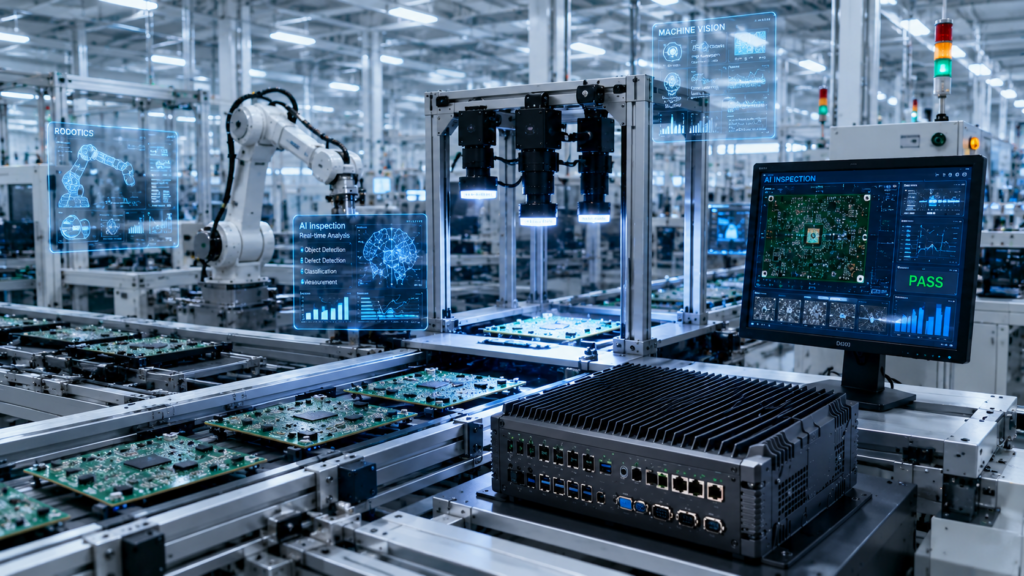
GPU-Industriecomputer ermöglichen Echtzeit-KI-Inferenz für die maschinelle Bildverarbeitung, Robotik, Qualitätsprüfung, und intelligente Automatisierung in modernen Smart Factorys.
Branchenüberblick
Künstliche Intelligenz verändert Industrieabläufe in praktisch allen Sektoren. Moderne Unternehmen verlassen sich zunehmend auf KI-gesteuerte Technologien, um die Produktivität zu verbessern, Betriebskosten senken, Verbesserung der Qualitätskontrolle, und die Entscheidungsfindung beschleunigen.
Zu den industriellen KI-Anwendungen gehören::
- Bildverarbeitungsinspektion
- Vorausschauende Wartung
- Autonome mobile Roboter (AMR)
- Fahrerlose Transportfahrzeuge (AGV)
- Intelligente Überwachung
- Industrierobotik
- Intelligenter Transport
- Industrielle IoT-Analyse
- Fehlererkennung
- Prozessoptimierung
- Vermögensüberwachung
- Sicherheitsmanagement
Historisch, Die KI-Verarbeitung wurde hauptsächlich in zentralisierten Cloud-Umgebungen durchgeführt. Jedoch, Industrielle Bereitstellungen stoßen oft an Einschränkungen, die mit cloudbasierten Architekturen verbunden sind, einschließlich:
- Netzwerklatenz
- Bandbreitenbeschränkungen
- Datenschutzbedenken
- Konnektivitätsbeschränkungen
- Anforderungen an Echtzeit-Antworten
Infolge, Edge-KI-Computing hat sich für viele industrielle Anwendungen als bevorzugtes Einsatzmodell herausgestellt.
GPU-Industriecomputer stellen die erforderliche Rechenleistung bereit, um KI-Modelle direkt am Netzwerkrand auszuführen. Durch die Kombination von Computerhardware in Industriequalität mit GPU-Beschleunigungstechnologien, Diese Plattformen unterstützen KI-Inferenz in Echtzeit und gewährleisten gleichzeitig die Zuverlässigkeit in rauen Umgebungen.
Zu den Branchen, die zunehmend GPU-gestützte Edge-KI-Systeme einsetzen, gehören::
- Herstellung
- Transport
- Logistik
- Gesundheitspflege
- Energie
- Sicherheit
- Intelligente Städte
- Landwirtschaft
- Einzelhandelsautomatisierung
Da die Einführung von KI immer schneller voranschreitet, GPU industrial computers are becoming foundational components of modern intelligent infrastructure.
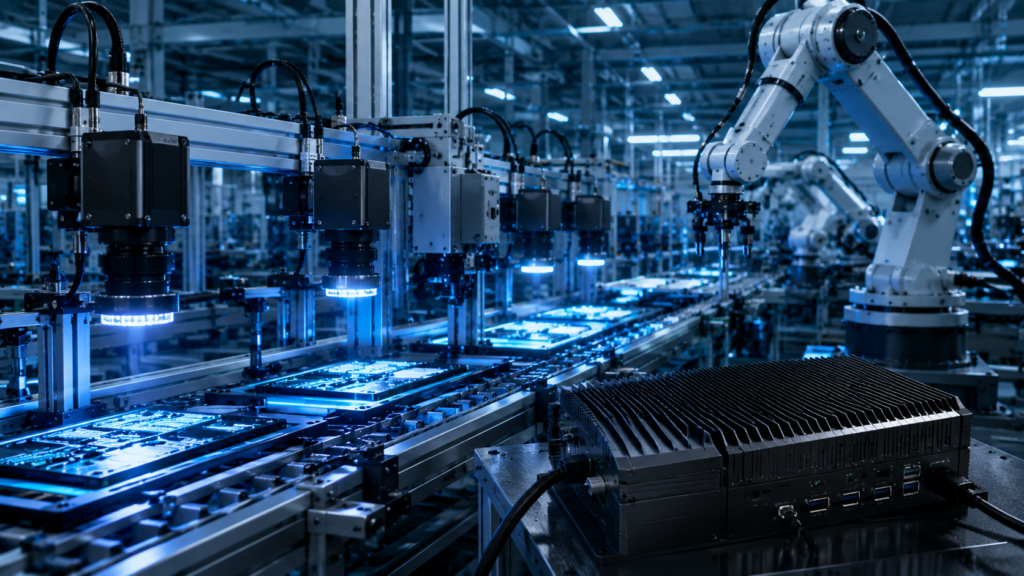
Modern edge AI systems must simultaneously process machine vision data, industrial sensor inputs, and real-time AI inference workloads while maintaining low latency and high reliability.
Wichtigste Herausforderungen
Real-Time Inference Requirements
Industrial applications often require immediate responses to operational events.
Beispiele hierfür sind:
- Defect detection on production lines
- Autonomous robot navigation
- Sicherheitsüberwachung
- Verkehrsmanagement
- Machine condition analysis
Cloud-based processing may introduce unacceptable delays.
Edge AI systems must deliver inference results in milliseconds.
High Computational Demands
Modern AI models require significant computing resources.
Common workloads include:
- Objekterkennung
- Bildklassifizierung
- Semantic segmentation
- Facial recognition
- OCR processing
- Prädiktive Analysen
Running these models efficiently often requires GPU acceleration.
Raue Einsatzumgebungen
Industrial environments expose computing platforms to:
- Staub
- Vibration
- Shock
- Temperaturextreme
- Luftfeuchtigkeit
- Elektromagnetische Störungen
Traditional workstation or server hardware may not withstand these conditions.
Große Datenmengen
AI applications frequently process:
- Hochauflösende Bilder
- Videostreams
- Sensor data
- Operational logs
- Industrial telemetry
Managing and analyzing this information requires robust computing infrastructure.
Power and Space Constraints
Many industrial deployments require compact systems that fit within:
- Schaltschränke
- Machine enclosures
- Vehicles
- Edge cabinets
- Mobile platforms
Balancing performance, Wärmemanagement, and power consumption presents significant engineering challenges.
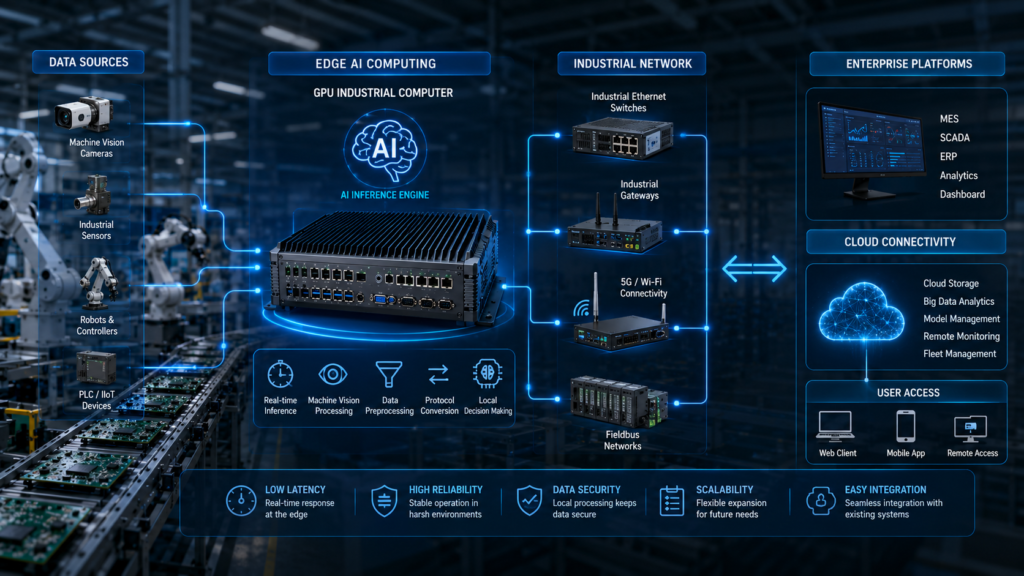
GPU industrial computers serve as the central edge AI platform, connecting machine vision systems, Industrielle Netzwerke, enterprise applications, and cloud infrastructure for real-time AI inference.
Lösungsarchitektur
A modern AI inference architecture consists of multiple interconnected layers.
Schicht 1: Datenerfassungsschicht
Die Feldschicht umfasst:
- Industriekameras
- Sensoren
- LiDAR systems
- Radar devices
- SPS
- IoT-Geräte
- Kantensensoren
These devices generate the data used for AI analysis.
Schicht 2: Edge Connectivity Layer
Industrial networks connect field devices using:
- Industrielles Ethernet
- Gigabit-Ethernet
- 5G
- W-lan
- Fieldbus systems
- Industrielle IoT-Gateways
This layer ensures reliable data transmission.
Schicht 3: GPU Industrial Computer Layer
The GPU industrial computer serves as the AI inference engine.
Zu den Aufgaben gehören::
- AI model execution
- Bildbearbeitung
- Videoanalyse
- Data preprocessing
- Edge-Computing
- Protokollkonvertierung
- Lokale Entscheidungsfindung
GPU acceleration significantly improves inference performance.
Schicht 4: Anwendungsschicht
AI applications include:
- Bildverarbeitungssoftware
- Inspection systems
- Robotics platforms
- Videoanalyse
- Predictive maintenance engines
- Industrial monitoring applications
The GPU computer hosts and executes these workloads.
Schicht 5: Unternehmens- und Cloud-Schicht
Unterstützung für Unternehmensintegration:
- MES-Plattformen
- ERP-Systeme
- Cloud-Analyse
- Flottenmanagement
- Produktionsberichterstattung
- Datenseen
Only relevant information is transmitted upstream, reducing bandwidth requirements.
Hauptmerkmale
GPU-Beschleunigung
The defining feature of a GPU industrial computer is hardware acceleration.
Zu den Vorteilen gehören::
- Faster inference performance
- Parallel processing
- Reduzierte Latenz
- Higher throughput
- Improved AI efficiency
GPU acceleration enables deployment of complex deep learning models at the edge.
Zuverlässigkeit auf Industrieniveau
Industrial environments require dependable operation.
Industriecomputer bieten:
- Rugged enclosures
- Industrielle Komponenten
- Langer Lebenszyklus-Support
- Dauerbetriebsfähigkeit
- Enhanced durability
Diese Eigenschaften verbessern die Systemverfügbarkeit.
Fanless or Optimized Thermal Design
Many industrial AI systems utilize:
- Lüfterlose Kühlung
- Heat pipe technology
- Passive thermal management
- Industrial airflow optimization
Reliable thermal design is essential for stable AI performance.
High-Speed Networking
AI systems frequently process data from multiple sources.
Unterstützung für Industrieplattformen:
- Gigabit-Ethernet
- 2.5G Ethernet
- 10G Ethernet
- Drahtlose Konnektivität
- Industrial communication protocols
These interfaces support high-bandwidth workloads.
AI Framework Compatibility
GPU industrial computers commonly support:
- TensorFlow
- PyTorch
- ONNX Runtime
- OpenVINO
- TensorRT
- CUDA
This simplifies AI deployment and optimization.
Flexible Expansion Capability
Industrial AI applications often require:
- Additional storage
- Kameraschnittstellen
- Networking modules
- Accelerator cards
Expansion options improve deployment flexibility.
Langer Produktlebenszyklus
Industrial deployments often remain operational for many years.
Industrielle Plattformen bieten:
- Langfristige Verfügbarkeit
- Stabile Hardwarekonfigurationen
- Konsistenter Software-Support
This minimizes redesign costs and lifecycle risks.
Bereitstellungsszenarien
Bildverarbeitungsinspektion
GPU industrial computers support:
- Fehlererkennung
- Oberflächeninspektion
- OCR verification
- Product classification
- Qualitätskontrolle
Real-time AI inference improves manufacturing accuracy and efficiency.
Autonome mobile Roboter (AMR)
AI-enabled robots rely on GPU computing for:
- Navigation
- Hindernisvermeidung
- Abbildung
- Lokalisierung
- Flottenkoordination
Low-latency inference is critical for safe operation.
Intelligente Videoanalyse
GPU systems process video streams for:
- Object tracking
- Einbrucherkennung
- Sicherheitsüberwachung
- Verhaltensanalyse
- Occupancy analytics
These applications are widely used in industrial and public environments.
Vorausschauende Wartung
AI models analyze equipment data to identify:
- Abnormal operating conditions
- Performance degradation
- Potential failures
This reduces unplanned downtime and maintenance costs.
Intelligenter Transport
Transportation applications include:
- Verkehrsüberwachung
- Vehicle detection
- Incident analysis
- Tolling systems
- Smart intersections
Edge AI processing improves responsiveness and scalability.
Healthcare AI Systems
Medical environments deploy AI for:
- Medizinische Bildgebung
- Diagnoseunterstützung
- Patientenüberwachung
- Intelligent healthcare workflows
Industrial-grade computing platforms support reliable operation.
Geschäftsvorteile
Schnellere Entscheidungsfindung
Local AI inference eliminates cloud latency and enables real-time operational responses.
Verbesserte betriebliche Effizienz
Automation powered by AI reduces manual intervention and improves process consistency.
Enhanced Product Quality
Machine vision systems detect defects earlier and more accurately than traditional inspection methods.
Niedrigere Bandbreitenkosten
Processing data locally reduces cloud transmission requirements and network traffic.
Increased Data Security
Sensitive operational data remains on-site rather than being transmitted externally.
Scalability for Future AI Applications
GPU industrial computers provide a flexible platform for expanding AI initiatives as requirements evolve.
Warum CoreIPC
CoreIPC provides industrial computing platforms designed for AI inference, Edge-Computing, maschinelles Sehen, Robotik, und intelligente Automatisierungsanwendungen. Our GPU-enabled industrial computers deliver the processing power required for modern AI workloads while maintaining industrial-grade reliability, flexible I/O-Konnektivität, lange Produktlebenszyklen, und OEM/ODM-Anpassungsfunktionen. Whether supporting machine vision inspection, autonomous robotics, Videoanalyse, oder vorausschauende Wartung, CoreIPC solutions help organizations deploy scalable and future-ready edge AI infrastructures.
Häufig gestellte Fragen
What is a GPU industrial computer?
Ein GPU-Industriecomputer ist eine Computerplattform in Industriequalität, die mit GPU-Beschleunigungsfunktionen ausgestattet ist, um KI-Inferenzen auszuführen, maschinelles Sehen, und Edge-Computing-Workloads in anspruchsvollen Umgebungen.
Warum ist die GPU-Beschleunigung für die KI-Inferenz wichtig??
GPUs führen eine parallele Verarbeitung durch, Dies ermöglicht eine deutlich schnellere Ausführung von Deep-Learning-Modellen im Vergleich zu CPUs allein.
Kann KI-Inferenz ohne Cloud-Konnektivität durchgeführt werden??
Ja. Edge-KI-Systeme führen Inferenz lokal aus, Reduziert die Latenz und ermöglicht den Betrieb auch dann, wenn keine Internetverbindung verfügbar ist.
Welche Branchen nutzen GPU-Industriecomputer??
Herstellung, Transport, Logistik, Gesundheitspflege, Energie, Sicherheit, Intelligente Städte, In der Roboter- und Robotikbranche werden häufig GPU-basierte Industriecomputer eingesetzt.
Sind GPU-Industriecomputer für die maschinelle Bildverarbeitung geeignet??
Ja. Machine vision is one of the most common applications for GPU industrial computers due to the computational demands of image processing and AI inference.
What AI frameworks are typically supported?
Most systems support TensorFlow, PyTorch, ONNX Runtime, OpenVINO, CUDA, and TensorRT.
Can GPU industrial computers support multiple cameras?
Ja. Many platforms support multiple high-resolution cameras for machine vision and video analytics applications.
Are fanless GPU industrial computers available?
Ja. Many industrial AI platforms utilize advanced passive cooling and optimized thermal designs to achieve reliable operation.
How do GPU industrial computers improve predictive maintenance?
They process sensor and operational data locally, enabling AI models to identify equipment abnormalities before failures occur.
What should be considered when selecting a GPU industrial computer?
Important factors include GPU performance, CPU capability, Speicherkapazität, thermisches Design, Umweltspezifikationen, Konnektivitätsoptionen, und Lebenszyklusverfügbarkeit.
Abschluss
A GPU-Industriecomputer für KI-Inferenz provides the computing foundation necessary for modern edge AI applications. By combining industrial-grade reliability with GPU acceleration, these platforms enable real-time AI processing, Bildverarbeitungsanalyse, autonomous robotics, vorausschauende Wartung, and intelligent automation across diverse industrial environments.
As organizations continue to adopt AI-driven technologies, GPU industrial computers will play an increasingly important role in delivering low-latency inference, enhanced operational efficiency, improved quality control, and scalable intelligent infrastructure. Their ability to execute advanced AI workloads at the edge makes them a key component of future Industry 4.0 and smart manufacturing initiatives.
Kontaktieren Sie uns
Looking for a GPU industrial computer for AI inference applications?
CoreIPC bietet Industriecomputer an, eingebettete Computer, Industrie-Motherboards, and customized edge AI platforms designed for machine vision, Robotik, intelligent video analytics, vorausschauende Wartung, und industrielle Automatisierung.
Contact our engineering team to discuss your AI deployment requirements and identify the ideal industrial computing solution for your project.