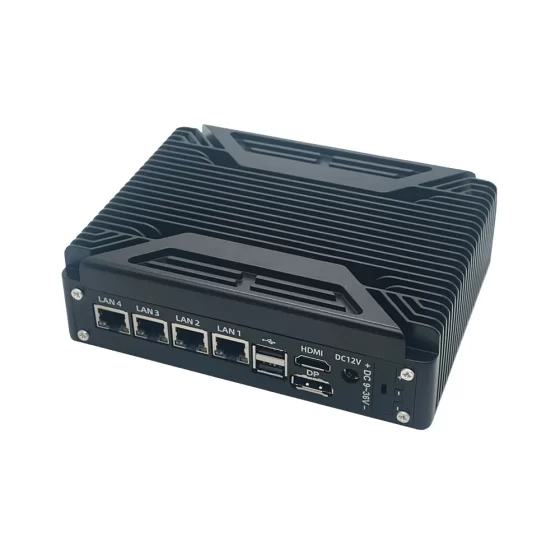
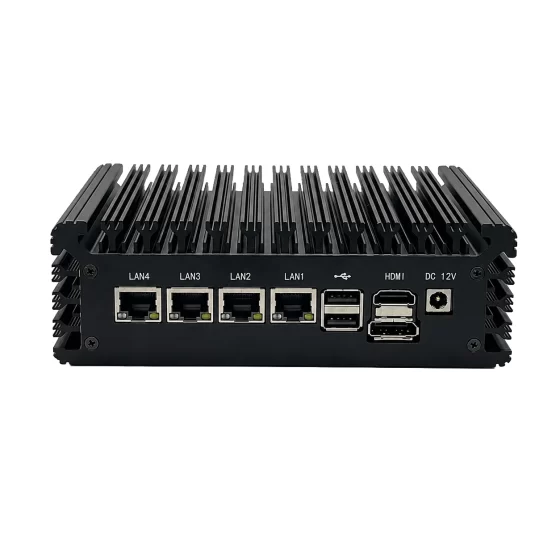
CoreIPC 産業用コンピューティング ソリューション

AI推論用GPU産業用コンピュータ
エグゼクティブサマリー
あ AI推論用GPU産業用コンピュータ has become a critical enabling technology for modern intelligent automation, マシンビジョン, ロボット工学, 産業用IoT, およびエッジ AI アプリケーション. 業界では業務効率を向上させるために人工知能の導入が進んでいます, 製品の品質, 予知保全, そして自律的な意思決定, AI 推論ワークロードをリアルタイムで実行できる高性能コンピューティング プラットフォームに対する需要は増加し続けています。.
従来のクラウドベースの AI アーキテクチャとは異なります, 産業環境では多くの場合、低遅延の処理が必要です, リアルタイム応答性, データプライバシーの強化, インターネット接続に依存しない信頼性の高い動作. エッジで直接実行される AI 推論により、産業システムがセンサー データを処理できるようになります, 画像, ビデオストリーム, リモートのクラウド リソースに依存せずにローカルで運用情報を取得できます。.
GPU 産業用コンピュータは、産業グレードの信頼性と強力な GPU アクセラレーションを組み合わせています。, 工場に導入された AI を活用したアプリケーションに最適です, 交通システム, スマートシティ, 医療環境, 物流施設, とエネルギーインフラ. These systems provide the computing resources necessary for deep learning inference, マシンビジョン分析, 物体検出, 予知保全, 自律航法, and industrial automation while maintaining reliable operation under demanding environmental conditions.
This article explores the role of GPU industrial computers in AI inference applications, 導入の主要な課題, solution architecture considerations, 重要な機能, 導入シナリオ, and the business benefits of implementing edge AI computing platforms.
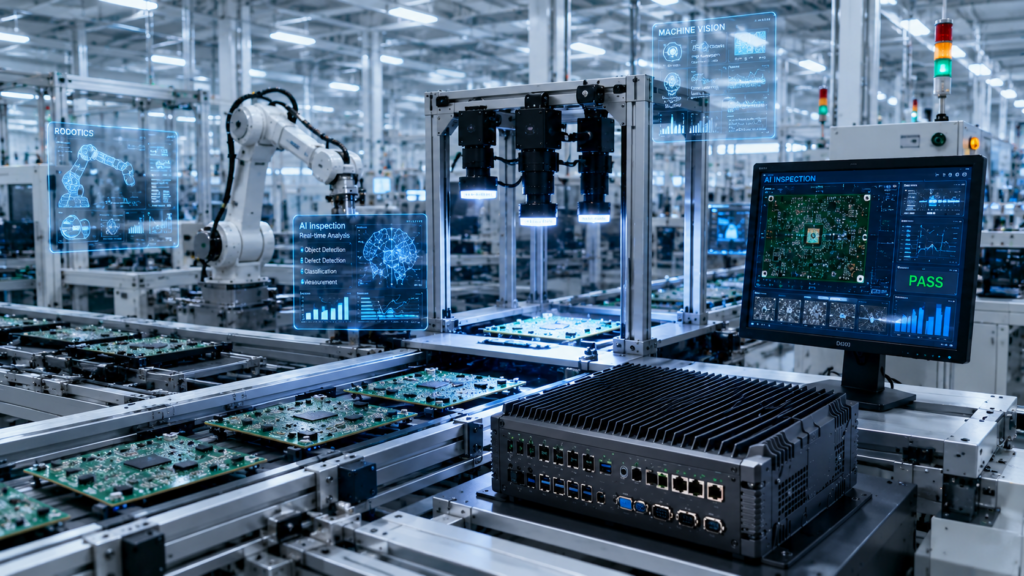
GPU industrial computers enable real-time AI inference for machine vision, ロボット工学, 品質検査, and intelligent automation in modern smart factories.
業界の概要
Artificial Intelligence is transforming industrial operations across virtually every sector. Modern organizations increasingly rely on AI-driven technologies to improve productivity, 運用コストを削減する, enhance quality control, and accelerate decision-making.
Industrial AI applications include:
- マシンビジョン検査
- 予知保全
- 自律移動ロボット (AMR)
- Automated guided vehicles (AGV)
- インテリジェントな監視
- 産業用ロボット
- Smart transportation
- Industrial IoT analytics
- 欠陥検出
- プロセスの最適化
- 資産監視
- Safety management
Historically, AI processing was primarily performed in centralized cloud environments. しかし, industrial deployments often face limitations associated with cloud-based architectures, 含む:
- ネットワーク遅延
- Bandwidth constraints
- データプライバシーに関する懸念
- Connectivity limitations
- リアルタイム応答要件
結果として, edge AI computing has emerged as a preferred deployment model for many industrial applications.
GPU industrial computers provide the processing power required to execute AI models directly at the edge. By combining industrial-grade computing hardware with GPU acceleration technologies, these platforms support real-time AI inference while maintaining reliability in harsh environments.
Industries increasingly deploying GPU-powered edge AI systems include:
- 製造業
- 交通機関
- Logistics
- 健康管理
- エネルギー
- Security
- スマートシティ
- Agriculture
- Retail automation
As AI adoption continues to accelerate, GPU industrial computers are becoming foundational components of modern intelligent infrastructure.
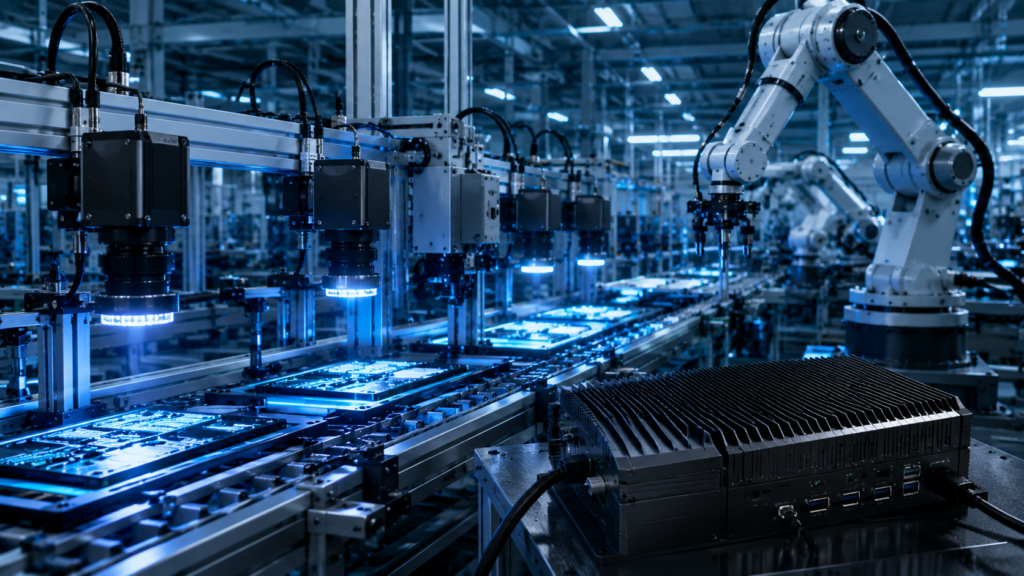
Modern edge AI systems must simultaneously process machine vision data, industrial sensor inputs, and real-time AI inference workloads while maintaining low latency and high reliability.
主要な課題
Real-Time Inference Requirements
Industrial applications often require immediate responses to operational events.
例としては次のものが挙げられます。:
- Defect detection on production lines
- Autonomous robot navigation
- 安全監視
- 交通管理
- Machine condition analysis
Cloud-based processing may introduce unacceptable delays.
Edge AI systems must deliver inference results in milliseconds.
High Computational Demands
Modern AI models require significant computing resources.
Common workloads include:
- 物体検出
- 画像分類
- Semantic segmentation
- 顔認識
- OCR processing
- 予測分析
Running these models efficiently often requires GPU acceleration.
過酷な導入環境
Industrial environments expose computing platforms to:
- ほこり
- 振動
- Shock
- 極端な温度
- 湿度
- 電磁妨害
Traditional workstation or server hardware may not withstand these conditions.
大量のデータ
AI applications frequently process:
- 高解像度の画像
- ビデオストリーム
- センサーデータ
- Operational logs
- Industrial telemetry
Managing and analyzing this information requires robust computing infrastructure.
Power and Space Constraints
Many industrial deployments require compact systems that fit within:
- Control cabinets
- Machine enclosures
- Vehicles
- Edge cabinets
- Mobile platforms
Balancing performance, 熱管理, and power consumption presents significant engineering challenges.
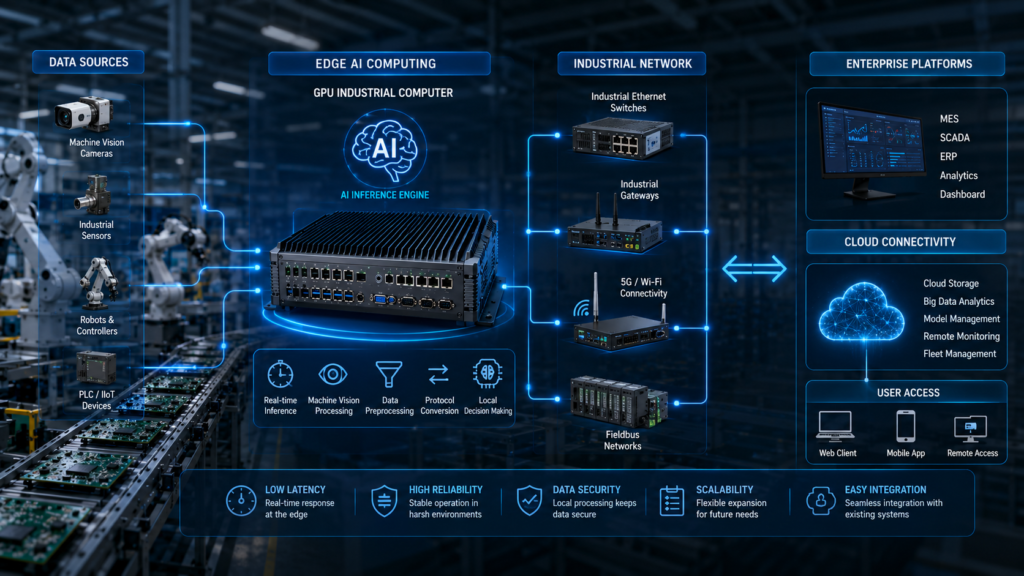
GPU industrial computers serve as the central edge AI platform, connecting machine vision systems, 産業用ネットワーク, エンタープライズアプリケーション, and cloud infrastructure for real-time AI inference.
ソリューションアーキテクチャ
A modern AI inference architecture consists of multiple interconnected layers.
層 1: データ取得層
フィールド層には以下が含まれます:
- 産業用カメラ
- センサー
- LiDARシステム
- Radar devices
- PLC
- IoTデバイス
- エッジセンサー
These devices generate the data used for AI analysis.
層 2: Edge Connectivity Layer
Industrial networks connect field devices using:
- 産業用イーサネット
- ギガビットイーサネット
- 5G
- Wi-Fi
- Fieldbus systems
- 産業用IoTゲートウェイ
This layer ensures reliable data transmission.
層 3: GPU Industrial Computer Layer
The GPU industrial computer serves as the AI inference engine.
責任には以下が含まれます::
- AI model execution
- 画像処理
- ビデオ分析
- Data preprocessing
- エッジコンピューティング
- プロトコル変換
- 現地での意思決定
GPU acceleration significantly improves inference performance.
層 4: アプリケーション層
AI applications include:
- マシンビジョンソフトウェア
- Inspection systems
- Robotics platforms
- ビデオ分析
- Predictive maintenance engines
- Industrial monitoring applications
The GPU computer hosts and executes these workloads.
層 5: エンタープライズ層とクラウド層
エンタープライズ統合のサポート:
- MESプラットフォーム
- ERPシステム
- クラウド分析
- フリート管理
- 生産報告
- データレイク
Only relevant information is transmitted upstream, reducing bandwidth requirements.
主な特長
GPU アクセラレーション
The defining feature of a GPU industrial computer is hardware acceleration.
メリットとしては以下が挙げられます:
- Faster inference performance
- Parallel processing
- 待ち時間の短縮
- Higher throughput
- Improved AI efficiency
GPU acceleration enables deployment of complex deep learning models at the edge.
産業グレードの信頼性
Industrial environments require dependable operation.
産業用コンピュータが提供する:
- Rugged enclosures
- 産業用コンポーネント
- 長期にわたるライフサイクルのサポート
- 連続運転能力
- Enhanced durability
これらの特性によりシステムの可用性が向上します.
Fanless or Optimized Thermal Design
Many industrial AI systems utilize:
- ファンレス冷却
- Heat pipe technology
- Passive thermal management
- Industrial airflow optimization
Reliable thermal design is essential for stable AI performance.
高速ネットワーク
AI systems frequently process data from multiple sources.
産業用プラットフォームのサポート:
- ギガビットイーサネット
- 2.5G イーサネット
- 10G イーサネット
- ワイヤレス接続
- Industrial communication protocols
These interfaces support high-bandwidth workloads.
AI Framework Compatibility
GPU industrial computers commonly support:
- TensorFlow
- PyTorch
- ONNX Runtime
- OpenVINO
- TensorRT
- CUDA
This simplifies AI deployment and optimization.
Flexible Expansion Capability
Industrial AI applications often require:
- Additional storage
- カメラインターフェース
- Networking modules
- Accelerator cards
Expansion options improve deployment flexibility.
長い製品ライフサイクル
Industrial deployments often remain operational for many years.
産業用プラットフォームが提供するのは、:
- 長期的な可用性
- 安定したハードウェア構成
- 一貫したソフトウェアサポート
This minimizes redesign costs and lifecycle risks.
導入シナリオ
マシンビジョン検査
GPU industrial computers support:
- 欠陥検出
- 表面検査
- OCR verification
- Product classification
- 品質管理
Real-time AI inference improves manufacturing accuracy and efficiency.
自律移動ロボット (AMR)
AI-enabled robots rely on GPU computing for:
- ナビゲーション
- 障害物回避
- マッピング
- ローカリゼーション
- 艦隊調整
Low-latency inference is critical for safe operation.
インテリジェントなビデオ分析
GPU systems process video streams for:
- オブジェクト追跡
- 侵入検知
- 安全監視
- 行動分析
- Occupancy analytics
These applications are widely used in industrial and public environments.
予知保全
AI models analyze equipment data to identify:
- Abnormal operating conditions
- パフォーマンスの低下
- 潜在的な障害
This reduces unplanned downtime and maintenance costs.
スマートな輸送
輸送用途には以下が含まれます:
- トラフィック監視
- 車両検知
- Incident analysis
- Tolling systems
- スマート交差点
Edge AI processing improves responsiveness and scalability.
Healthcare AI Systems
Medical environments deploy AI for:
- 医用画像処理
- 診断支援
- 患者のモニタリング
- Intelligent healthcare workflows
Industrial-grade computing platforms support reliable operation.
ビジネス上のメリット
より迅速な意思決定
Local AI inference eliminates cloud latency and enables real-time operational responses.
業務効率の向上
Automation powered by AI reduces manual intervention and improves process consistency.
製品品質の向上
Machine vision systems detect defects earlier and more accurately than traditional inspection methods.
帯域幅コストの削減
Processing data locally reduces cloud transmission requirements and network traffic.
Increased Data Security
Sensitive operational data remains on-site rather than being transmitted externally.
Scalability for Future AI Applications
GPU industrial computers provide a flexible platform for expanding AI initiatives as requirements evolve.
CoreIPC を選ぶ理由
CoreIPC provides industrial computing platforms designed for AI inference, エッジコンピューティング, マシンビジョン, ロボット工学, インテリジェントな自動化アプリケーション. Our GPU-enabled industrial computers deliver the processing power required for modern AI workloads while maintaining industrial-grade reliability, 柔軟な I/O 接続, 長い製品ライフサイクル, OEM/ODMカスタマイズ機能. Whether supporting machine vision inspection, autonomous robotics, ビデオ分析, or predictive maintenance, CoreIPC solutions help organizations deploy scalable and future-ready edge AI infrastructures.
よくある質問
What is a GPU industrial computer?
A GPU industrial computer is an industrial-grade computing platform equipped with GPU acceleration capabilities designed to execute AI inference, マシンビジョン, and edge computing workloads in demanding environments.
Why is GPU acceleration important for AI inference?
GPUs perform parallel processing, enabling significantly faster execution of deep learning models compared to CPUs alone.
Can AI inference be performed without cloud connectivity?
はい. Edge AI systems execute inference locally, reducing latency and allowing operation even when internet connectivity is unavailable.
What industries use GPU industrial computers?
製造業, 交通機関, ロジスティクス, 健康管理, エネルギー, 安全, スマートシティ, and robotics industries commonly deploy GPU-powered industrial computers.
Are GPU industrial computers suitable for machine vision?
はい. Machine vision is one of the most common applications for GPU industrial computers due to the computational demands of image processing and AI inference.
What AI frameworks are typically supported?
Most systems support TensorFlow, PyTorch, ONNX Runtime, OpenVINO, CUDA, and TensorRT.
Can GPU industrial computers support multiple cameras?
はい. Many platforms support multiple high-resolution cameras for machine vision and video analytics applications.
Are fanless GPU industrial computers available?
はい. Many industrial AI platforms utilize advanced passive cooling and optimized thermal designs to achieve reliable operation.
How do GPU industrial computers improve predictive maintenance?
They process sensor and operational data locally, enabling AI models to identify equipment abnormalities before failures occur.
What should be considered when selecting a GPU industrial computer?
Important factors include GPU performance, CPU capability, メモリ容量, 熱設計, 環境仕様, 接続オプション, ライフサイクルの可用性.
結論
あ AI推論用GPU産業用コンピュータ provides the computing foundation necessary for modern edge AI applications. By combining industrial-grade reliability with GPU acceleration, these platforms enable real-time AI processing, マシンビジョン分析, autonomous robotics, 予知保全, and intelligent automation across diverse industrial environments.
As organizations continue to adopt AI-driven technologies, GPU industrial computers will play an increasingly important role in delivering low-latency inference, enhanced operational efficiency, improved quality control, and scalable intelligent infrastructure. Their ability to execute advanced AI workloads at the edge makes them a key component of future Industry 4.0 スマートマニュファクチャリングへの取り組み.
お問い合わせ
Looking for a GPU industrial computer for AI inference applications?
CoreIPC は産業用コンピュータを提供します, 組み込みコンピュータ, 産業用マザーボード, and customized edge AI platforms designed for machine vision, ロボット工学, intelligent video analytics, 予知保全, および産業オートメーション.
Contact our engineering team to discuss your AI deployment requirements and identify the ideal industrial computing solution for your project.